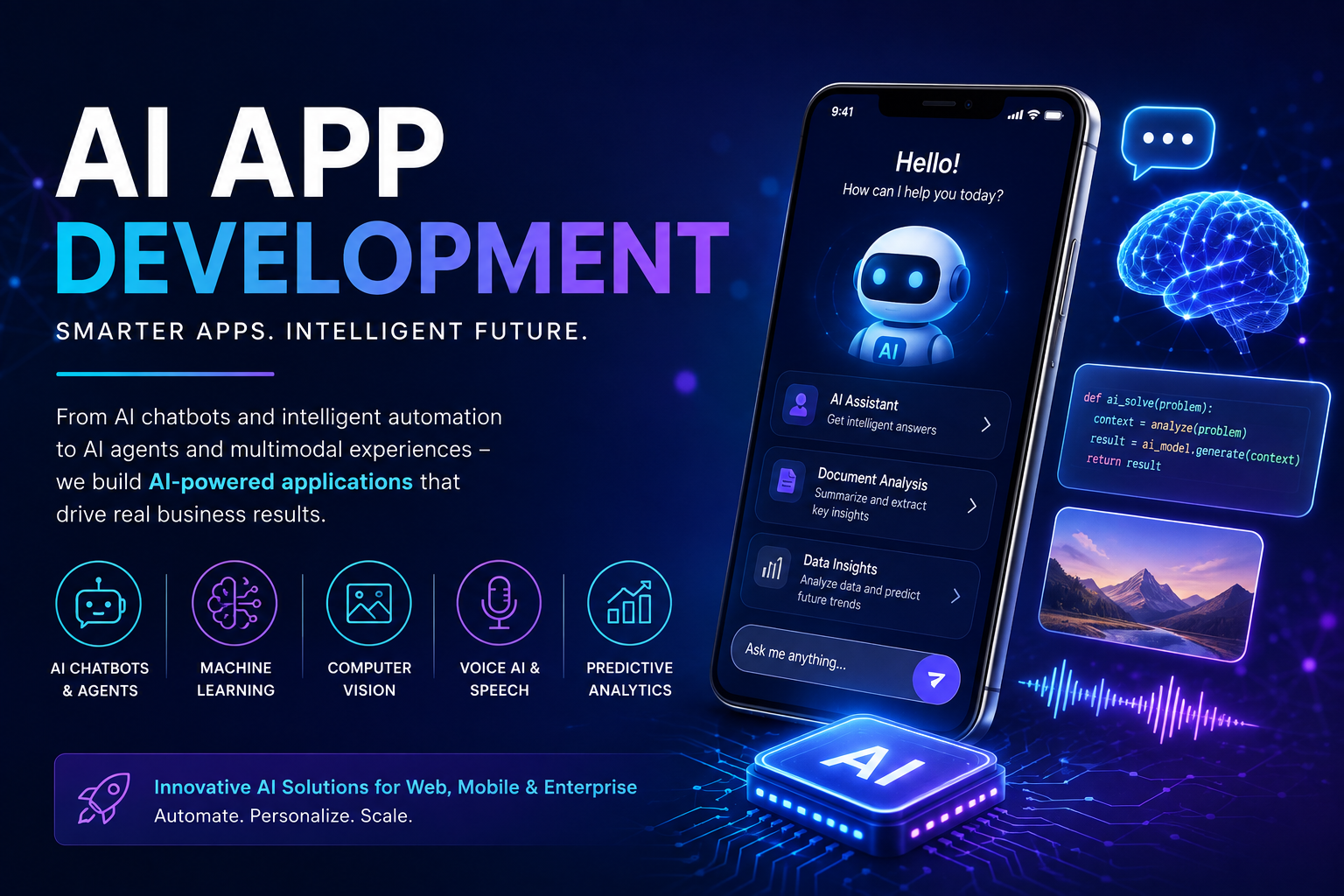
Artificial intelligence is changing how modern applications are designed, developed, and used.
A few years ago, adding AI to an application often meant integrating a chatbot, recommendation engine, or basic machine-learning model. In 2026, AI application development is moving toward something much more powerful: applications that can understand context, work with multiple types of data, use external tools, and complete tasks on behalf of users.
AI agents, multimodal AI, voice interfaces, retrieval-augmented generation, personalized experiences, and AI-powered automation are becoming important components of modern software architecture.
For businesses planning a new AI product, the question is no longer simply:
“Can we add AI to our app?”
The more important question is:
“What should AI actually do inside our application?”
What Is AI App Development?
AI app development is the process of building applications that use artificial intelligence to understand information, generate content, make predictions, automate tasks, interact with users, or support decision-making.
An AI application can combine:
- Artificial intelligence models
- Machine learning
- Large language models
- Natural language processing
- Computer vision
- Speech recognition
- Generative AI
- AI agents
- APIs
- Databases
- Cloud infrastructure
- Mobile and web interfaces
A typical architecture might look like:
User → Application → AI Model → Business Data → Tools/APIs → Response or Action
The architecture becomes more sophisticated when the AI can actually perform tasks instead of simply generating text.
Why AI App Development Is Growing in 2026
AI is moving from experimental projects into production software.
Businesses are using AI to improve:
- Customer support
- Sales
- Marketing
- Healthcare workflows
- Finance
- Education
- Retail
- Logistics
- Human resources
- Software development
- Business operations
The major shift is from AI as a feature to AI as part of the application architecture.
Current developer platforms are increasingly focused on agents that can use tools, access business context, and perform actions across systems. OpenAI, for example, describes its current platform around agent workflows, tool use, file search, web search, remote MCP servers, and realtime voice experiences.
AI Chatbots Are Evolving Into AI Agents
Chatbots primarily respond to user messages.
AI agents are designed to go further.
An AI agent can potentially:
- Understand a user’s objective
- Break the objective into tasks
- Retrieve relevant information
- Use external tools
- Make decisions within defined boundaries
- Complete actions
- Report the result
For example, a traditional customer-support chatbot might answer:
“What is the status of my order?”
An AI agent could potentially:
Identify the customer → Find the order → Check shipping information → Contact an internal system → Explain the status → Create an escalation if necessary.
This is one of the biggest opportunities in modern AI application development.
Google’s developer ecosystem similarly describes agents as systems that can perceive their environment, make decisions, and take actions toward goals.
Top AI App Development Trends in 2026
1. Agentic AI Applications
Agentic AI is becoming one of the most important areas of AI software development.
Instead of waiting for a user to provide instructions at every step, an AI agent can execute a defined workflow using tools and business information.
Potential applications include:
- AI sales agents
- Customer-support agents
- Research agents
- Personal assistants
- Recruiting agents
- Finance assistants
- Healthcare workflow assistants
- IT support agents
- Marketing agents
The key difference is that the AI can move from answering to acting.
2. Multimodal AI Applications
Modern AI applications are no longer limited to text.
AI systems can increasingly work with:
- Text
- Images
- Audio
- Video
- Documents
- Structured data
Google’s Gemini Embedding 2, for example, is designed to map text, images, video, audio, and documents into a shared embedding space, enabling applications such as multimodal retrieval and agentic RAG.
This creates opportunities for applications that can understand information from multiple sources simultaneously.
Example
A construction application could allow a worker to:
Take a photo → Ask a voice question → AI analyzes the image → Retrieves relevant project documentation → Provides an answer.
That’s considerably more powerful than a traditional text chatbot.
3. Voice AI Applications
Voice is becoming an important interface for AI applications.
Businesses can develop:
- AI voice assistants
- Customer-service agents
- Voice-enabled mobile apps
- Healthcare assistants
- Sales assistants
- Appointment-booking systems
- Voice-based learning applications
Real-time AI APIs are making it increasingly practical to build applications where users can communicate naturally through speech.
Voice can be particularly useful when users are driving, working, exercising, or operating in environments where typing is inconvenient.
4. Retrieval-Augmented Generation
Large language models are powerful, but businesses often need AI systems to work with their own information.
This is where Retrieval-Augmented Generation (RAG) becomes useful.
A simplified RAG architecture is:
User Question → Search Knowledge Base → Retrieve Relevant Data → AI Model → Answer
A company can connect an AI application to:
- PDFs
- Product catalogs
- Internal documents
- Knowledge bases
- Websites
- Databases
- Support documentation
The AI can then use relevant information as context when generating responses.
Multimodal retrieval is also expanding beyond text. Google’s Gemini Embedding 2 is designed to support text, image, video, audio, and document embeddings, opening additional possibilities for multimodal RAG applications.
5. Personalized AI Applications
Personalization is another major opportunity.
Instead of giving every user the same experience, an AI application can potentially adapt based on:
- User preferences
- Previous interactions
- Purchase history
- Location
- Behavior
- Account information
- Business context
For example, an AI fitness application could provide recommendations based on a user’s previous activity.
A shopping application could personalize product discovery.
A learning platform could adjust explanations according to a student’s progress.
Personalization should still be designed with appropriate privacy, consent, and data-governance controls.
6. AI-Powered Mobile Applications
Mobile applications are becoming important delivery platforms for AI experiences.
Businesses can integrate AI into:
- iOS applications
- Android applications
- Cross-platform applications
- Tablet applications
- Wearable applications
AI can power:
- Smart search
- Voice interaction
- Image analysis
- Personalized recommendations
- Automated content generation
- Customer support
- Predictive features
- Intelligent notifications
Modern mobile applications can also combine cloud AI with on-device processing when latency, privacy, or offline functionality makes that architecture appropriate.
Google’s 2026 release of Gemma 4 12B is one example of the continued push toward capable multimodal models that can run locally on suitable hardware.
7. AI-Powered Business Automation
AI applications can automate repetitive business workflows.
Consider a sales workflow:
Lead Arrives → AI Qualifies Lead → AI Enriches Information → CRM Updated → Salesperson Notified
Or a support workflow:
Customer Request → AI Understands Issue → Retrieves Knowledge → Generates Response → Creates Ticket When Necessary
The value comes from connecting AI to the systems where business work actually happens.
8. Generative UI and AI-First Interfaces
Traditional applications provide fixed interfaces.
AI-first applications can increasingly create interfaces around what the user is trying to accomplish.
For example, instead of navigating through multiple screens, a user could say:
“Show me this month’s sales and identify the products that are underperforming.”
The application could respond with relevant charts, filters, summaries, and recommended actions.
Google has been exploring standards for portable, framework-agnostic generative interfaces that allow AI agents to produce UI experiences across platforms.
This points toward applications where user intent becomes an important part of the interface.
AI App Development Use Cases
Healthcare
AI applications can assist with:
- Patient information workflows
- Medical documentation
- Appointment systems
- Healthcare chat assistants
- Image analysis
- Patient communication
- Administrative automation
Healthcare applications require especially careful attention to privacy, security, safety, and applicable regulations.
FinTech
AI can support:
- Fraud detection
- Financial assistants
- Document analysis
- Customer support
- Risk analysis
- Personalized financial insights
- Transaction monitoring
Financial applications also require strong security and compliance controls.
Retail and E-Commerce
AI can improve:
- Product recommendations
- Visual search
- Customer support
- Personalized shopping
- Inventory forecasting
- Product discovery
- Automated content
Education
AI-powered education applications can provide:
- Personalized tutoring
- Homework assistance
- Language learning
- Automated feedback
- Learning recommendations
- Educational content generation
Real Estate
AI applications can help with:
- Property search
- Lead qualification
- Property descriptions
- Document analysis
- Customer communication
- Market insights
Logistics
AI can support:
- Route optimization
- Demand forecasting
- Delivery tracking
- Customer communication
- Warehouse automation
- Document processing
Hospitality
AI applications can assist with:
- Reservations
- Guest communication
- Personalized recommendations
- Concierge services
- Restaurant ordering
- Customer support
AI App Architecture
A modern AI application usually contains several layers.
Frontend
The user interface can be built for:
- Web
- iOS
- Android
- Cross-platform mobile
- Desktop
Application Backend
The backend manages:
- Authentication
- Business logic
- APIs
- User data
- Permissions
- AI orchestration
AI Layer
This layer can contain:
- LLMs
- Vision models
- Speech models
- Embedding models
- Classification models
- AI agents
Knowledge Layer
The AI may access:
- Databases
- Vector databases
- Documents
- APIs
- Business systems
- Knowledge bases
Integration Layer
AI applications can connect with:
- CRM
- ERP
- Payment systems
- Communication platforms
- Search services
- Internal APIs
Monitoring Layer
Production AI applications need monitoring for:
- Accuracy
- Latency
- Cost
- Errors
- Security
- Model performance
- User feedback
AI App Development Challenges
AI application development creates enormous opportunities, but it also introduces new engineering challenges.
Hallucinations
AI models can sometimes produce incorrect information.
Applications should therefore use techniques such as retrieval, validation, structured outputs, tool constraints, and human review where appropriate.
Data Privacy
Businesses must carefully determine what information is sent to AI models and where that information is stored.
Sensitive information requires appropriate security controls.
Cost
AI inference can create significant operating costs.
Developers should consider:
- Model selection
- Token usage
- Caching
- Request routing
- Batch processing
- Smaller models where appropriate
Latency
Users expect applications to respond quickly.
Developers may need to combine:
- Streaming
- Caching
- Edge processing
- Smaller models
- Parallel tool calls
- Efficient retrieval
Reliability
An AI application should not fail unpredictably.
Production systems need:
- Error handling
- Fallbacks
- Monitoring
- Evaluation
- Guardrails
- Human escalation
AI App Security
Security becomes even more important when AI applications can access tools and business systems.
Developers should consider:
- Authentication
- Authorization
- Prompt injection
- Data leakage
- API security
- Tool permissions
- Secrets management
- Audit logging
- Model access controls
- Human approval for sensitive actions
An AI agent should not automatically receive unrestricted access to a company’s systems.
A better architecture is:
AI Agent → Permission Layer → Approved Tool → Business System
This allows organizations to control what the agent can and cannot do.
How to Build an AI Application
A successful AI application should begin with a business problem rather than a model.
Step 1: Define the Problem
Identify the specific workflow that AI should improve.
Step 2: Identify the Users
Understand who will interact with the application.
Step 3: Determine the AI Capability
Decide whether the application needs:
- Generative AI
- RAG
- Computer vision
- Speech AI
- Predictive analytics
- AI agents
- Multimodal AI
Step 4: Design the Architecture
Choose the appropriate:
- Models
- APIs
- Database
- Cloud infrastructure
- Frontend
- Backend
- Integrations
Step 5: Build an MVP
Start with the smallest version capable of demonstrating real business value.
Step 6: Test the AI
Evaluate:
- Accuracy
- Reliability
- Latency
- Cost
- Security
- User experience
Step 7: Deploy and Monitor
Production AI requires continuous monitoring and improvement.
Step 8: Scale
Once the application demonstrates value, expand features, integrations, and user capacity.
How Much Does AI App Development Cost?
There is no single price for developing an AI application.
The cost depends on factors such as:
- Application complexity
- Number of platforms
- AI model requirements
- Custom model development
- API usage
- Data requirements
- Integrations
- Security requirements
- User volume
- Development team
- Maintenance requirements
A simple AI assistant and an enterprise AI agent platform are completely different projects.
Instead of asking only “How much does an AI app cost?”, businesses should first determine:
What problem will the application solve, how many users will it serve, and what systems must it connect to?
Why Businesses Need Experienced AI App Developers
AI development requires more than connecting an API to a chatbot interface.
A production-ready AI application may require expertise in:
- AI architecture
- LLM integration
- Agent development
- RAG
- Vector databases
- Mobile development
- Web development
- Cloud infrastructure
- API development
- Security
- Data engineering
- AI evaluation
- DevOps
The strongest AI applications combine software engineering and AI engineering rather than treating AI as an isolated feature.
The Future of AI Application Development
The direction of AI app development is increasingly clear.
Applications are becoming:
More intelligent
More conversational
More multimodal
More personalized
More autonomous
More connected to business systems
The biggest change may be the transition from applications that simply respond to users toward applications that can understand intent and complete workflows.
AI agents are already being developed to work across files, tools, code, and longer-running tasks, while multimodal systems are expanding how applications understand text, images, audio, video, and documents.
This creates a new model of application development:
User Intent → AI Reasoning → Tools → Data → Action → Result
Conclusion
AI app development in 2026 is moving far beyond chatbots.
Businesses can now build applications that combine generative AI, AI agents, multimodal models, RAG, voice interfaces, personalization, automation, and intelligent user experiences.
But successful AI development isn’t about adding the most AI features.
It’s about using AI where it creates measurable value.
A well-designed AI application should solve a real problem, protect user data, integrate with existing systems, deliver reliable results, and continuously improve.
For businesses planning their next digital product, the opportunity is significant:
Don’t just build an app with AI. Build an application where AI makes the entire experience smarter.
Final Takeaway
The next generation of applications will increasingly be built around intent, intelligence, context, and automation.
Companies that start designing AI into their products today can create experiences that are faster, more personalized, and more capable than traditional software.
The future of app development is not simply about making applications smarter.
It is about making software capable of doing more.