Introduction
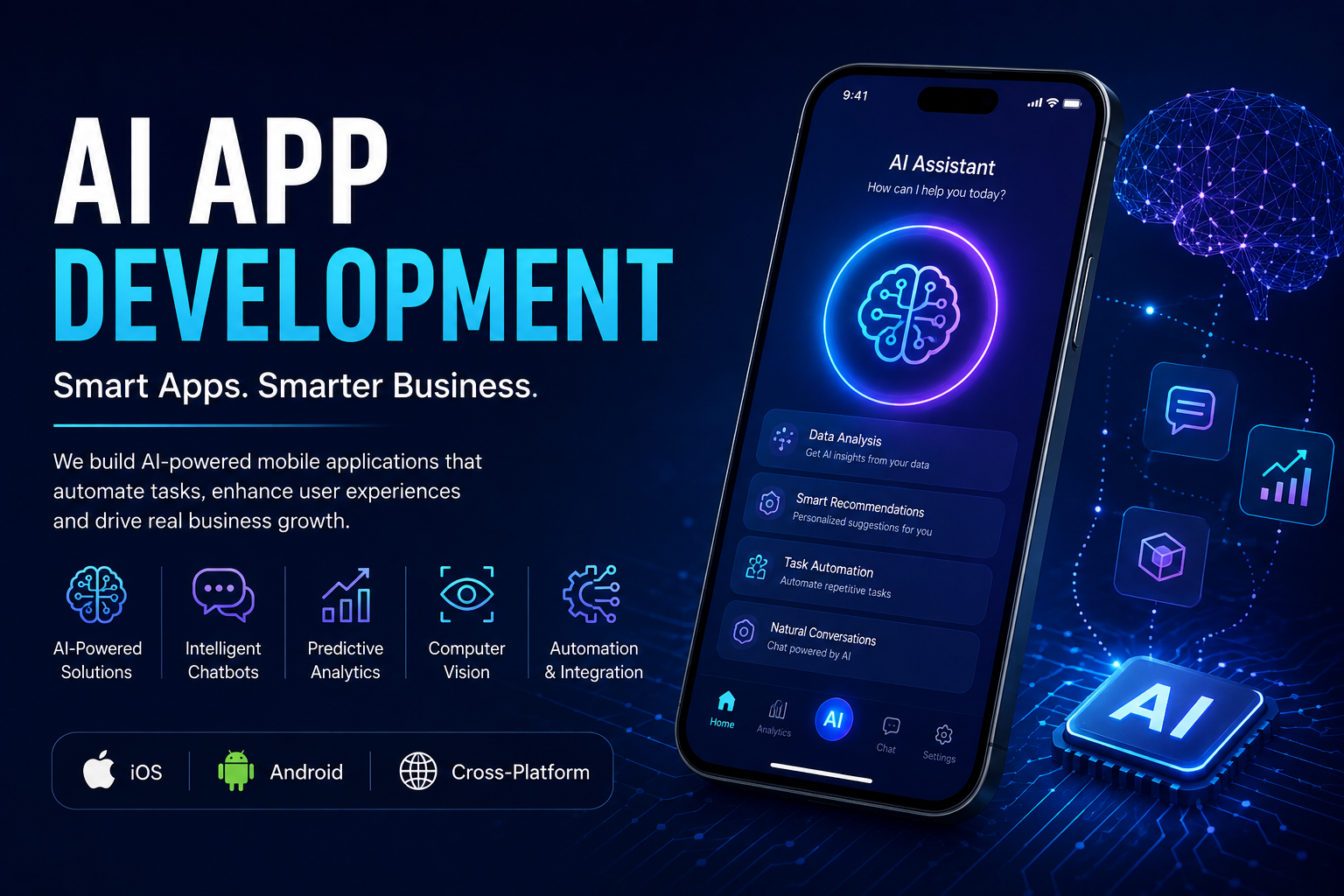
Artificial Intelligence is changing the way businesses build and use mobile applications. Traditional apps mainly respond to user commands, while modern AI-powered applications can understand information, generate content, make recommendations, automate tasks, and provide personalized experiences.
In 2026, businesses across industries are investing in AI app development to improve productivity, customer engagement, decision-making, and operational efficiency.
From AI chatbots and virtual assistants to predictive analytics, recommendation engines, computer vision, and generative AI, intelligent features are becoming an important part of modern mobile applications.
What Is AI App Development?
AI app development is the process of building mobile or web applications that use artificial intelligence technologies to perform tasks that traditionally require human intelligence.
AI can help applications:
- Understand natural language
- Analyze large amounts of data
- Recognize images and objects
- Generate text and content
- Make recommendations
- Predict user behavior
- Automate repetitive tasks
- Detect unusual patterns
- Personalize user experiences
AI can be integrated into new applications or added to existing software products.
Why AI Apps Are Becoming Important in 2026
Businesses are generating more data than ever before. The challenge is no longer simply collecting information; businesses need to turn that information into useful insights and actions.
AI can help transform application data into business value.
For example, an e-commerce application can use AI to recommend products, while a customer-service application can use an AI assistant to answer common questions.
A business application can also use AI to summarize documents, analyze customer feedback, predict demand, or automate internal workflows.
Key AI Technologies Used in App Development
Generative AI
Generative AI allows applications to create new content based on user instructions or available data.
Applications can use generative AI for:
- Text generation
- Content creation
- Summarization
- Product descriptions
- Email generation
- Document analysis
- Conversational assistants
Machine Learning
Machine learning models can analyze historical data and identify patterns.
Businesses can use machine learning for:
- Predictive analytics
- Customer segmentation
- Fraud detection
- Demand forecasting
- Recommendation systems
- Risk analysis
Natural Language Processing
Natural Language Processing, or NLP, enables applications to understand and process human language.
It can support:
- AI chatbots
- Voice assistants
- Sentiment analysis
- Text classification
- Search
- Automated support
Computer Vision
Computer vision enables applications to interpret images and visual information.
Potential applications include:
- Object detection
- Document scanning
- Facial recognition where appropriate
- Product identification
- Visual inspection
- Image classification
Popular AI App Development Use Cases
1. AI Chatbots
AI chatbots can provide automated customer support around the clock.
They can answer frequently asked questions, guide users through processes, and escalate complex requests to human agents.
2. AI Personal Assistants
AI assistants can help users manage information and complete tasks through conversational interfaces.
For example, an enterprise application could allow employees to ask questions about internal information using natural language.
3. Recommendation Applications
AI-powered recommendation engines can analyze user behavior and preferences to provide relevant suggestions.
They are useful in:
- E-commerce
- Entertainment
- Education
- Travel
- Food delivery
- Financial applications
4. Healthcare Applications
AI can support healthcare-related applications through capabilities such as data analysis, appointment assistance, patient communication, and information organization.
Healthcare AI applications require careful consideration of privacy, security, accuracy, and applicable regulations.
5. FinTech Applications
Financial applications can use AI for:
- Fraud detection
- Transaction monitoring
- Customer support
- Financial insights
- Risk analysis
- Personalized recommendations
6. Education Applications
AI can help create personalized learning experiences.
Applications can provide:
- AI tutors
- Personalized learning paths
- Automated feedback
- Question generation
- Content recommendations
- Learning analytics
7. Retail Applications
Retail apps can use AI for:
- Personalized recommendations
- Customer segmentation
- Product discovery
- Inventory forecasting
- Automated customer support
- Marketing personalization
AI + Mobile Apps
Mobile applications provide an ideal interface for AI-powered experiences.
An AI mobile application can combine:
Mobile UI + AI Model + Backend + Database + APIs
The mobile application handles user interaction, while backend services can manage authentication, business logic, AI processing, data storage, and integrations.
This architecture allows businesses to create AI features without putting all processing directly on the user’s device.
Cloud AI vs On-Device AI
One important decision during AI app development is determining where AI processing should occur.
Cloud-Based AI
AI processing takes place on remote servers.
Advantages can include:
- Access to powerful computing resources
- Easier model updates
- Centralized management
- Support for larger AI models
On-Device AI
AI processing takes place directly on the smartphone or connected device.
Potential advantages include:
- Lower latency
- Reduced dependency on internet connectivity
- Greater privacy for certain use cases
- Faster responses for some tasks
The appropriate approach depends on the application’s requirements, data sensitivity, performance expectations, and AI model.
AI App Development Architecture
A modern AI application can include several layers:
Mobile/Web Application
↓
API & Authentication Layer
↓
Business Logic
↓
AI/ML Services
↓
Database & Cloud Infrastructure
↓
Third-Party Integrations
This architecture can be customized according to the application and business requirements.
Benefits of AI App Development
Increased Productivity
AI can automate repetitive tasks and allow employees to focus on higher-value activities.
Better Customer Experience
AI-powered personalization and conversational interfaces can make applications more responsive to individual users.
Faster Decision-Making
AI can analyze large amounts of information and provide insights quickly.
Automation
Businesses can automate workflows that previously required significant manual effort.
Personalization
AI can adapt recommendations, content, and experiences based on user behavior.
Scalability
AI-powered automation can help businesses handle increasing numbers of users and requests without increasing manual workloads at the same rate.
Challenges in AI App Development
AI applications also introduce technical and business challenges.
Data Quality
AI models depend heavily on the quality and relevance of the data they receive.
Poor-quality data can produce unreliable results.
Privacy
Applications handling personal or sensitive information need appropriate privacy and security controls.
AI Accuracy
AI-generated results should be evaluated carefully, particularly when incorrect information could cause financial, legal, healthcare, or operational consequences.
Integration
Integrating AI with existing enterprise systems can require significant API and backend development.
Cost
AI applications can involve model usage, cloud infrastructure, data processing, monitoring, and ongoing optimization costs.
AI Security and Responsible Development
Security should be part of the AI application architecture from the beginning.
Important areas include:
- Secure authentication
- Data encryption
- API security
- Access control
- Secure storage
- Prompt and input validation
- Monitoring
- Model security
- Privacy protection
Businesses should also establish appropriate human oversight for AI features where incorrect outputs could create significant consequences.
How to Build an AI Application
Step 1: Identify the Business Problem
Start with a specific problem rather than simply deciding to “add AI.”
For example, the goal could be reducing customer-support workload or improving product recommendations.
Step 2: Define AI Requirements
Determine what AI capability is actually needed.
Step 3: Select the Technology
Choose an appropriate AI model, framework, API, database, and cloud infrastructure.
Step 4: Design the Application Architecture
Plan the relationship between the mobile application, backend, AI services, databases, and external systems.
Step 5: Develop an MVP
Build a focused version of the application to validate the concept.
Step 6: Test AI Performance
Evaluate accuracy, reliability, response time, security, and user experience.
Step 7: Launch and Monitor
AI applications require continuous monitoring and optimization after launch.
How AIAppDeveloper Can Help
AIAppDeveloper focuses on helping businesses build modern applications using Artificial Intelligence, machine learning, generative AI, mobile development, and cloud technologies.
AI application development can include:
- AI mobile applications
- Generative AI applications
- AI chatbot development
- AI assistant development
- Machine learning applications
- Recommendation systems
- AI automation
- Computer vision applications
- AI API integration
- Enterprise AI solutions
The development strategy should be based on the specific business problem, target users, data requirements, and expected outcomes.
The Future of AI Applications
AI applications are moving toward more personalized and autonomous experiences.
Future applications are likely to combine:
AI + Mobile + Cloud + Automation + Real-Time Data
AI agents may increasingly perform multi-step tasks rather than simply answering questions.
For businesses, this creates opportunities to automate complex workflows, improve customer experiences, and create entirely new digital products.
Conclusion
AI app development is becoming a major part of digital product development in 2026.
Businesses can use AI to automate processes, personalize experiences, analyze information, improve customer support, and build smarter products.
However, successful AI applications require more than integrating an AI model. Businesses need the right architecture, data strategy, security controls, user experience, testing process, and long-term development roadmap.
AIAppDeveloper helps businesses transform ideas into intelligent mobile and web applications powered by modern AI technologies.
Suggested SEO Keywords
Primary Keywords:
AI app development, AI application development, AI app developer, AI mobile app development
Secondary Keywords:
AI app development company, generative AI app development, machine learning app development, AI chatbot development, AI assistant development, AI mobile application, custom AI software development, enterprise AI development
Suggested Meta Title
AI App Development in 2026 | Build Smarter Mobile Applications
Suggested Meta Description
Discover how AI app development is transforming mobile applications in 2026. Learn about generative AI, machine learning, chatbots, architecture, use cases, security, and development strategies.