Introduction
Artificial intelligence is rapidly changing how businesses build software, serve customers, automate operations, and analyze data. In 2026, AI is no longer limited to research labs or large technology companies. Businesses of different sizes are integrating AI into mobile apps, web platforms, SaaS products, healthcare solutions, financial applications, e-commerce platforms, and enterprise systems.
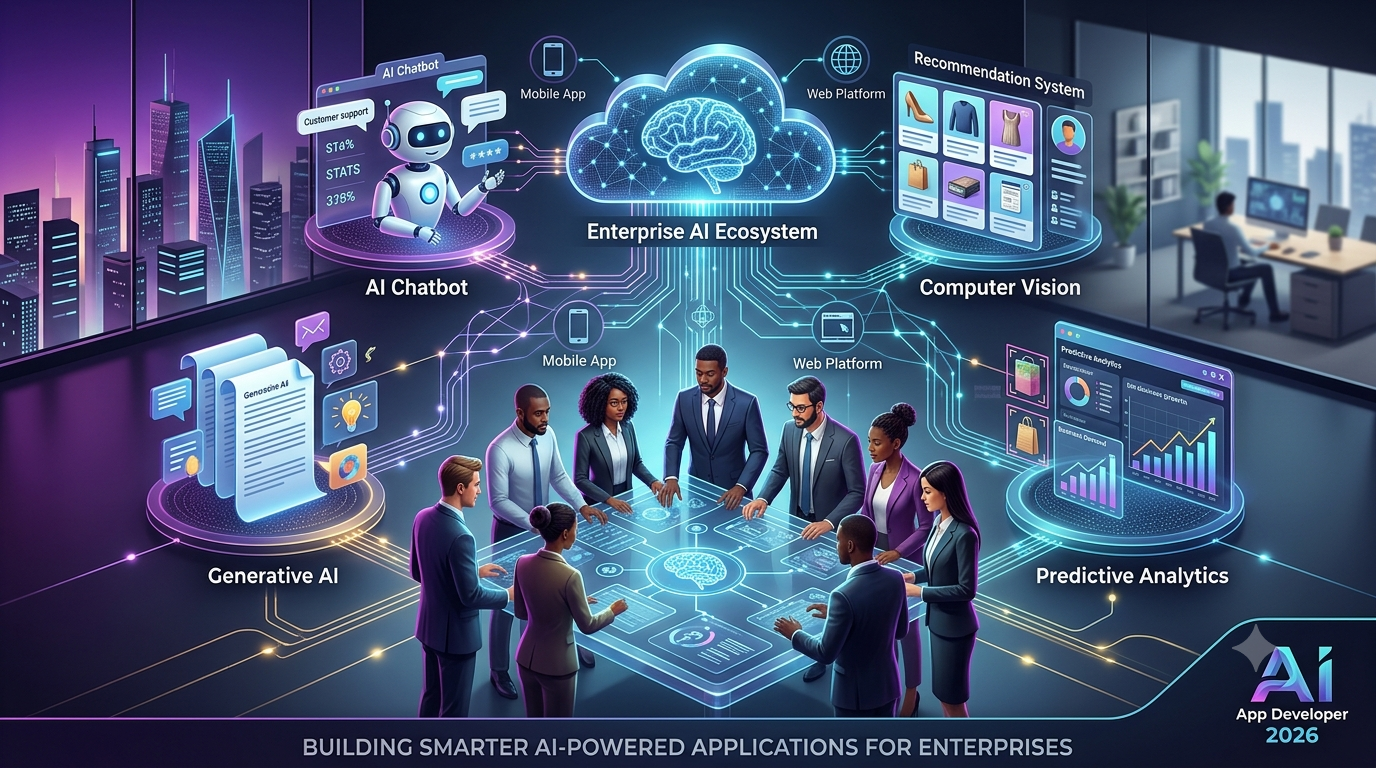
AI app development allows businesses to combine traditional application functionality with intelligent capabilities such as conversational AI, predictive analytics, automation, computer vision, recommendation systems, and generative AI.
For businesses planning an AI-powered product, selecting the right technology architecture and development partner is essential for creating a secure, scalable, and useful application.
What Is AI App Development?
AI app development is the process of designing and building applications that use artificial intelligence and machine learning technologies to perform tasks that traditionally require human intelligence.
Depending on the business requirements, an AI application can include:
- AI chatbots
- Generative AI
- Voice assistants
- Recommendation engines
- Predictive analytics
- Computer vision
- Natural language processing
- Document processing
- AI-powered automation
- Fraud detection
- Personalized user experiences
The objective is not simply to add AI to an application but to use AI where it creates measurable business value.
Why Businesses Are Investing in AI Applications
AI applications can help businesses improve productivity, automate repetitive tasks, and create more personalized customer experiences.
Business Benefits of AI App Development
- Automate repetitive processes
- Reduce manual workloads
- Improve customer support
- Analyze large datasets
- Generate personalized recommendations
- Improve decision-making
- Accelerate business processes
- Create new digital products
- Improve operational efficiency
A well-designed AI application can become an important part of a company’s long-term digital strategy.
Top AI App Development Use Cases
1. AI Chatbots
AI-powered chatbots can provide automated customer support and answer common questions.
Modern conversational applications can understand natural-language queries and provide context-aware responses.
Businesses can use AI chatbots for:
- Customer support
- Lead qualification
- Product assistance
- Internal knowledge management
- Appointment support
- Frequently asked questions
2. Generative AI Applications
Generative AI can create text, images, summaries, code, and other types of content.
Businesses can build customized applications that use generative AI for content creation, document analysis, business assistance, and workflow automation.
3. AI Recommendation Systems
Recommendation engines analyze user behavior and other relevant information to suggest products, services, content, or actions.
E-commerce businesses, streaming platforms, marketplaces, and SaaS companies can use recommendation systems to personalize experiences.
4. Computer Vision Applications
Computer vision enables applications to interpret visual information.
Potential use cases include:
- Image classification
- Object detection
- Document scanning
- Quality inspection
- Facial recognition where appropriate and legally permitted
- Visual search
- Retail analytics
5. Predictive Analytics
AI models can analyze historical information to identify patterns and generate predictions.
Businesses can apply predictive analytics to areas such as:
- Demand forecasting
- Customer behavior
- Sales forecasting
- Inventory planning
- Risk analysis
- Predictive maintenance
AI in Mobile App Development
AI can transform traditional mobile applications by adding intelligent features.
For example, a mobile application can use AI to provide:
- Personalized recommendations
- Voice-based interaction
- AI search
- Smart notifications
- Image recognition
- Automated assistance
- Predictive features
AI functionality can be implemented using cloud-based models, on-device machine learning, or a combination of both depending on performance, privacy, and business requirements.
AI App Development Architecture
A typical AI application can include several interconnected layers:
Mobile/Web App → Backend/API → AI Model → Data Layer → Analytics
The exact architecture depends on the application.
Some AI applications may use third-party AI APIs, while others may require customized models or machine-learning infrastructure.
Important architectural considerations include:
- Model selection
- Data requirements
- API architecture
- Cloud infrastructure
- Database design
- Authentication
- Security
- Scalability
- Monitoring
- Cost optimization
Generative AI and AI Agents
Generative AI has created new opportunities for businesses to build applications capable of producing and processing information.
AI agents can go a step further by combining AI models with tools, APIs, databases, and business workflows.
For example, an AI-powered business application could potentially:
- Understand a user’s request.
- Retrieve relevant information.
- Analyze the information.
- Use connected business tools.
- Complete an approved workflow.
- Provide the result to the user.
However, AI agents should be designed with appropriate permissions, monitoring, validation, and human oversight where necessary.
Security and Privacy in AI App Development
AI applications can process sensitive business and customer information, making security an essential consideration.
A secure AI application should consider:
- Data encryption
- Authentication
- Authorization
- Secure APIs
- Access controls
- Data retention policies
- Secure model integration
- Prompt and input validation
- Monitoring
- Protection against unauthorized data exposure
Businesses should also understand how third-party AI services handle submitted information before integrating them into applications.
Challenges of AI App Development
AI provides significant opportunities, but businesses should also understand the challenges.
Data Quality
AI systems depend heavily on the quality and relevance of their data.
Poor-quality or incomplete data can negatively affect results.
Model Accuracy
AI-generated responses may sometimes be incorrect or unreliable.
Applications should use validation mechanisms appropriate to the business use case.
Infrastructure Costs
AI workloads can require significant computing resources.
Businesses should evaluate model size, API costs, usage volume, caching, and infrastructure requirements.
Scalability
An AI application that works well with a small number of users may require architectural changes as usage increases.
Scalable APIs, cloud infrastructure, databases, and monitoring systems should be considered from the beginning.
AI App Development Process
Step 1: Identify the Business Problem
The first step is determining what problem AI needs to solve.
Not every application requires AI. The technology should provide a clear business benefit.
Step 2: Define AI Requirements
The development team identifies the required AI capabilities, data sources, integrations, user workflows, and expected outputs.
Step 3: Select the AI Technology
Depending on the application, the team may select:
- Generative AI models
- Machine-learning models
- Computer vision systems
- Natural language processing
- Recommendation algorithms
- Third-party AI APIs
Step 4: Design the Application
The AI functionality is integrated into the broader application architecture.
Step 5: Develop and Integrate
Developers build the frontend, backend, APIs, AI components, databases, and required integrations.
Step 6: Test the AI System
Testing should evaluate both traditional application functionality and AI performance.
Important areas can include accuracy, reliability, security, response time, scalability, and user experience.
Step 7: Monitor and Improve
AI applications require ongoing monitoring.
Models, prompts, data, workflows, and application features may need continuous improvement as business requirements change.
Why Choose AIAppDeveloper?
AIAppDeveloper helps businesses build customized AI-powered applications designed around specific business requirements.
Development services can include:
- AI mobile app development
- Generative AI application development
- AI chatbot development
- AI agent development
- Machine-learning integration
- Computer vision applications
- AI recommendation systems
- Predictive analytics
- AI API integration
- SaaS AI application development
- Custom AI solutions
The development approach can combine AI technologies with mobile, web, backend, cloud, and API development to create complete business applications.
The Future of AI App Development
AI application development is moving toward more intelligent and autonomous software.
Businesses are increasingly exploring applications that can understand natural language, work with business data, interact with software tools, and automate complex workflows.
Future AI applications are likely to focus on:
- AI agents
- Personalized experiences
- Multimodal AI
- Voice-based applications
- Intelligent automation
- On-device AI
- Predictive systems
- AI-powered enterprise software
Businesses that identify practical AI use cases early can create new products and improve existing workflows while building a stronger digital foundation.
Conclusion
AI app development is becoming an important part of modern software development. From intelligent chatbots and recommendation systems to generative AI applications and autonomous workflows, businesses have many opportunities to use artificial intelligence to improve products and operations.
However, successful AI development requires more than integrating an AI model. Businesses need a strong application architecture, quality data, secure integrations, scalable infrastructure, effective testing, and continuous monitoring.
AIAppDeveloper can help businesses turn AI concepts into customized applications that combine artificial intelligence with modern mobile, web, cloud, and backend technologies.