Artificial intelligence is no longer limited to research labs or large technology companies. In 2026, businesses of all sizes are using AI applications to automate operations, improve customer experiences, analyze data, and create new digital products.
From AI-powered mobile apps and intelligent chatbots to predictive analytics and computer vision, AI is becoming an important part of modern software development.
For businesses planning their next digital product, the key question is no longer whether to use AI, but how to build an AI application that delivers measurable business value.
What Is AI App Development?
AI app development is the process of creating software applications that use artificial intelligence technologies to perform tasks that traditionally require human intelligence.
These applications can use technologies such as:
- Machine learning
- Generative AI
- Natural language processing
- Computer vision
- Predictive analytics
- Recommendation systems
- Speech recognition
- Large language models
- AI agents
- Deep learning
An AI application can be built for mobile, web, desktop, enterprise, or embedded platforms depending on the business requirement.
Why Are Businesses Investing in AI Applications?
The rapid adoption of AI is being driven by the need for automation, personalization, and better decision-making.
1. Business Process Automation
AI applications can automate repetitive tasks such as:
- Customer support
- Data classification
- Document processing
- Email responses
- Report generation
- Appointment scheduling
- Lead qualification
This allows employees to spend more time on strategic and creative work.
2. Personalized Customer Experiences
AI can analyze customer behavior and provide personalized recommendations, content, products, and services.
For example, an eCommerce application can use AI to recommend products based on browsing history, previous purchases, and customer preferences.
3. Faster Decision-Making
AI applications can process large amounts of data much faster than traditional software systems.
Businesses can use AI-powered analytics to identify trends, forecast demand, detect unusual activity, and support better business decisions.
4. Intelligent Customer Support
AI chatbots and virtual assistants can provide 24/7 customer support.
Modern AI assistants can understand natural language, remember conversation context, answer questions, and connect users with human agents when necessary.
Popular Types of AI Applications
Businesses can build different types of AI-powered applications depending on their industry and objectives.
AI Chatbot Applications
AI chatbots are among the most common AI applications.
They can help businesses with:
- Customer service
- Sales assistance
- FAQs
- Product recommendations
- Internal employee support
- Lead generation
Generative AI Applications
Generative AI applications can create new content based on user instructions.
Examples include:
- AI writing assistants
- Image-generation applications
- AI video tools
- Coding assistants
- Marketing content generators
- Document summarization tools
AI-Powered Mobile Applications
AI can be integrated into iOS and Android applications to create smarter user experiences.
Examples include fitness apps that provide personalized recommendations, finance apps that detect unusual transactions, and healthcare platforms that assist with data analysis.
Computer Vision Applications
Computer vision allows applications to understand and analyze images and videos.
Businesses use it for:
- Object detection
- Facial recognition
- Quality inspection
- Security systems
- OCR
- Medical image analysis
- Retail analytics
Predictive Analytics Applications
Predictive AI can analyze historical data to identify potential future outcomes.
Applications include:
- Sales forecasting
- Customer churn prediction
- Fraud detection
- Demand forecasting
- Risk analysis
- Predictive maintenance
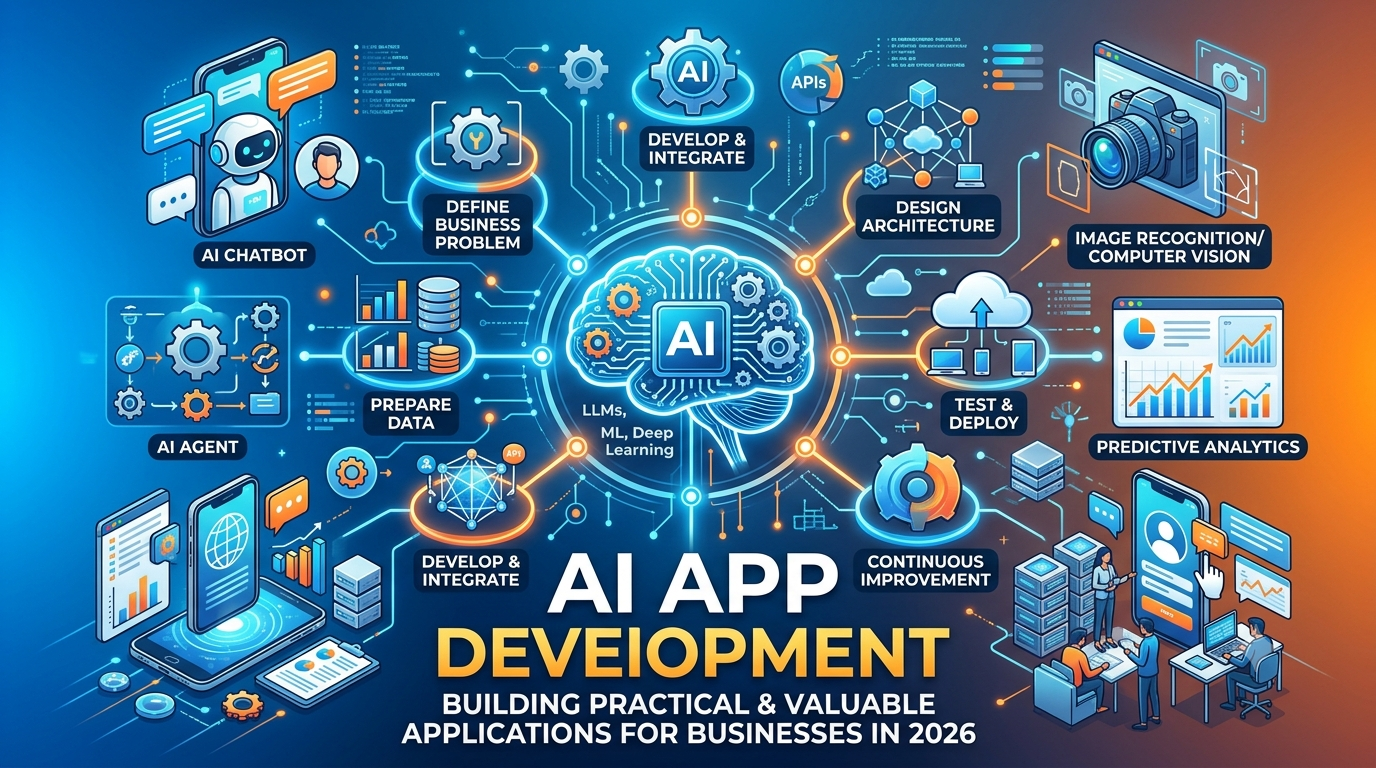
How to Build an AI Application
Building a successful AI application requires more than simply connecting an AI API to an existing application.
A structured development process is essential.
Step 1: Define the Business Problem
Start by identifying the problem the AI application needs to solve.
Instead of asking:
“Where can we use AI?”
businesses should ask:
“Which problem can AI solve better, faster, or more efficiently?”
This helps prevent unnecessary AI implementation.
Step 2: Choose the Right AI Technology
The technology should match the application’s requirements.
Depending on the project, developers may use:
- Large language models
- Machine learning models
- Computer vision
- Natural language processing
- Speech-to-text
- Recommendation algorithms
- Predictive models
Step 3: Design the Application Architecture
AI functionality needs to work together with the rest of the software system.
A typical AI application may include:
Mobile/Web App → Backend → AI Model/API → Database → Analytics
The architecture should also consider scalability, security, latency, and future integrations.
Step 4: Prepare and Manage Data
Data is one of the most important components of AI development.
Businesses may need to:
- Collect data
- Clean data
- Structure data
- Label datasets
- Store data securely
- Remove duplicate information
- Protect sensitive information
Poor-quality data can negatively affect AI performance.
Step 5: Develop and Integrate AI Features
Developers can integrate AI models through APIs, cloud services, open-source models, or custom-trained models.
The best approach depends on factors such as:
- Budget
- Performance requirements
- Data privacy
- Accuracy
- Application scale
- Industry regulations
Step 6: Test the AI Application
AI applications require both traditional software testing and AI-specific testing.
Developers should evaluate:
- Accuracy
- Response quality
- Speed
- Reliability
- Security
- Scalability
- Edge cases
- Model behavior
Continuous monitoring is particularly important because AI systems can behave differently as data and usage patterns change.
AI App Development Technologies
A modern AI application may use multiple technologies across its stack.
Frontend Technologies
Depending on the platform, developers may use:
- React
- React Native
- Flutter
- Swift
- Kotlin
- Next.js
Backend Technologies
Common backend technologies include:
- Python
- Node.js
- Java
- .NET
- FastAPI
- Django
AI and Machine Learning
AI applications can incorporate:
- OpenAI-compatible LLM APIs
- Machine learning frameworks
- Vector databases
- Embedding models
- Retrieval-augmented generation
- AI agent frameworks
- Computer vision models
The exact technology stack should be selected according to the application’s requirements rather than following technology trends blindly.
What Is RAG in AI App Development?
Retrieval-Augmented Generation, commonly known as RAG, is becoming an important architecture for enterprise AI applications.
Instead of relying only on the information contained in an AI model, a RAG application can retrieve relevant information from a company’s own knowledge sources.
For example, an enterprise AI assistant could search:
- Internal documents
- Product manuals
- Knowledge bases
- Company policies
- Customer records
- Business databases
The retrieved information can then be provided to the AI model to generate a more relevant response.
This makes RAG particularly useful for enterprise knowledge assistants and customer-support applications.
AI Agents: The Next Step in Intelligent Applications
AI agents are another major development in modern AI application development.
Instead of simply responding to a prompt, an AI agent can potentially:
- Understand a goal
- Break the goal into tasks
- Access tools
- Retrieve information
- Perform actions
- Evaluate results
- Continue until the task is completed
For businesses, this can create opportunities for intelligent automation across sales, support, operations, research, and administration.
How Much Does AI App Development Cost?
The cost of developing an AI application depends heavily on its complexity.
Factors include:
- Application platform
- Number of AI features
- AI model requirements
- Custom model training
- Data requirements
- Backend complexity
- Third-party integrations
- Security requirements
- User scale
- Maintenance requirements
A simple AI chatbot can be significantly less expensive than a complex enterprise AI platform requiring custom models, large datasets, integrations, and advanced security.
Therefore, businesses should define the MVP before estimating the complete development budget.
Common Mistakes in AI App Development
Businesses should avoid several common mistakes.
Building AI Without a Clear Business Objective
Adding AI simply because it is trending does not guarantee ROI.
Ignoring Data Quality
Poor data can produce poor AI results.
Choosing a Model Based Only on Popularity
The most popular AI model isn’t necessarily the right choice for every application.
Forgetting Security
AI applications may process sensitive business or customer information. Security and access controls should be considered from the beginning.
Ignoring Scalability
An application that works for 100 users may behave very differently when it reaches 100,000 users.
How AI App Developers Can Help Businesses
Experienced AI app developers can help businesses move from an initial idea to a production-ready application.
A professional AI development team can assist with:
- AI strategy
- Product discovery
- UI/UX design
- AI model integration
- Custom AI development
- Mobile app development
- Web application development
- Backend development
- API integration
- RAG implementation
- AI agent development
- Cloud deployment
- Testing
- Maintenance and optimization
The goal should be to build an AI application that is not only technically impressive but also useful, secure, scalable, and commercially viable.
The Future of AI Application Development
AI applications are moving toward more autonomous and context-aware experiences.
Future applications are likely to combine:
AI + Automation + Personalization + Real-Time Data + Intelligent Agents
Instead of using separate tools for individual tasks, businesses may increasingly rely on AI systems capable of understanding context and completing multiple connected tasks.
This shift creates significant opportunities for startups and enterprises looking to develop new AI-powered products.
Conclusion
AI app development is transforming the way businesses build digital products.
Whether it is an AI chatbot, intelligent mobile application, predictive analytics platform, computer vision solution, or AI agent, the right technology can help businesses automate processes and create better customer experiences.
However, successful AI development requires more than selecting an AI model. Businesses need a clear use case, reliable data, scalable architecture, strong security, and an experienced development strategy.
If you’re planning to build an AI-powered product, AIAppDevelopers.ai can be positioned around helping businesses turn AI ideas into practical, scalable applications