Artificial intelligence is rapidly changing how businesses build software, serve customers, automate operations, and analyze data.
Traditional mobile and web applications relied purely on hard-coded rules and user inputs—reacting only when a button was pressed. In 2026, modern AI-powered applications have shifted from reactive tools to proactive partners. They can understand natural language, generate real-time insights, automate complex workflows, and deliver deeply personalized user experiences.
For businesses looking to stay competitive, integrating AI into application development is no longer optional—it is a core strategic requirement.
Why AI App Development Matters in 2026
Building an AI-driven application allows companies to bridge the gap between static user interfaces and intelligent action. The primary benefits include:
- Hyper-Personalization: Delivering context-aware content, recommendations, and interfaces tailored to individual user behaviors.
- Operational Automation: Using autonomous AI agents to execute multi-step tasks, reducing weekly manual work.
- Real-Time Predictive Insights: Forecasting customer trends, churn risk, and operational bottlenecks before they occur.
- 24/7 Intelligent Support: Deploying next-generation conversational assistants that resolve complex inquiries instantly.
Core Technologies Powering Modern AI Applications
To build a scalable AI app, developers combine multiple core capabilities:
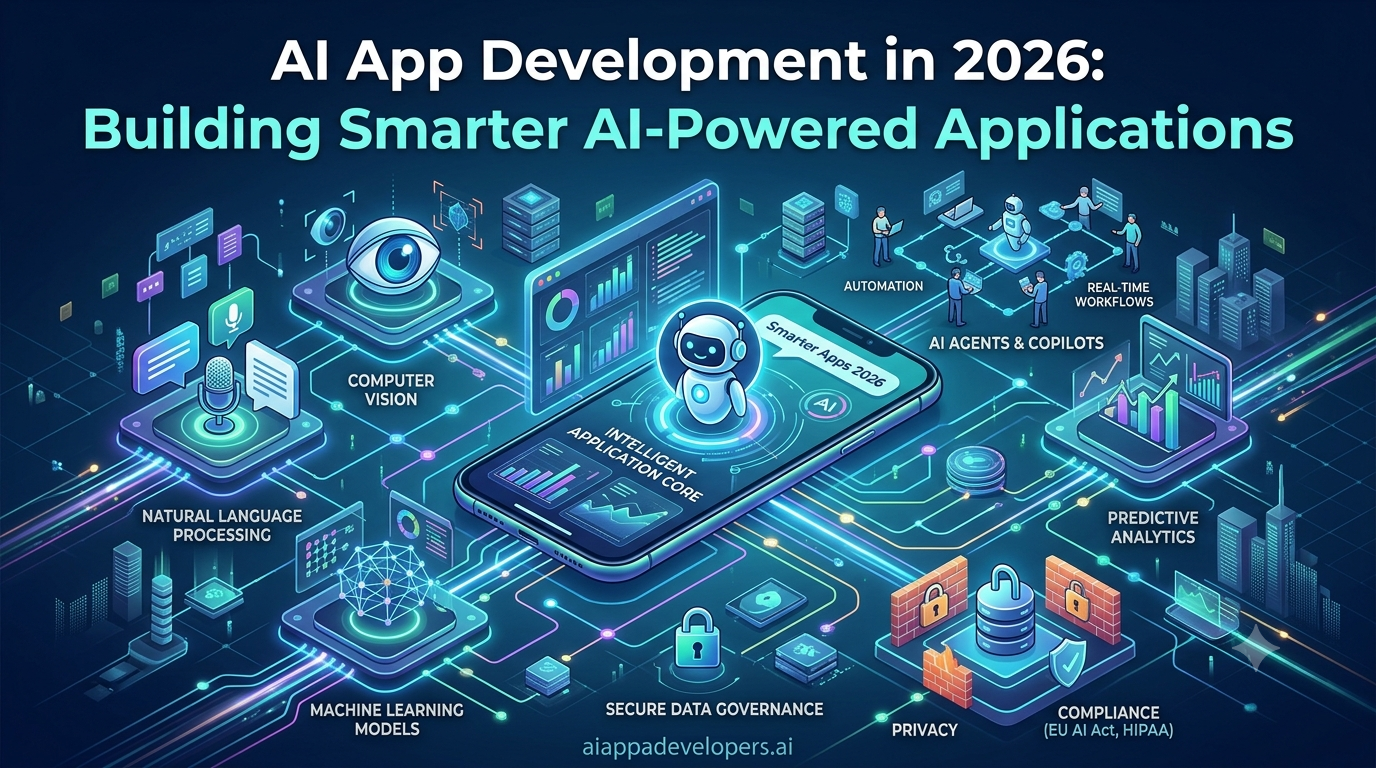
[ Natural Language Processing ] + [ Computer Vision ]
                 \                      /
                  [ AI Core Engine ]
                 /                      \
[ Machine Learning Models ] + [ Predictive Analytics ]
1. Generative AI & LLMs
Generative capabilities allow applications to summarize documents, draft contextually relevant responses, and convert unstructured inputs into structured data.
2. Autonomous AI Agents & Copilots
Unlike simple chatbots, AI agents can make decisions, interact with external software APIs, and perform actions on behalf of the user—such as scheduling meetings, processing refunds, or generating financial reports.
3. Machine Learning (ML) & Predictive Analytics
Machine learning algorithms analyze past data to detect anomalies, optimize pricing, and predict user intent in real time.
4. Computer Vision
Computer vision enables applications to interpret visual data—powering facial recognition, object detection, document scanning, and augmented reality (AR) workflows.
Step-by-Step AI App Development Process
Building a production-ready AI application requires a structured, security-first strategy:
- Define the Business Problem: Identify clear use cases where AI adds value—such as customer support, workflow automation, or personalized search.
- Data Strategy & Governance: Clean, organize, and secure the training and operational data needed to feed your AI models.
- Architecture & API Integration: Determine whether to use fine-tuned open-source models, pre-trained APIs, or custom-trained architectures.
- UI/UX Design for AI: Design interfaces that seamlessly handle asynchronous AI responses, streaming text, and confidence indicators.
- Testing & Evaluation: Test for model accuracy, latency, security vulnerabilities, and edge-case handling.
- Deployment & Monitoring: Deploy on scalable cloud infrastructure with real-time logging to track performance and prevent model drift.
Key Considerations: Security and Compliance
Integrating AI into mobile and web systems introduces new responsibilities:
- Data Privacy: Ensure user data is encrypted and not used to train public models without explicit user consent.
- Regulatory Compliance: Adhere to global AI governance frameworks (e.g., EU AI Act) and industry standards (e.g., HIPAA, PCI DSS).
- System Latency: Optimize API calls and leverage edge computing where necessary to ensure real-time app responsiveness.
Building the Future of Software
In 2026, the standard for digital experiences is set by apps that learn, adapt, and act. By embedding artificial intelligence into your application strategy from day one, your business can unlock higher productivity, lower operational costs, and deliver unforgettable experiences to your users.