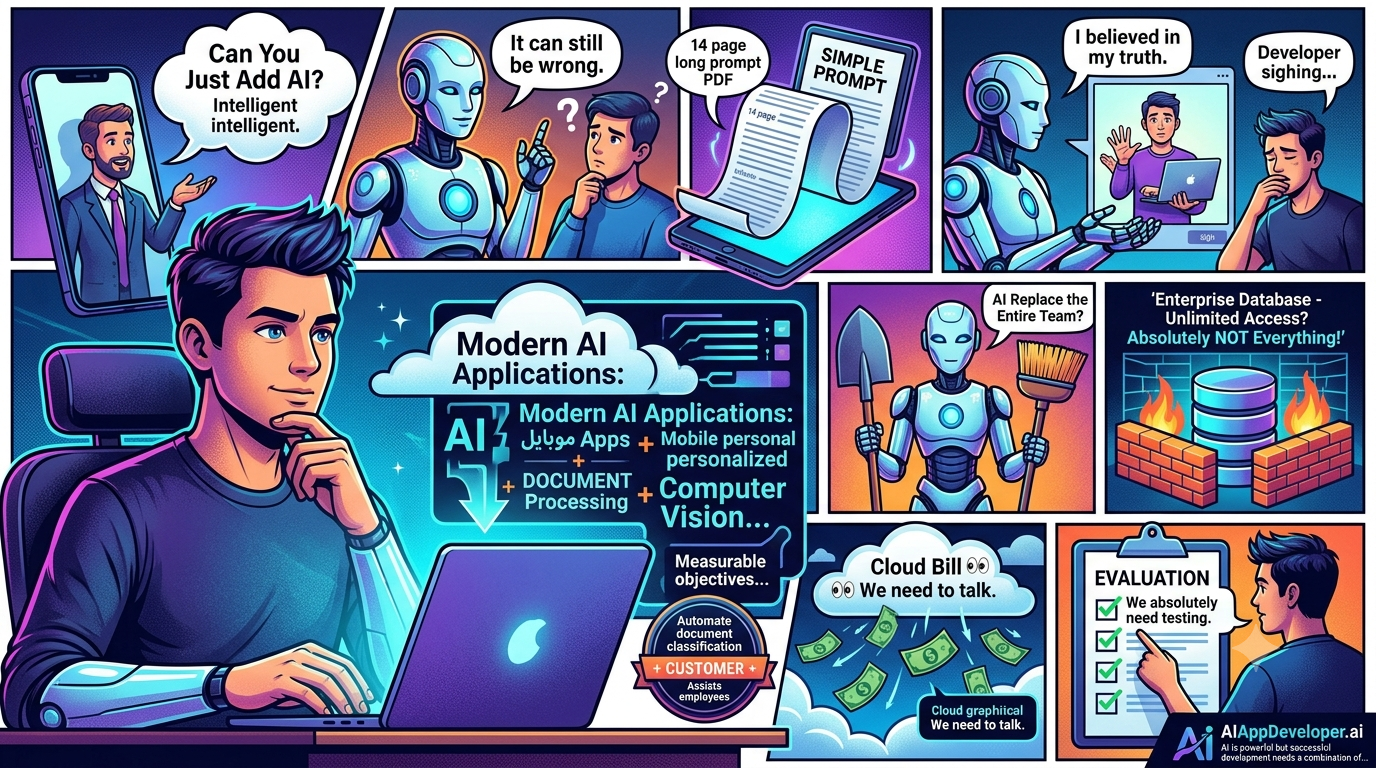
AI is everywhere.
AI writes code.
AI creates images.
AI answers questions.
AI summarizes meetings.
AI analyzes data.
AI can even write an email explaining why you didn’t finish the meeting notes.
And yet, when you tell someone you’re an AI app developer, the first question is often:
“So… can you build me an AI that does everything?”
Well, technically…
Let’s talk about it.
1. “Can You Just Add AI?”
Client:
“The app is almost finished. Can we just add AI?”
Developer:
“Sure. What should the AI do?”
Client:
“Make it intelligent.”
Developer:
“Intelligent how?”
Client:
“You know… AI intelligent.”
And that’s when the requirements meeting begins.
AI isn’t a magic button.
An effective AI application needs a clear use case, appropriate models, quality data, integrations, security, testing, monitoring, and a good user experience.
2. The AI Knows Everything
User:
“Does AI know everything?”
Developer:
“No.”
User:
“But it’s AI.”
Developer:
“It can still be wrong.”
User:
“Really?”
Developer:
“Yes.”
User:
“Then why did it answer so confidently?”
Developer:
“That’s a very good question.”
Modern AI applications can be powerful, but AI-generated answers still need appropriate validation, especially in business-critical applications.
3. “Make the Chatbot Sound Human”
Client:
“We need a chatbot that sounds exactly like a human.”
Developer:
“Okay.”
Client:
“And it should understand everything.”
Developer:
“Okay.”
Client:
“And never make mistakes.”
Developer:
“Okay.”
Client:
“And it should answer instantly.”
Developer:
“Would you like it to make coffee too?”
A good AI chatbot requires more than connecting a language model to a chat window.
It may involve:
- Natural language processing
- Retrieval-augmented generation
- Knowledge bases
- API integrations
- Conversation memory
- Authentication
- Security
- Monitoring
- Human escalation
4. The Prompt Is 14 Pages Long
Developer:
“What prompt are you using?”
AI enthusiast:
“It’s simple.”
Developer:
“Okay.”
They open the prompt.
Page 1…
Page 2…
Page 7…
Page 14…
Developer:
“That’s not a prompt. That’s a novel.”
Prompt engineering can be useful, but building reliable AI applications often requires architecture beyond increasingly complicated instructions.
5. “AI Will Replace the Entire Team”
Someone says:
“AI will replace all developers.”
Developers:
“Interesting.”
Then AI generates code.
Developer reviews it.
Fixes three bugs.
Changes the architecture.
Updates the security logic.
Adds error handling.
Tests the integration.
Reviews the output again.
Developer:
“So who’s reviewing the AI?”
AI:
“Apparently you.”
AI-assisted development can improve productivity, but human oversight remains important for architecture, security, testing, business logic, and quality.
6. The AI Image Problem
User:
“Generate a picture of a person holding a laptop.”
AI:
Done.
User:
“Great! Now make the laptop look realistic.”
AI:
Done.
User:
“Why does the person have six fingers?”
Developer:
“Let’s not focus on that.”
AI image generation has improved dramatically, but generated content can still contain unexpected details.
7. “Can AI Read Our Entire Database?”
Client:
“Can we connect the AI to our database?”
Developer:
“Yes, depending on the architecture and data.”
Client:
“Excellent.”
Developer:
“Which data?”
Client:
“Everything.”
Developer:
“Absolutely not everything.”
Enterprise AI applications need careful consideration of permissions, privacy, security, data access, retrieval architecture, and governance.
Giving an AI application access to business data should never mean giving it unlimited access to everything.
8. The AI API Bill
Developer:
“The prototype works!”
Team:
“Excellent!”
Developer:
“Let’s test it with more users.”
A few days later:
Cloud bill:
👀
Developer:
“We need to talk.”
AI applications need cost management just like any other software system.
Model selection, token usage, caching, request optimization, architecture, and workload design can all affect operating costs.
9. “Make It Smarter”
Client:
“The AI works well, but can you make it smarter?”
Developer:
“How?”
Client:
“Smarter.”
Developer:
“What exactly should it improve?”
Client:
“Everything.”
Developer:
“Excellent. I’ll just add the ‘Everything’ module.”
The best AI development projects start with measurable objectives.
For example:
- Improve customer support response time
- Automate document classification
- Generate product recommendations
- Analyze business data
- Summarize internal documents
- Automate repetitive workflows
- Assist employees with knowledge retrieval
Specific goals make AI systems easier to design, test, and improve.
10. The Most Dangerous AI Sentence
Everything is working.
The model responds.
The application is fast.
The dashboard looks great.
The client is happy.
Then someone says:
“We don’t need testing. It’s AI.”
Every AI developer in the room:
“We absolutely need testing.”
AI applications require evaluation just like traditional software.
Accuracy, hallucinations, latency, security, reliability, edge cases, data quality, and user experience all need to be considered.
What Does an AI App Developer Actually Build?
Modern AI app development can involve much more than chatbots.
AI applications can include:
- AI-powered mobile apps
- AI chatbots
- Generative AI applications
- AI customer-support systems
- Recommendation engines
- AI document processing
- Voice-enabled applications
- Computer vision applications
- Predictive analytics
- AI automation platforms
- Intelligent search
- AI assistants
- Enterprise knowledge systems
The technology stack can include AI models, APIs, databases, cloud platforms, mobile applications, web applications, automation systems, and custom backend services.
The Future of AI App Development
AI applications are becoming increasingly integrated into everyday software.
Instead of treating AI as a separate feature, businesses are increasingly using it as part of broader workflows.
A customer-support platform might use AI to summarize conversations.
A retail application might use AI for recommendations.
An enterprise application might use AI to search internal knowledge.
A mobile application might use AI to personalize the user experience.
The important question isn’t simply:
“Where can we add AI?”
It’s:
“Where can AI solve a real problem?”
Final Thoughts
AI is powerful.
AI is exciting.
AI is changing software development.
But AI is also occasionally wrong, occasionally expensive, and occasionally capable of confidently explaining something that isn’t true.
That’s why successful AI application development needs a combination of:
AI + software engineering + good data + security + testing + human oversight.
At AIAppDeveloper.ai, the focus is on building practical AI applications that connect intelligent technology with real business requirements.
Because adding AI to an application is easy to say.
Building AI that actually helps users?
That’s the interesting part.