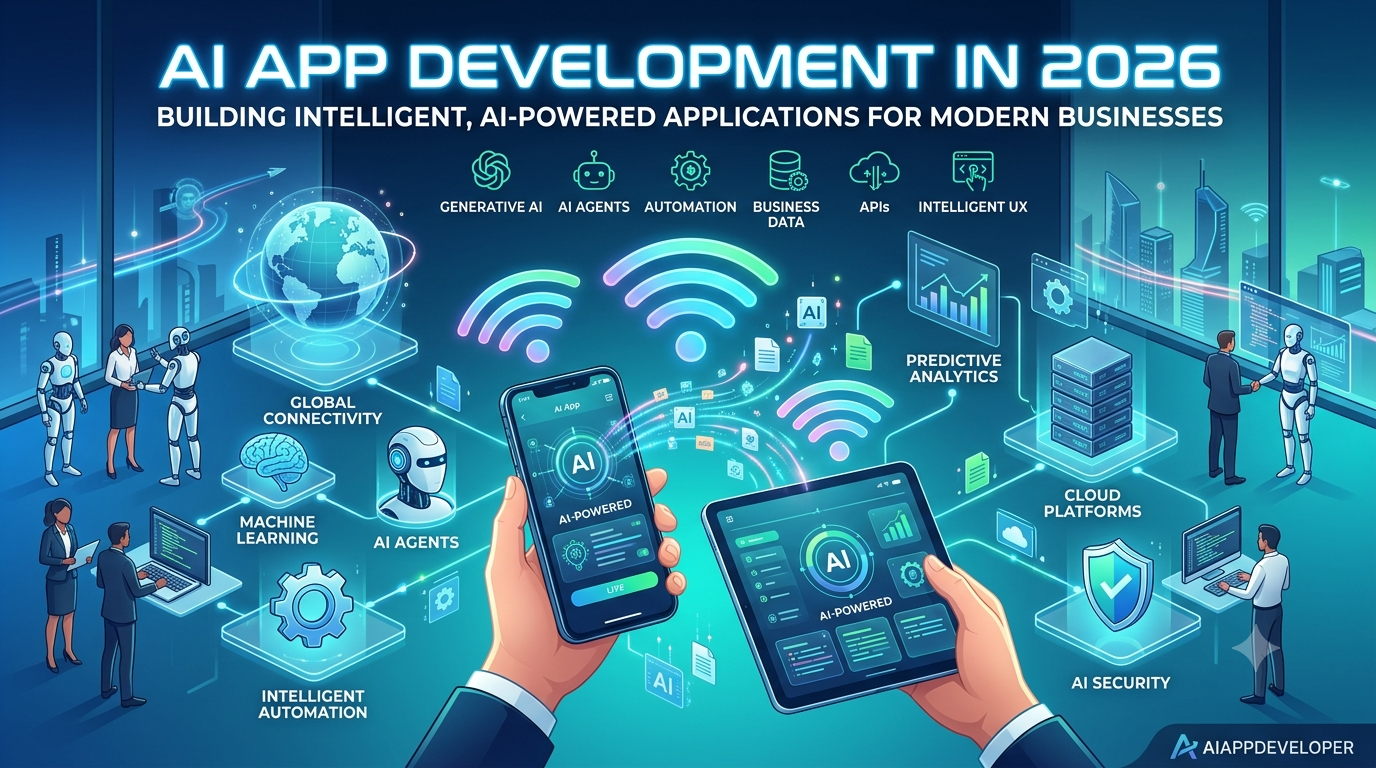
Artificial intelligence is changing the way businesses build and use software. Applications are moving beyond traditional interfaces and rule-based workflows toward systems that can understand natural language, analyze data, generate content, automate tasks, and support complex business processes.
In 2026, AI app development is increasingly focused on building applications that combine generative AI, AI agents, automation, business data, APIs, and intelligent user experiences.
For businesses, the goal is no longer simply to add a chatbot to an existing application. Modern AI applications can be designed to solve specific business problems, automate workflows, provide personalized experiences, and help users make data-driven decisions.
What Is AI App Development?
AI app development is the process of creating software applications that use artificial intelligence technologies to perform tasks that traditionally require human interaction or decision-making.
Depending on the use case, an AI application can include:
- Generative AI
- Machine learning
- Natural language processing
- Computer vision
- Speech recognition
- AI agents
- Recommendation systems
- Predictive analytics
- Intelligent automation
- Large language models
- Retrieval-augmented generation (RAG)
These technologies can be integrated into mobile applications, web platforms, enterprise software, SaaS products, and IoT systems.
Why AI App Development Matters in 2026
AI is increasingly becoming part of mainstream enterprise software rather than remaining limited to experimental projects. Industry research in 2026 points toward greater adoption of AI agents, AI-native architectures, and AI-powered workflows.
Businesses are exploring AI applications for:
- Automating repetitive tasks
- Improving customer support
- Analyzing large datasets
- Generating content
- Personalizing user experiences
- Supporting employees
- Detecting anomalies
- Improving decision-making
- Automating business workflows
The most useful AI applications typically start with a clearly defined business problem rather than simply adding AI because it is available.
Popular Types of AI Applications
1. Generative AI Applications
Generative AI applications can create new content based on user input and available context.
Examples include:
- AI writing assistants
- Image generation platforms
- AI coding applications
- Document analysis tools
- Marketing assistants
- Business intelligence assistants
Generative AI can be integrated into existing software or used as the foundation of an entirely new product.
2. AI Chatbot Applications
AI-powered chatbots can provide conversational interfaces for customers and employees.
Modern chatbots can potentially:
- Answer questions
- Search company knowledge
- Summarize documents
- Support customers
- Generate responses
- Assist employees
- Connect with business systems
A production chatbot should be designed around reliable data, appropriate access controls, monitoring, and human escalation where needed.
3. AI Agent Applications
One of the major developments in 2026 is the movement toward AI agents.
Unlike a traditional chatbot that primarily responds to questions, an AI agent can be designed to understand a goal, plan a sequence of actions, use tools, retrieve information, and complete defined tasks under appropriate controls.
Google Cloud describes 2026 as a period in which agentic workflows are increasingly being used for multi-step business processes.
Possible applications include:
- Customer-service agents
- Sales assistants
- Research agents
- IT support agents
- Data-analysis agents
- Scheduling agents
- Workflow automation agents
AI agents should still operate within clearly defined permissions and business rules.
AI-Powered Mobile App Development
AI can transform conventional mobile applications into more intelligent products.
An AI-powered mobile application might provide:
- Voice interaction
- Personalized recommendations
- Intelligent search
- Image recognition
- Predictive notifications
- AI assistants
- Automated content generation
- Personalized user experiences
For example, a fitness application could analyze user activity and generate personalized recommendations, while an e-commerce application could provide conversational product discovery.
AI + IoT App Development
AI becomes particularly powerful when combined with connected-device data.
A typical architecture can look like:
IoT Device → Mobile App → API → Cloud → AI Model → Analytics / Automation
AI can analyze data from connected devices to identify patterns, detect anomalies, or trigger automated actions.
Potential applications include:
- Smart homes
- Industrial IoT
- Predictive maintenance
- Wearables
- Healthcare monitoring
- Smart buildings
- Connected vehicles
This creates opportunities for businesses developing integrated AI, IoT, and mobile applications.
AI-Powered Business Automation
AI applications can automate workflows that traditionally require multiple manual steps.
For example:
Customer Request → AI Classification → Data Retrieval → Decision Support → Workflow Action → Human Approval
Depending on the application, AI can interact with APIs and enterprise systems to perform specific actions.
This approach can help organizations move from simple AI assistants toward more integrated intelligent workflows.
Retrieval-Augmented Generation for AI Apps
AI applications often need access to company-specific information.
A general-purpose language model may not automatically know an organization’s latest internal information.
Retrieval-Augmented Generation (RAG) can address this by allowing an AI application to retrieve relevant information from approved knowledge sources before generating a response.
A RAG architecture may include:
- Documents
- Databases
- APIs
- Vector databases
- Embedding models
- Retrieval systems
- AI models
- Application interfaces
This can be useful for:
- Enterprise knowledge assistants
- Customer support
- Document search
- Internal research
- Product information
- Technical documentation
Multimodal AI Applications
AI applications are increasingly capable of working with multiple forms of information.
A multimodal application can potentially process:
- Text
- Images
- Audio
- Video
- Documents
- Structured data
For example, a healthcare-related application might combine text and image inputs, while a manufacturing application could combine sensor data, images, and maintenance records.
The exact capabilities depend on the selected AI models and application architecture.
AI App Development Architecture
A modern AI application can contain several layers.
User Interface
The frontend can be a:
- Mobile application
- Web application
- Enterprise dashboard
- Voice interface
- Conversational interface
Application Layer
This layer manages:
- Authentication
- Business logic
- User requests
- AI orchestration
- Workflow management
- API integrations
AI Layer
The AI layer can include:
- Foundation models
- Machine-learning models
- AI agents
- Embedding models
- Classification models
- Computer-vision models
Data Layer
The application may connect to:
- SQL databases
- NoSQL databases
- Vector databases
- Data warehouses
- Enterprise knowledge bases
Integration Layer
APIs and connectors allow AI applications to communicate with external systems.
This architecture enables AI to become part of the complete business workflow rather than functioning as an isolated feature.
AI App Security and Privacy
Security needs to be considered from the beginning of AI application development.
Important areas include:
- User authentication
- Authorization
- Data encryption
- API security
- Access control
- Secure prompt handling
- Sensitive-data protection
- Model access controls
- Audit logging
- Monitoring
AI agents introduce additional considerations because they may have permission to access systems or perform actions.
Deloitte’s 2026 enterprise AI research highlights that AI-agent adoption is advancing while governance maturity is not keeping pace in many organizations.
For this reason, AI applications should use appropriate guardrails, permission boundaries, testing, monitoring, and human oversight.
AI App Development Process
A structured development process can help businesses move from an AI idea to a production application.
Step 1: Identify the Business Problem
Start by defining the problem the AI application needs to solve.
Ask:
- What task should AI improve?
- Who will use the application?
- What data is required?
- What outcome should the system produce?
Step 2: Select the AI Approach
Determine whether the application needs:
- Generative AI
- Machine learning
- RAG
- Computer vision
- Speech AI
- AI agents
- Predictive analytics
Not every application needs the same AI technology.
Step 3: Design the Architecture
Define the relationship between:
Frontend + Backend + AI Model + Data + APIs + Security
Step 4: Develop the MVP
Build a focused version of the application that validates the core use case.
Step 5: Integrate Business Data
Connect the AI system with approved databases, documents, APIs, or other information sources.
Step 6: Test the AI Application
Testing should cover both traditional software quality and AI-specific behavior.
Areas can include:
- Accuracy
- Reliability
- Security
- Response quality
- Hallucination risks
- API failures
- Performance
- Access controls
- Cost
Step 7: Deploy and Monitor
After deployment, AI applications require ongoing monitoring.
Models, data, user behavior, costs, and application requirements can change over time.
How Much Does AI App Development Cost?
There is no single price for AI application development.
Development costs depend on factors such as:
- Application complexity
- AI model requirements
- Number of platforms
- Custom AI model development
- API integrations
- Data requirements
- RAG implementation
- AI agent functionality
- Security requirements
- Cloud infrastructure
- User volume
- Ongoing AI inference costs
A simple AI assistant can have a very different development scope from a multi-agent enterprise platform.
Businesses should therefore define the required functionality and technical architecture before creating a detailed budget.
Choosing an AI App Development Company
When selecting an AI app development company, businesses should evaluate experience across both traditional software development and AI engineering.
Important capabilities can include:
- AI application development
- Generative AI integration
- AI agent development
- Machine learning
- Mobile app development
- Web application development
- RAG implementation
- API integration
- Cloud architecture
- Data engineering
- AI security
- Application maintenance
The development team should also understand that successful AI projects require more than model selection. Data quality, workflow design, application architecture, security, and monitoring all affect the final product.
The Future of AI App Development
AI applications are moving toward more intelligent and action-oriented experiences.
Industry research in 2026 highlights several important directions, including agentic AI, domain-specific models, multimodal AI, AI-native architecture, and intelligent workflow automation.
The future of AI application development is likely to include:
- AI-native applications
- Autonomous task execution
- Multi-agent workflows
- Voice-first interfaces
- Multimodal applications
- Personalized AI assistants
- AI-powered enterprise software
- AI + IoT applications
- Intelligent automation
- Human-AI collaboration
However, successful adoption will depend on more than technological capability. Businesses will also need reliable data, appropriate governance, security controls, and clear business objectives.
Conclusion
AI app development in 2026 is moving beyond simple chatbots and isolated AI features. Businesses are building applications that combine generative AI, AI agents, machine learning, RAG, multimodal capabilities, automation, APIs, and enterprise data.
For companies planning an AI-powered product, the most important starting point is a clearly defined business problem and a practical technical strategy.
Whether you are building an AI mobile app, AI chatbot, enterprise AI platform, AI agent, recommendation engine, or AI-powered SaaS product, the right architecture can help transform an idea into a scalable application.
AIAppDeveloper can help businesses explore AI application concepts, intelligent automation, AI agent development, and custom AI-powered software solutions designed around specific business requirements.