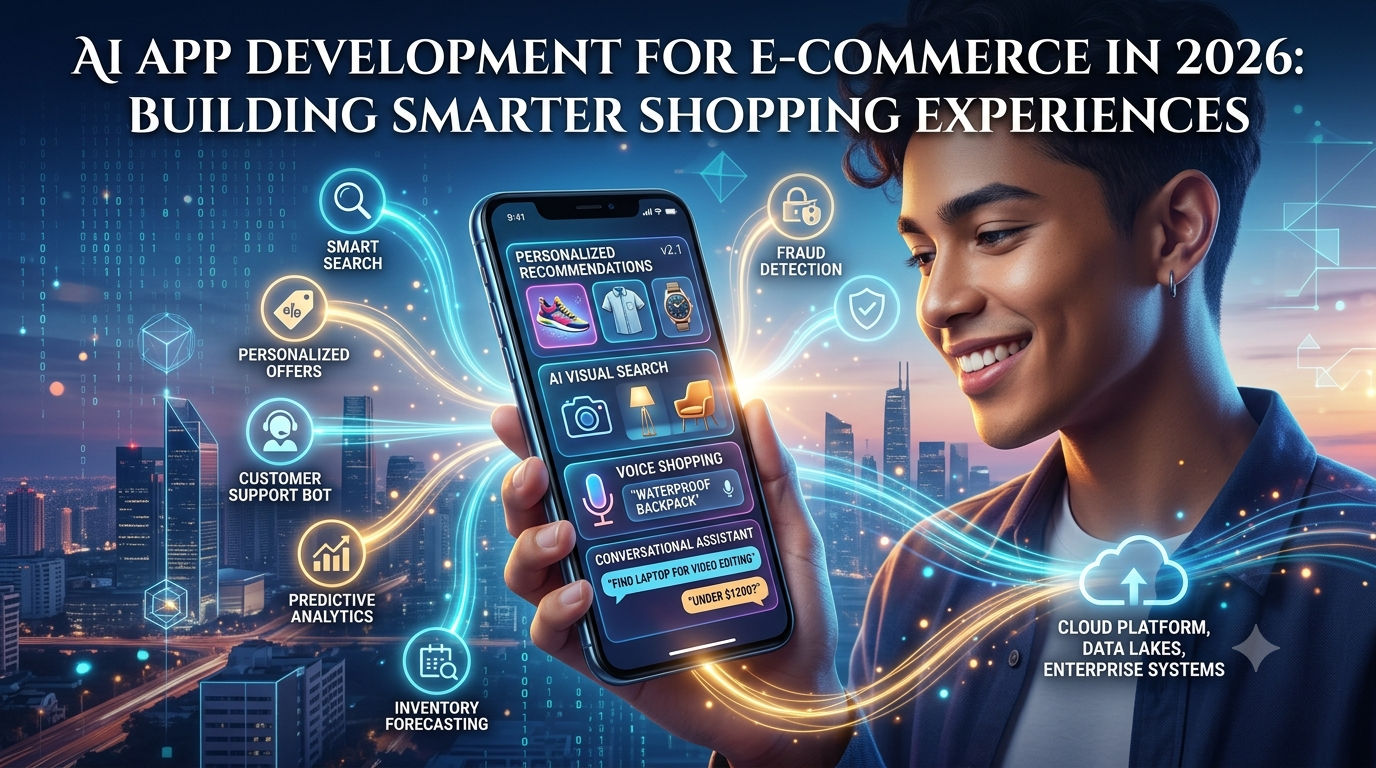
E-commerce is no longer just about displaying products, processing payments, and delivering orders. Customers increasingly expect shopping experiences that understand their needs, provide relevant recommendations, answer questions instantly, and reduce the effort required to find the right product.
This is where AI app development for e-commerce is creating new opportunities.
Modern AI-powered shopping applications can combine conversational AI, recommendation engines, computer vision, predictive analytics, voice interfaces, and intelligent automation to create more personalized customer experiences.
In 2026, businesses can use AI not simply as a chatbot feature, but as an intelligent layer across the entire e-commerce application.
What Is AI E-Commerce App Development?
AI e-commerce app development is the process of building shopping applications that use artificial intelligence to improve customer experiences and automate business processes.
An AI-powered e-commerce application can include:
- AI product recommendations
- Conversational shopping assistants
- Visual product search
- Voice search
- Personalized offers
- Customer-support automation
- Product description generation
- Inventory forecasting
- Customer behavior analysis
- AI-powered search
- Fraud and anomaly detection
- Marketing automation
A typical architecture may look like:
Customer → E-Commerce App → AI Layer → Product Data → Business Systems → Personalized Experience
The exact architecture depends on the business model, product catalog, customer data, and required AI capabilities.
Why AI Is Important for E-Commerce Apps in 2026
Traditional e-commerce applications generally rely on predefined filters, categories, keywords, and recommendation rules.
AI allows applications to understand more complex customer intent.
For example, instead of searching:
“Men’s black running shoes size 10”
a customer might type:
“I need comfortable black shoes for daily running under $100.”
An AI-powered application can interpret the intent and potentially combine:
- Product category
- Budget
- Color
- Activity
- Customer preferences
- Product specifications
- Previous interactions
The result can be a more natural shopping experience.
AI is also moving beyond conversational interfaces. Modern AI application architectures increasingly combine models with retrieval, tools, business data, and automated workflows.
AI Product Recommendations
One of the most common applications of AI in e-commerce is personalization.
Instead of showing every customer identical products, an AI recommendation system can consider signals such as:
- Browsing behavior
- Purchase history
- Product preferences
- Search activity
- Product interactions
- Customer segments
- Context
For example:
A customer purchases running shoes.
The application may recommend:
- Running socks
- Sportswear
- Insoles
- Fitness accessories
- Similar running products
The goal is to make product discovery more relevant without overwhelming the customer with unrelated products.
AI-Powered Product Search
Search is one of the most important components of an e-commerce application.
Traditional search often depends heavily on exact keywords.
AI-powered search can understand semantic meaning and user intent.
For example:
“lightweight laptop for college students”
could return products based on characteristics such as:
- Weight
- Battery life
- Price
- Portability
- Performance
- Student use case
This can make product discovery more intuitive.
Conversational Shopping Assistants
AI shopping assistants can act as digital product advisors.
A customer might ask:
“Which laptop is better for video editing?”
The AI application can analyze available product information and provide a comparison based on defined product attributes.
A more advanced system could ask follow-up questions:
- What is your budget?
- Which software do you use?
- Do you need portability?
- How much storage do you need?
The application can then narrow down suitable products.
This transforms the shopping journey from:
Search → Filter → Compare → Purchase
into:
Ask → Understand → Recommend → Compare → Purchase
AI Visual Search
Computer vision can create another powerful e-commerce experience.
Instead of typing a product description, customers can upload an image.
For example:
Customer uploads a picture of a chair → AI analyzes the image → Application identifies visual characteristics → Similar products are displayed.
Visual search can be useful for:
- Fashion
- Furniture
- Home décor
- Jewelry
- Automotive parts
- Electronics
- Retail products
AI-powered image understanding can help customers discover products that may be difficult to describe using words.
Voice Search for Shopping Apps
Voice interfaces are another area where AI can improve mobile commerce.
A customer could say:
“Find me a waterproof backpack under $80.”
The application can convert speech into an intent and search the product catalog.
Voice commerce can be particularly useful when users are:
- Driving
- Cooking
- Working
- Shopping hands-free
- Using smart devices
AI voice functionality can combine speech recognition, language understanding, product search, and text-to-speech.
AI-Powered Customer Support
Customer support is another strong use case.
An AI support assistant can help answer questions about:
- Orders
- Shipping
- Returns
- Products
- Payments
- Account information
- Store policies
A typical workflow could be:
Customer Question → AI Understands Intent → Retrieves Relevant Information → Generates Response
If the issue requires human intervention, the system can escalate the conversation to a support representative.
AI and Product Knowledge
A major challenge for e-commerce AI is ensuring that the application uses accurate product information.
A business may have:
- Product catalogs
- Specifications
- FAQs
- Manuals
- Return policies
- Shipping information
- Inventory information
Retrieval-Augmented Generation (RAG) can allow an AI system to retrieve relevant information before generating an answer.
A simplified architecture is:
Customer Question → Knowledge Search → Relevant Product Data → AI Model → Response
This can be useful for product questions where generic AI knowledge is insufficient.
AI for Personalized Shopping
Personalization can extend beyond product recommendations.
An AI application can potentially personalize:
Homepage
Display products and categories relevant to the customer.
Search
Prioritize results according to customer context.
Notifications
Send more relevant product or order updates.
Offers
Present promotions based on business rules and customer segments.
Content
Adapt product descriptions or educational content to customer needs.
Personalization should be implemented with appropriate privacy, consent, and data-governance controls.
AI for Inventory Forecasting
AI isn’t limited to the customer-facing side of e-commerce.
It can also support business operations.
Inventory forecasting systems can analyze historical and current data to help businesses understand potential demand patterns.
Possible inputs include:
- Historical sales
- Seasonal trends
- Product demand
- Promotions
- Regional activity
- Inventory levels
- Order patterns
The output can help businesses make more informed inventory decisions.
AI predictions should be treated as decision-support rather than guaranteed forecasts.
AI for E-Commerce Marketing
AI applications can also support marketing teams.
Potential use cases include:
- Product description generation
- Email personalization
- Customer segmentation
- Campaign analysis
- SEO content assistance
- Ad creative generation
- Customer behavior analysis
- Product recommendations
For example, an e-commerce business could use AI to generate an initial product description from structured product information and then apply editorial review before publishing.
AI Fraud and Anomaly Detection
E-commerce businesses process large volumes of transactions and user activity.
AI-based anomaly detection can help identify unusual patterns.
Potential signals include:
- Unusual transaction behavior
- Multiple rapid transactions
- Account activity anomalies
- Suspicious purchasing patterns
- Abnormal login behavior
AI systems can flag activity for additional verification or human review.
For payment-related decisions, businesses should combine AI with established security, fraud-prevention, and compliance systems rather than relying solely on model output.
AI-Powered E-Commerce Mobile Apps
Mobile commerce continues to provide an important environment for AI features.
Businesses can integrate AI into:
- iOS shopping applications
- Android shopping applications
- Cross-platform apps
- Tablet applications
Features can include:
- AI search
- Voice shopping
- Visual search
- Personalized recommendations
- AI chat
- Smart notifications
- Product comparison
- Customer support
- Personalized content
An AI-first mobile architecture can combine on-device processing with cloud-based AI depending on the feature and requirements. AIAppDevelopers describes this type of architecture as combining mobile UX, edge processing, RAG/orchestration, and enterprise data infrastructure.
AI E-Commerce App Architecture
A modern AI-powered e-commerce application can include several layers.
Frontend
The customer interface may be developed for:
- iOS
- Android
- Web
- Cross-platform mobile
- Tablet
Backend
The backend manages:
- Authentication
- Customer accounts
- Orders
- Product data
- Business rules
- APIs
- Payments
- Inventory
AI Layer
The AI layer can contain:
- Large language models
- Recommendation models
- Vision models
- Speech models
- Embedding models
- Predictive models
Knowledge Layer
This may include:
- Product databases
- Vector databases
- FAQs
- Product documentation
- Customer information
- Business policies
Integration Layer
The application may connect to:
- CRM
- ERP
- Payment gateways
- Inventory systems
- Shipping platforms
- Marketing platforms
- Customer-support systems
Challenges in AI E-Commerce App Development
AI can create significant opportunities, but businesses need to plan carefully.
Incorrect AI Responses
Generative AI can sometimes produce inaccurate information.
Product recommendations and customer answers should therefore be grounded in reliable business data.
Data Privacy
E-commerce applications may process:
- Customer information
- Purchase history
- Addresses
- Payment-related information
- Behavioral data
Appropriate security and privacy controls are essential.
AI Costs
AI features create ongoing infrastructure and model costs.
Businesses should consider:
- Model selection
- API usage
- Caching
- Request volume
- Data retrieval
- Infrastructure
Integration Complexity
AI must often work alongside existing e-commerce infrastructure.
Connecting:
AI + Product Catalog + Inventory + CRM + Orders + Payments + Shipping
can be more complex than implementing an isolated AI chatbot.
Response Speed
Customers generally expect fast shopping experiences.
Developers may use techniques such as:
- Streaming
- Caching
- Efficient retrieval
- Model selection
- On-device processing
- Asynchronous workflows
to improve performance.
How to Build an AI-Powered E-Commerce App
A practical development process can follow these stages.
Step 1: Identify the Business Goal
Determine what the AI application should improve.
For example:
- Increase product discovery
- Improve customer support
- Reduce manual work
- Improve personalization
- Automate product content
Step 2: Define AI Features
Choose the features that directly support the business objective.
Step 3: Prepare Data
Organize:
- Product data
- Customer data
- Business policies
- FAQs
- Inventory information
Step 4: Select AI Models
Choose models according to:
- Accuracy
- Cost
- Latency
- Data type
- Deployment requirements
Step 5: Build the MVP
Start with a focused feature set.
For example:
AI Product Search + Recommendation Engine
can be developed before adding voice, visual search, and autonomous workflows.
Step 6: Integrate Business Systems
Connect the AI application to product catalogs, CRM, inventory, order systems, and other required platforms.
Step 7: Test
Evaluate:
- AI accuracy
- Search relevance
- Recommendation quality
- Performance
- Security
- User experience
Step 8: Launch and Optimize
Monitor real-world usage and continuously improve the application.
How Much Does AI E-Commerce App Development Cost?
The cost of an AI-powered e-commerce application depends on its architecture and feature set.
Factors include:
- Number of platforms
- UI/UX requirements
- AI models
- Product catalog size
- RAG implementation
- Recommendation engine
- Computer vision
- Voice functionality
- Third-party integrations
- Backend infrastructure
- Security requirements
- User volume
A basic AI shopping assistant and a full AI commerce platform can require very different development investments.
A detailed technical specification should therefore be prepared before finalizing a development budget.
Why Choose an AI App Development Company?
AI e-commerce development requires expertise across multiple areas.
A development team may need experience with:
- AI application development
- Mobile development
- Web development
- LLM integration
- RAG
- Recommendation systems
- Computer vision
- Voice AI
- Backend development
- API integration
- Cloud infrastructure
- Security
AIAppDevelopers’ published architecture emphasizes combining mobile engineering with AI orchestration, retrieval, edge processing, and enterprise infrastructure rather than treating AI as an isolated feature.
This approach can be useful for businesses building AI into a larger e-commerce ecosystem.
The Future of AI E-Commerce Apps
The next generation of shopping applications is likely to become increasingly conversational and intelligent.
Customers may be able to say:
“Find me a complete home-office setup under $1,500.”
Instead of manually searching for each item, an AI-powered application could potentially understand the request, search the product catalog, compare products, check availability, and present suitable combinations.
The application could also combine:
- Text
- Voice
- Images
- Product data
- Customer preferences
- Business rules
- Real-time inventory
This creates a shopping experience where AI becomes part of the entire customer journey.
Conclusion
AI app development for e-commerce in 2026 is changing how customers discover products, communicate with businesses, and complete purchases.
From AI product recommendations and semantic search to visual search, voice commerce, customer support, and intelligent inventory systems, AI can become an important layer across the entire e-commerce ecosystem.
The key is to start with a real business problem.
Instead of adding AI simply because it is trending, businesses should identify the customer or operational workflow where intelligent software can create measurable value.
With the right architecture, data, AI models, integrations, and user experience, an AI-powered e-commerce application can become more than an online store—it can become an intelligent shopping platform.
Ready to build an AI-powered e-commerce application? AIAppDevelopers can help transform your idea into a scalable AI-driven digital product.