AI App Developers

Tag: best ai

  • AI App Development in 2026: The Ultimate Guide for U.S. Businesses

    AI App Development in 2026: The Ultimate Guide for U.S. Businesses

    Artificial Intelligence is no longer the future—it’s the foundation of modern digital transformation. In 2026, U.S. businesses are rapidly investing in AI-powered applications to automate operations, enhance customer experiences, and gain a competitive edge.

    Whether you’re a startup or an enterprise, hiring an AI app developer is now essential to stay ahead in a data-driven world. At QuartusTech, we specialize in building intelligent, scalable, and high-performance AI applications tailored to business needs.


    🧠 What is AI App Development?

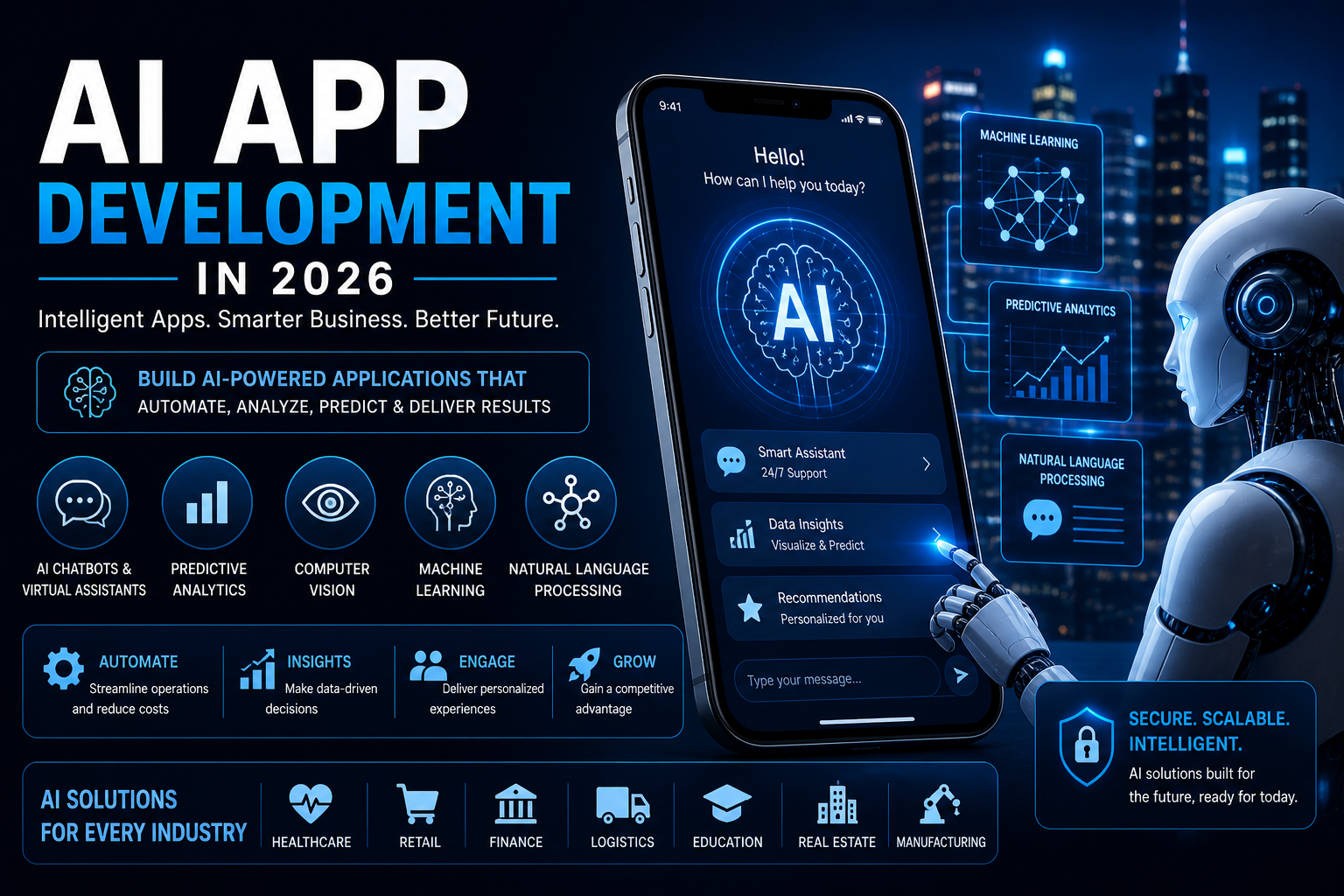
    AI app development involves creating software applications that use artificial intelligence technologies such as:

    • Machine Learning (ML)
    • Natural Language Processing (NLP)
    • Computer Vision
    • Predictive Analytics

    These applications can learn from data, make decisions, and improve performance over time.


    📊 Why U.S. Businesses Are Investing in AI Apps

    1. Automation at Scale

    AI reduces manual effort and increases operational efficiency.

    2. Personalized Customer Experience

    AI apps analyze user behavior to deliver tailored experiences.

    3. Data-Driven Decision Making

    AI helps businesses make smarter decisions using real-time insights.

    4. Competitive Advantage

    Companies using AI outperform competitors in innovation and growth.


    📱 Types of AI Applications

    Chatbots & Virtual Assistants

    Automate customer support with 24/7 availability.

    Recommendation Systems

    Used by eCommerce and streaming platforms to suggest products/content.

    AI-Powered Mobile Apps

    Smart apps with voice recognition, image processing, and automation.

    Predictive Analytics Tools

    Forecast trends, sales, and customer behavior.

    Computer Vision Apps

    Used in healthcare, security, and retail.


    ⚙️ Technologies Used in AI App Development

    • Python, TensorFlow, PyTorch
    • OpenAI APIs & LLMs
    • Cloud platforms (AWS, Azure, Google Cloud)
    • Data engineering tools
    • AI model deployment frameworks

    🏪 AI in Real-World Business Applications

    Retail

    • Smart POS systems
    • Customer behavior analysis
    • Inventory forecasting

    Healthcare

    • AI diagnostics
    • Remote monitoring
    • Medical imaging

    Finance

    • Fraud detection
    • Risk assessment
    • Automated trading

    Logistics

    • Route optimization
    • Demand forecasting

    🔐 Security & Ethics in AI Development

    AI applications must follow strict guidelines:

    • Data privacy compliance (GDPR, CCPA)
    • Secure data handling
    • Bias-free AI models
    • Transparent decision-making

    QuartusTech ensures ethical and secure AI development for U.S. businesses.


    💡 Benefits of Hiring an AI App Developer

    • Faster development cycles
    • Scalable solutions
    • Custom AI models
    • Integration with existing systems
    • Future-ready applications

    🏆 Why Choose QuartusTech for AI App Development?

    QuartusTech delivers end-to-end AI solutions:

    • Custom AI application development
    • AI-powered POS systems (MusePOS)
    • Mobile & web AI integration
    • Enterprise AI solutions
    • Ongoing optimization and support

    We focus on building intelligent systems that drive real business results.


    🔮 Future Trends in AI App Development (2026)

    • Generative AI applications
    • Autonomous AI agents
    • AI + IoT integration
    • Voice-first applications
    • AI-driven cybersecurity

    ❓ Frequently Asked Questions (FAQ)

    1. What does an AI app developer do?

    An AI app developer builds applications that use artificial intelligence to automate tasks, analyze data, and improve decision-making.


    2. How much does AI app development cost in the U.S.?

    Costs vary widely depending on complexity. Basic apps may start from $10,000+, while advanced enterprise solutions can go much higher.


    3. How long does it take to develop an AI app?

    It can take anywhere from a few weeks to several months depending on features and complexity.


    4. Which industries benefit most from AI apps?

    Retail, healthcare, finance, logistics, and SaaS industries benefit the most.


    5. Can QuartusTech build custom AI solutions?

    Yes, QuartusTech specializes in fully customized AI applications tailored to your business goals.


  • AI App Development in 2026: The Ultimate Guide for Businesses

    AI App Development in 2026: The Ultimate Guide for Businesses

    Artificial Intelligence is no longer a futuristic concept—it’s a business necessity. From automating operations to delivering personalized user experiences, AI-powered applications are transforming industries at scale.

    If you’re planning to build a future-ready product, AI app development is your competitive advantage in 2026.


    🔍 What is AI App Development?

    AI app development refers to building applications that use machine learning, natural language processing (NLP), computer vision, and predictive analytics to perform intelligent tasks.

    These apps can:

    • Learn from data 📊
    • Automate decisions ⚙️
    • Improve over time 🔁

    🚀 Why AI App Development is Growing Rapidly

    1. Data-Driven Decision Making

    Businesses are leveraging AI to analyze massive datasets and gain actionable insights.

    2. Automation at Scale

    AI reduces manual work and increases operational efficiency.

    3. Hyper-Personalization

    AI apps deliver tailored experiences based on user behavior.

    4. Competitive Advantage

    Companies using AI outperform competitors in speed, efficiency, and innovation.


    📱 Top Use Cases of AI App Development

    🛒 E-commerce

    • Product recommendations
    • Chatbots & virtual assistants
    • Demand forecasting

    🏥 Healthcare

    • AI diagnosis tools
    • Medical imaging analysis
    • Patient data management

    💳 FinTech

    • Fraud detection
    • Risk assessment
    • Automated trading

    🏭 Enterprise Solutions

    • Workflow automation
    • Predictive maintenance
    • Business intelligence dashboards

    🧠 Key Technologies Used in AI Apps

    • Machine Learning (ML)
    • Natural Language Processing (NLP)
    • Computer Vision
    • Deep Learning
    • Generative AI (like ChatGPT models)

    🛠️ AI App Development Process

    Step 1: Business Understanding

    Identify use cases and define AI goals.

    Step 2: Data Collection & Preparation

    Clean and structure data for training models.

    Step 3: Model Development

    Build and train AI models using ML algorithms.

    Step 4: App Development

    Integrate AI models into mobile/web applications.

    Step 5: Testing & Optimization

    Ensure accuracy, performance, and scalability.

    Step 6: Deployment & Monitoring

    Launch and continuously improve the AI system.


    💰 AI App Development Cost in 2026

    Project TypeEstimated Cost (USA Market)
    Basic AI App$10,000 – $25,000
    Mid-Level AI App$25,000 – $80,000
    Advanced AI Solution$80,000 – $250,000+

    💡 Cost depends on:

    • Complexity of AI models
    • Data availability
    • Integration requirements
    • Platform (web/mobile)

    🚧 Challenges in AI App Development

    • Data quality and availability
    • High development cost
    • Model accuracy issues
    • Integration complexity
    • Security & compliance

    👉 Partnering with experienced AI developers helps minimize these risks.


    🏆 Why Choose AIAppDevelopers?

    At AIAppDevelopers, we deliver cutting-edge AI solutions tailored for modern businesses.

    ✔️ Our Expertise:

    • Custom AI app development
    • Machine learning solutions
    • AI chatbot development
    • Computer vision apps
    • Generative AI integration

    ✔️ Industries We Serve:

    • Healthcare
    • Finance
    • Retail
    • Logistics
    • SaaS

    🔮 Future of AI App Development

    The AI landscape is evolving rapidly with:

    • Autonomous AI agents
    • AI-powered SaaS platforms
    • Voice & conversational AI
    • AI + IoT integration
    • Real-time predictive intelligence

    Businesses investing in AI today will dominate tomorrow’s digital economy.


    📢 Final Thoughts

    AI app development is not just about technology—it’s about transforming how businesses operate and deliver value.

    Whether you’re a startup or an enterprise, adopting AI can unlock new growth opportunities and efficiencies.


    ❓ FAQs (SEO Boost Section)

    Q1. What is AI app development?

    AI app development involves creating applications that use AI technologies to perform intelligent tasks.

    Q2. How long does it take to build an AI app?

    Typically 3–9 months depending on complexity.

    Q3. Is AI app development expensive?

    It can be, but ROI is high due to automation and efficiency gains.

    Q4. Which industries benefit most from AI?

    Healthcare, finance, retail, and logistics benefit significantly.

    Q5. Do AI apps require a lot of data?

    Yes, high-quality data is essential for accurate AI performance.

  • How AI is Transforming Mobile App Development in 2025

    How AI is Transforming Mobile App Development in 2025

    In recent years, integrating Artificial Intelligence into mobile apps has gone from “nice-to-have” to a core requirement. Whether it’s personalization, predictive analytics, or automation, AI is redefining what apps can do—and how fast developers need to adapt. In this article, we’ll explore the latest trends in AI app development, the challenges and how to tackle them, and ideas for leveraging AI tools to build smarter apps.


    1. Key Trends in AI App Development

    • On-device AI and edge computing
      Brands are moving more AI processing onto the device itself (smartphones, wearables) for faster responses and better privacy.
    • Generative AI gets creative
      Tools like GPT, image generation, and voice synthesis are now being embedded in apps—from content creation to assistive features.
    • Natural language interfaces and chatbots
      Voice & text-based interfaces are growing more sophisticated, letting users interact with apps more naturally.
    • AI-driven personalization
      More apps adjust content, UX, notifications based on user behavior, preferences, and context (location, time, device, etc.).
    • Ethical, Explainable AI & Privacy
      As AI decisions affect more parts of user experience, there’s more emphasis on transparency, bias mitigation, and preserving user data privacy.

    2. Challenges for AI App Developers

    • Data quantity & quality: AI needs good, clean, representative datasets. Gathering that, maintaining it, and ensuring it’s bias-free are big tasks.
    • Performance & battery constraints: On-device AI is great, but running AI models locally uses processing power, memory, and energy.
    • Model updates & maintenance: AI models degrade or become less effective over time as user behavior or environments change. Continuous retraining is needed.
    • Regulation and compliance: Data protection laws (GDPR, CCPA, etc.), plus legal requirements around AI (e.g. explainability, liability).
    • Testing & debugging AI features: Unlike deterministic code, AI features may behave unexpectedly; testing edge cases is harder.

    3. Best Practices & Strategies

    • Hybrid architectures: Combine cloud and on-device AI for balance—local inference for speed/privacy, cloud for heavy compute or model updates.
    • Use pre-trained models where possible: It saves time. Fine-tune them rather than building from scratch unless needed.
    • Modular design: Keep AI components (models, pipelines) loosely coupled so you can update or swap them without rewriting everything.
    • User feedback loops: Let users flag mispredictions, etc. Gather data to improve models.
    • Transparency & documentation: Be clear with users about what data you collect, how AI is used, and what they can expect.

    4. Interesting Use-Cases & Future Opportunities

    • AI assistants in apps that go beyond chat—e.g. proactive suggestions, auto-tasking (e.g. summarizing calls or meetings).
    • Apps for health and wellness that monitor signs, predict issues before they become serious.
    • Educational apps adapting to each learner’s style, pace, strengths/weaknesses.
    • Smart home / IoT apps that anticipate user needs, automating based on habits (with privacy in mind).
    • Tools for creators: AI-powered design, photo/video/audio tools built into mobile apps.

    5. How to Start Building an AI-powered App (at aiappdevelopers.ai)

    • ** ideation & validation**: Pick a user problem where AI adds clear value (not just for novelty).
    • choose appropriate AI tools/platforms: E.g. TensorFlow Lite / ONNX for mobile, OpenAI / Claude APIs for generative features.
    • UX design for AI: Think about error states, user trust, UI to explain what AI is doing or why.
    • Prototype, test, iterate: Build a minimum viable AI feature, test with small audience, learn and adjust.
    • Deploy & monitor: Track performance, resource usage, model drift; plan for updates.

    Conclusion

    AI app development in 2025 isn’t just about adding ML or chatbots onto existing apps. It’s about rethinking how apps behave, making them smarter, more responsive, ethical, and personalized. For developers at aiappdevelopers.ai, staying ahead means embracing the tools, understanding the trade-offs, continuously learning, and focusing on real problems users face. The future belongs to apps that don’t just serve users—but anticipate their needs.