AI App Developers

Author: Joseph

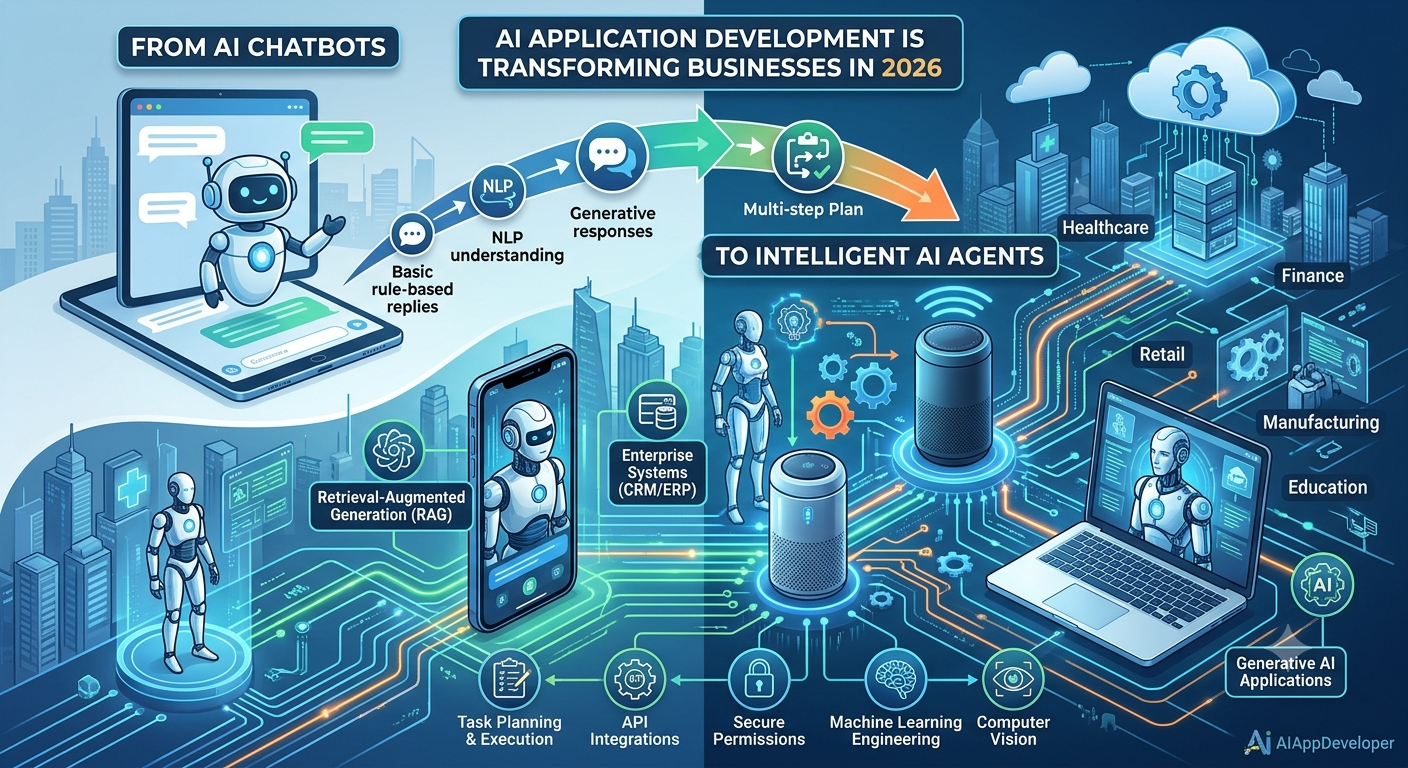
  • From AI Chatbots to Intelligent AI Agents: How AI Application Development Is Transforming Businesses in 2026

    From AI Chatbots to Intelligent AI Agents: How AI Application Development Is Transforming Businesses in 2026


    Introduction

    Artificial intelligence is changing how businesses develop software, serve customers, manage information, and automate everyday operations.

    A few years ago, AI-powered applications were primarily associated with chatbots, recommendation engines, and automated customer support. Today, businesses are exploring more advanced applications that can understand requests, analyze information, coordinate tasks, and execute defined workflows.

    This evolution is bringing AI agents, generative AI, machine learning, and intelligent automation into modern application development.

    In 2026, companies are increasingly looking beyond basic AI features. They want applications that solve practical business problems, integrate with existing software, protect sensitive information, and deliver measurable value.

    For organizations planning their next digital product, understanding this shift is essential.

    Let’s explore how AI application development is evolving and what businesses should consider when building intelligent software solutions.

    1. The Evolution of AI Application Development

    Traditional applications follow predefined instructions. Users enter information, select options, and receive outputs based on programmed rules.

    AI-powered applications introduce additional capabilities. Depending on their design, they can interpret natural language, recognize patterns, generate content, summarize information, and make predictions.

    Modern AI applications may combine several technologies:

    • Machine Learning: Identifies patterns and generates predictions from data.
    • Natural Language Processing: Helps applications understand and process human language.
    • Generative AI: Produces text, images, code, and other content.
    • Large Language Models: Support conversational experiences, reasoning, and information processing.
    • Computer Vision: Analyzes images and video.
    • AI Agents: Perform defined tasks by interacting with tools, APIs, and business systems.

    The most important change is that AI is becoming part of the application’s core functionality rather than simply an additional feature.

    Businesses can now explore software experiences that respond more naturally to users and automate complex workflows.

    2. AI Agents Are Changing How Business Applications Work

    One of the major developments in AI application development is the growth of agent-based systems.

    A traditional chatbot usually responds to user questions. An AI agent can go further by planning and carrying out a sequence of permitted actions using connected tools.

    For example, consider an AI-powered customer support application.

    A basic chatbot might answer questions about an order. An AI agent could potentially:

    1. Understand the customer’s request.
    2. Retrieve order information through an authorized API.
    3. Check the delivery status.
    4. Identify whether an issue needs escalation.
    5. Prepare an appropriate response.
    6. Request human approval before performing a sensitive action.

    This creates opportunities for businesses to automate workflows that previously required multiple manual steps.

    Business Applications of AI Agents

    • Customer service automation
    • Sales lead qualification
    • Appointment scheduling
    • Document processing
    • Internal knowledge management
    • IT support workflows
    • Financial reporting assistance
    • Inventory and operations coordination

    However, AI agents should operate within clearly defined permissions. Businesses need human oversight, action limits, audit logs, and safeguards for important decisions.

    3. Generative AI Is Creating New Possibilities for Custom Applications

    Generative AI has expanded what businesses can build into their digital products.

    Instead of relying exclusively on fixed templates and predefined interactions, applications can generate context-aware responses and content based on user input.

    Some practical examples include:

    AI-Powered Content Applications

    Businesses can develop applications that help users generate product descriptions, marketing content, reports, and summaries.

    Intelligent Document Processing

    AI applications can extract information from invoices, contracts, forms, and other business documents.

    Personalized Learning Platforms

    Educational applications can provide explanations, learning recommendations, and interactive exercises based on individual progress.

    AI-Powered Search

    Businesses can build intelligent search experiences that understand the meaning and context of user questions rather than relying only on exact keyword matches.

    Automated Business Reporting

    AI can help users summarize business information, identify trends, and generate reports from connected data sources.

    The value of generative AI depends on the quality of the underlying information, the application’s design, and how effectively the technology is integrated into real workflows.

    4. Five Industries Benefiting from AI Application Development

    AI applications are becoming relevant across industries because many business operations involve large amounts of information, repetitive tasks, and complex decisions.

    A. Healthcare

    Healthcare organizations can explore AI applications for administrative workflows, medical document processing, appointment management, and patient communication.

    Potential solutions include:

    • AI-powered appointment assistants
    • Medical document summarization
    • Healthcare administrative automation
    • Patient engagement applications
    • Clinical information search tools

    Healthcare AI requires particular attention to privacy, accuracy, clinical validation, and applicable regulations. AI-generated information should not replace qualified medical judgment.

    B. Finance and Banking

    Financial institutions handle large volumes of transactions, customer information, and operational data.

    AI-powered applications can support:

    • Fraud detection
    • Transaction monitoring
    • Customer support automation
    • Document verification
    • Financial data analysis
    • Risk assessment assistance

    Sensitive financial decisions should include appropriate validation, security controls, and human review.

    C. Retail and E-Commerce

    Retail businesses can use AI applications to create more personalized customer experiences and improve operational efficiency.

    Examples include:

    • AI shopping assistants
    • Product recommendation systems
    • Intelligent inventory forecasting
    • Automated customer support
    • Visual product search
    • Customer sentiment analysis

    These applications can help businesses connect customer information with relevant product and service experiences.

    D. Manufacturing

    Manufacturers can use AI-powered software to analyze equipment data, monitor production processes, and support maintenance planning.

    Common applications include:

    • Predictive maintenance
    • Visual quality inspection
    • Production analytics
    • Equipment monitoring
    • Supply chain forecasting
    • Manufacturing workflow automation

    AI systems need reliable data and proper integration with operational technology to produce useful results.

    E. Education

    Educational institutions and learning platforms can use AI to create more interactive and personalized experiences.

    Examples include:

    • AI learning assistants
    • Automated content recommendations
    • Intelligent assessment support
    • Student engagement analytics
    • Personalized learning paths
    • Educational content generation

    Responsible implementation is important, especially when applications involve student information or automated assessments.

    5. AI-Powered Mobile App Development Is Becoming More Intelligent

    Mobile applications are also evolving as AI capabilities become easier to integrate into software products.

    Businesses are exploring AI features that make mobile applications more responsive, personalized, and useful.

    Some examples include:

    Voice-enabled applications: Users can interact with apps through natural speech.

    Image recognition: Applications can identify objects, products, and visual information.

    Personalized recommendations: AI can suggest relevant products, services, or content based on user behavior.

    AI assistants: Mobile users can access conversational assistance and task automation.

    Predictive features: Applications can identify patterns and provide useful recommendations.

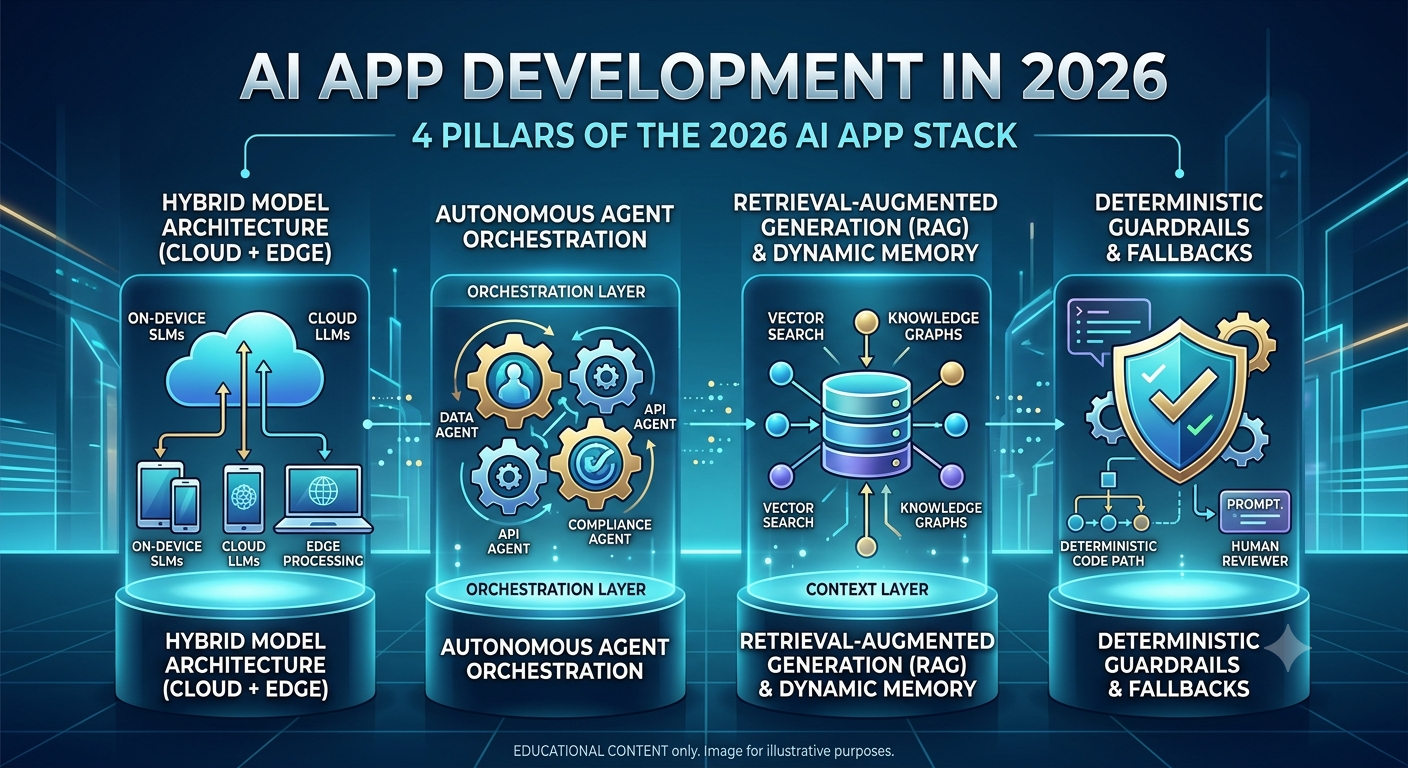
    Developers must consider whether AI processing should happen on the device, through a cloud-based model, or using a combination of both.

    On-device AI may support privacy and offline functionality in suitable cases, while cloud-based processing can provide access to larger models and more computational resources.

    6. Important Technologies Behind Modern AI Applications

    Building a reliable AI application requires selecting the right combination of technologies.

    Large Language Models

    LLMs support natural language understanding, conversational interfaces, content generation, and other language-based features.

    Retrieval-Augmented Generation (RAG)

    RAG connects AI models with external information sources so applications can retrieve relevant business documents and provide responses grounded in available information.

    It is particularly useful for enterprise knowledge assistants and document-based applications.

    Machine Learning Frameworks

    Frameworks such as TensorFlow and PyTorch help developers build, train, and deploy machine learning models.

    AI APIs and Model Integration

    AI APIs allow applications to connect with external models and services without developing every AI capability from scratch.

    Vector Databases

    Vector databases help applications store and retrieve information based on semantic similarity. They are commonly used in RAG and intelligent search systems.

    Cloud and Edge Computing

    Cloud infrastructure supports scalable AI workloads, while edge computing enables selected processing closer to the device or data source.

    The right technology stack depends on application requirements, data sensitivity, latency, operating costs, and scalability.

    7. Security and Privacy: Essential Requirements for AI App Development

    AI applications often interact with customer information, business documents, internal databases, and external services.

    This creates security and privacy considerations that developers must address from the beginning.

    Important practices include:

    • Encrypting sensitive information in transit and at rest
    • Applying role-based access controls
    • Protecting API credentials and application secrets
    • Validating user input and model outputs
    • Preventing unauthorized access to connected tools
    • Monitoring application activity
    • Maintaining audit logs
    • Establishing data retention and deletion policies
    • Testing for prompt injection and other AI-specific risks

    For AI agents, tool permissions should be especially restrictive. An agent that can read information does not necessarily need permission to modify records, issue refunds, or transfer funds.

    Human approval should be included where actions have financial, legal, operational, or privacy consequences.

    Security is not an optional feature of an AI application. It is a fundamental part of product architecture.

    8. Challenges Businesses Should Consider Before Building an AI Application

    Although AI creates significant opportunities, implementing it successfully requires careful planning.

    Data Quality

    AI applications depend on relevant and reliable data. Incomplete, outdated, or inconsistent information can lead to inaccurate outputs.

    Integration Complexity

    Connecting AI models with existing CRM, ERP, payment, inventory, and other enterprise systems can require significant development work.

    AI Hallucinations

    Generative AI systems can produce incorrect information. Applications should use appropriate validation, retrieval, confidence checks, and human review.

    Operating Costs

    AI usage can involve model inference, API calls, infrastructure, storage, and monitoring costs.

    Businesses should estimate ongoing expenses rather than considering development costs alone.

    Performance and Scalability

    An AI application must respond reliably as the number of users, requests, and connected systems increases.

    Compliance and Governance

    Organizations must consider applicable privacy, industry, data protection, and AI governance requirements.

    A successful AI application balances innovation with reliability, security, usability, and long-term maintenance.

    9. How to Choose the Right AI Application Development Company

    Selecting an experienced development partner can make a major difference in the success of an AI project.

    Businesses should evaluate potential partners based on their technical expertise and ability to understand real business requirements.

    Look for experience in:

    • Custom AI application development
    • Generative AI integration
    • AI agent development
    • Machine learning engineering
    • Natural language processing
    • Mobile and web application development
    • API and enterprise software integration
    • Cloud infrastructure
    • AI security and testing
    • Ongoing application maintenance

    A development partner should also help determine whether AI is actually the right solution for the problem.

    Not every business process needs an AI agent. Sometimes traditional automation, better software integration, or a simpler machine learning model may provide a more reliable and cost-effective result.

    10. The Future of AI Application Development

    AI application development is moving toward more intelligent, integrated, and task-oriented software.

    Several trends are likely to influence upcoming projects:

    Agentic AI Applications

    Applications will increasingly use agents to coordinate defined tasks across connected systems, with appropriate permissions and oversight.

    Multimodal AI

    AI applications can combine text, images, audio, and video to support richer user experiences.

    AI-Powered Software Engineering

    AI tools are increasingly supporting coding, testing, documentation, and other software development activities.

    Domain-Specific AI Models

    Businesses may adopt models tailored to particular industries, workflows, or specialized information requirements.

    AI Governance and Observability

    Organizations will need better tools to monitor model performance, control permissions, evaluate outputs, and manage operational risks.

    Human-AI Collaboration

    Rather than removing people from every process, many applications will combine AI automation with human expertise and approval.

    The strongest AI applications will not simply use the newest models. They will solve specific problems, integrate with business systems, and deliver outcomes that can be measured.

    Frequently Asked Questions (FAQs)

    1. What is AI application development?

    AI application development is the process of creating software that uses artificial intelligence technologies such as machine learning, natural language processing, computer vision, and generative AI to perform intelligent tasks.

    2. What is the difference between AI app development and traditional app development?

    Traditional applications mainly follow predefined programming rules. AI-powered applications can also analyze information, recognize patterns, generate content, and provide context-aware responses.

    3. What is an AI agent?

    An AI agent is a software system that can interpret a goal, plan tasks, and use connected tools or services to complete defined actions within its permissions.

    4. What is generative AI in application development?

    Generative AI allows applications to create content such as text, images, summaries, and code based on user instructions and contextual information.

    5. What is RAG in AI application development?

    Retrieval-Augmented Generation connects an AI model with external information sources. It retrieves relevant information before generating a response, helping applications answer questions using specific business or organizational data.

    6. How much does custom AI application development cost?

    The cost depends on application complexity, model selection, data preparation, integrations, user experience, security requirements, infrastructure, and ongoing maintenance. A detailed project scope is necessary for an accurate estimate.

    7. Can AI be integrated into an existing mobile or web application?

    Yes. AI capabilities can often be integrated into existing applications through APIs, custom models, cloud services, or on-device AI technologies.

    8. Is AI application development secure?

    It can be designed securely through encryption, access controls, secure API integration, monitoring, data governance, and appropriate AI-specific safeguards. Security depends on implementation and ongoing maintenance.

    9. Which industries benefit from AI application development?

    Healthcare, finance, retail, manufacturing, education, logistics, real estate, and professional services are among the industries exploring AI-powered applications.

    10. How do I choose an AI app development company?

    Evaluate the company’s experience with AI technologies, software engineering, data integration, security, deployment, scalability, and ongoing support. Also look for a clear understanding of your business objectives.

    Conclusion

    AI application development is entering a new phase in 2026. Businesses are moving beyond basic chatbots and experimenting with intelligent applications that can understand information, automate workflows, and interact with connected software systems.

    Generative AI, machine learning, RAG, and AI agents are creating new opportunities across industries. However, successful implementation requires more than selecting an AI model.

    Data quality, security, integration, cost management, and human oversight are equally important.

    For organizations planning their next digital product, the goal should be to build AI applications that solve genuine business challenges and provide long-term value.

    AIAppDeveloper explores AI technologies, intelligent software solutions, and modern application development approaches helping businesses turn innovative ideas into practical digital products.
  • AI App Development for E-Commerce in 2026: Building Smarter Shopping Experiences

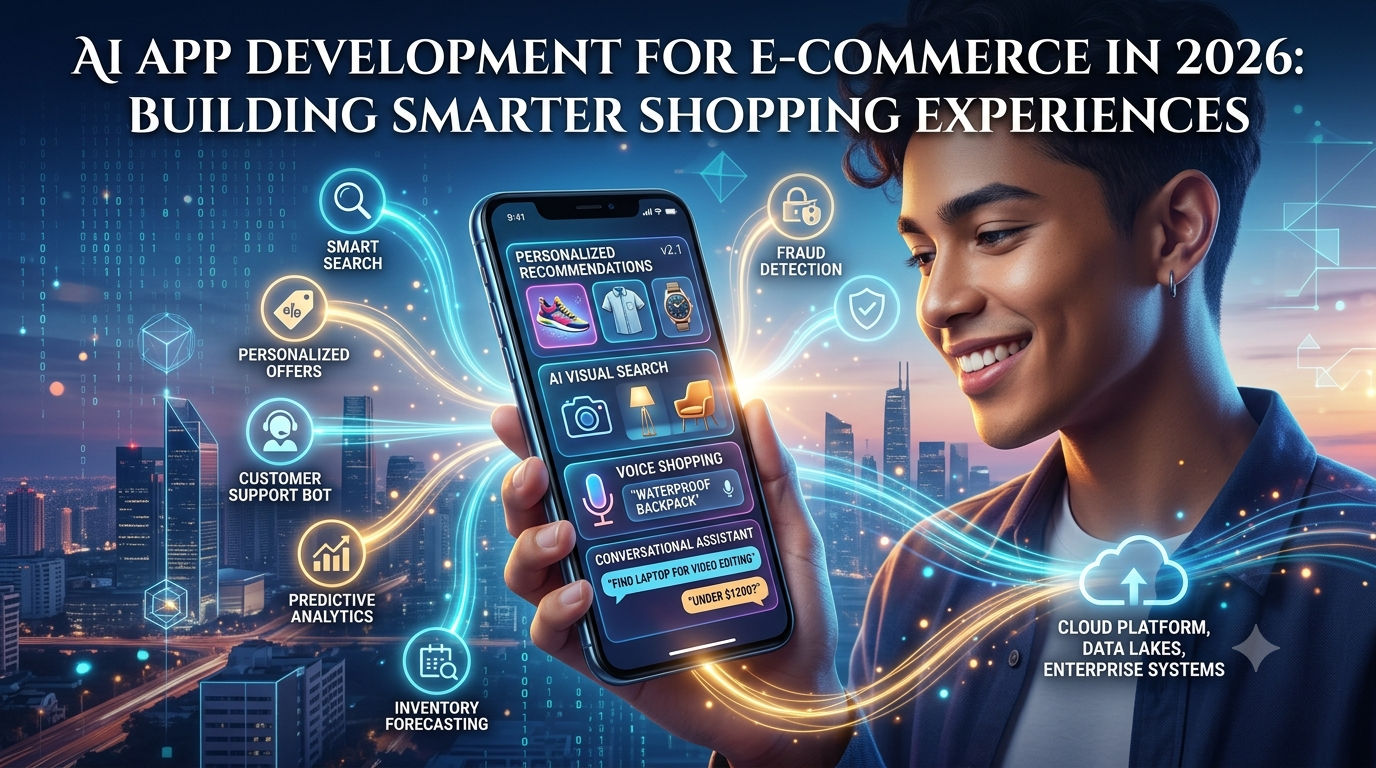
    AI App Development for E-Commerce in 2026: Building Smarter Shopping Experiences

    E-commerce is no longer just about displaying products, processing payments, and delivering orders. Customers increasingly expect shopping experiences that understand their needs, provide relevant recommendations, answer questions instantly, and reduce the effort required to find the right product.

    This is where AI app development for e-commerce is creating new opportunities.

    Modern AI-powered shopping applications can combine conversational AI, recommendation engines, computer vision, predictive analytics, voice interfaces, and intelligent automation to create more personalized customer experiences.

    In 2026, businesses can use AI not simply as a chatbot feature, but as an intelligent layer across the entire e-commerce application.

    What Is AI E-Commerce App Development?

    AI e-commerce app development is the process of building shopping applications that use artificial intelligence to improve customer experiences and automate business processes.

    An AI-powered e-commerce application can include:

    • AI product recommendations
    • Conversational shopping assistants
    • Visual product search
    • Voice search
    • Personalized offers
    • Customer-support automation
    • Product description generation
    • Inventory forecasting
    • Customer behavior analysis
    • AI-powered search
    • Fraud and anomaly detection
    • Marketing automation

    A typical architecture may look like:

    Customer → E-Commerce App → AI Layer → Product Data → Business Systems → Personalized Experience

    The exact architecture depends on the business model, product catalog, customer data, and required AI capabilities.

    Why AI Is Important for E-Commerce Apps in 2026

    Traditional e-commerce applications generally rely on predefined filters, categories, keywords, and recommendation rules.

    AI allows applications to understand more complex customer intent.

    For example, instead of searching:

    “Men’s black running shoes size 10”

    a customer might type:

    “I need comfortable black shoes for daily running under $100.”

    An AI-powered application can interpret the intent and potentially combine:

    • Product category
    • Budget
    • Color
    • Activity
    • Customer preferences
    • Product specifications
    • Previous interactions

    The result can be a more natural shopping experience.

    AI is also moving beyond conversational interfaces. Modern AI application architectures increasingly combine models with retrieval, tools, business data, and automated workflows.

    AI Product Recommendations

    One of the most common applications of AI in e-commerce is personalization.

    Instead of showing every customer identical products, an AI recommendation system can consider signals such as:

    • Browsing behavior
    • Purchase history
    • Product preferences
    • Search activity
    • Product interactions
    • Customer segments
    • Context

    For example:

    A customer purchases running shoes.

    The application may recommend:

    • Running socks
    • Sportswear
    • Insoles
    • Fitness accessories
    • Similar running products

    The goal is to make product discovery more relevant without overwhelming the customer with unrelated products.

    AI-Powered Product Search

    Search is one of the most important components of an e-commerce application.

    Traditional search often depends heavily on exact keywords.

    AI-powered search can understand semantic meaning and user intent.

    For example:

    “lightweight laptop for college students”

    could return products based on characteristics such as:

    • Weight
    • Battery life
    • Price
    • Portability
    • Performance
    • Student use case

    This can make product discovery more intuitive.

    Conversational Shopping Assistants

    AI shopping assistants can act as digital product advisors.

    A customer might ask:

    “Which laptop is better for video editing?”

    The AI application can analyze available product information and provide a comparison based on defined product attributes.

    A more advanced system could ask follow-up questions:

    • What is your budget?
    • Which software do you use?
    • Do you need portability?
    • How much storage do you need?

    The application can then narrow down suitable products.

    This transforms the shopping journey from:

    Search → Filter → Compare → Purchase

    into:

    Ask → Understand → Recommend → Compare → Purchase

    AI Visual Search

    Computer vision can create another powerful e-commerce experience.

    Instead of typing a product description, customers can upload an image.

    For example:

    Customer uploads a picture of a chair → AI analyzes the image → Application identifies visual characteristics → Similar products are displayed.

    Visual search can be useful for:

    • Fashion
    • Furniture
    • Home décor
    • Jewelry
    • Automotive parts
    • Electronics
    • Retail products

    AI-powered image understanding can help customers discover products that may be difficult to describe using words.

    Voice Search for Shopping Apps

    Voice interfaces are another area where AI can improve mobile commerce.

    A customer could say:

    “Find me a waterproof backpack under $80.”

    The application can convert speech into an intent and search the product catalog.

    Voice commerce can be particularly useful when users are:

    • Driving
    • Cooking
    • Working
    • Shopping hands-free
    • Using smart devices

    AI voice functionality can combine speech recognition, language understanding, product search, and text-to-speech.

    AI-Powered Customer Support

    Customer support is another strong use case.

    An AI support assistant can help answer questions about:

    • Orders
    • Shipping
    • Returns
    • Products
    • Payments
    • Account information
    • Store policies

    A typical workflow could be:

    Customer Question → AI Understands Intent → Retrieves Relevant Information → Generates Response

    If the issue requires human intervention, the system can escalate the conversation to a support representative.

    AI and Product Knowledge

    A major challenge for e-commerce AI is ensuring that the application uses accurate product information.

    A business may have:

    • Product catalogs
    • Specifications
    • FAQs
    • Manuals
    • Return policies
    • Shipping information
    • Inventory information

    Retrieval-Augmented Generation (RAG) can allow an AI system to retrieve relevant information before generating an answer.

    A simplified architecture is:

    Customer Question → Knowledge Search → Relevant Product Data → AI Model → Response

    This can be useful for product questions where generic AI knowledge is insufficient.

    AI for Personalized Shopping

    Personalization can extend beyond product recommendations.

    An AI application can potentially personalize:

    Homepage

    Display products and categories relevant to the customer.

    Search

    Prioritize results according to customer context.

    Notifications

    Send more relevant product or order updates.

    Offers

    Present promotions based on business rules and customer segments.

    Content

    Adapt product descriptions or educational content to customer needs.

    Personalization should be implemented with appropriate privacy, consent, and data-governance controls.

    AI for Inventory Forecasting

    AI isn’t limited to the customer-facing side of e-commerce.

    It can also support business operations.

    Inventory forecasting systems can analyze historical and current data to help businesses understand potential demand patterns.

    Possible inputs include:

    • Historical sales
    • Seasonal trends
    • Product demand
    • Promotions
    • Regional activity
    • Inventory levels
    • Order patterns

    The output can help businesses make more informed inventory decisions.

    AI predictions should be treated as decision-support rather than guaranteed forecasts.

    AI for E-Commerce Marketing

    AI applications can also support marketing teams.

    Potential use cases include:

    • Product description generation
    • Email personalization
    • Customer segmentation
    • Campaign analysis
    • SEO content assistance
    • Ad creative generation
    • Customer behavior analysis
    • Product recommendations

    For example, an e-commerce business could use AI to generate an initial product description from structured product information and then apply editorial review before publishing.

    AI Fraud and Anomaly Detection

    E-commerce businesses process large volumes of transactions and user activity.

    AI-based anomaly detection can help identify unusual patterns.

    Potential signals include:

    • Unusual transaction behavior
    • Multiple rapid transactions
    • Account activity anomalies
    • Suspicious purchasing patterns
    • Abnormal login behavior

    AI systems can flag activity for additional verification or human review.

    For payment-related decisions, businesses should combine AI with established security, fraud-prevention, and compliance systems rather than relying solely on model output.

    AI-Powered E-Commerce Mobile Apps

    Mobile commerce continues to provide an important environment for AI features.

    Businesses can integrate AI into:

    • iOS shopping applications
    • Android shopping applications
    • Cross-platform apps
    • Tablet applications

    Features can include:

    • AI search
    • Voice shopping
    • Visual search
    • Personalized recommendations
    • AI chat
    • Smart notifications
    • Product comparison
    • Customer support
    • Personalized content

    An AI-first mobile architecture can combine on-device processing with cloud-based AI depending on the feature and requirements. AIAppDevelopers describes this type of architecture as combining mobile UX, edge processing, RAG/orchestration, and enterprise data infrastructure.

    AI E-Commerce App Architecture

    A modern AI-powered e-commerce application can include several layers.

    Frontend

    The customer interface may be developed for:

    • iOS
    • Android
    • Web
    • Cross-platform mobile
    • Tablet

    Backend

    The backend manages:

    • Authentication
    • Customer accounts
    • Orders
    • Product data
    • Business rules
    • APIs
    • Payments
    • Inventory

    AI Layer

    The AI layer can contain:

    • Large language models
    • Recommendation models
    • Vision models
    • Speech models
    • Embedding models
    • Predictive models

    Knowledge Layer

    This may include:

    • Product databases
    • Vector databases
    • FAQs
    • Product documentation
    • Customer information
    • Business policies

    Integration Layer

    The application may connect to:

    • CRM
    • ERP
    • Payment gateways
    • Inventory systems
    • Shipping platforms
    • Marketing platforms
    • Customer-support systems

    Challenges in AI E-Commerce App Development

    AI can create significant opportunities, but businesses need to plan carefully.

    Incorrect AI Responses

    Generative AI can sometimes produce inaccurate information.

    Product recommendations and customer answers should therefore be grounded in reliable business data.

    Data Privacy

    E-commerce applications may process:

    • Customer information
    • Purchase history
    • Addresses
    • Payment-related information
    • Behavioral data

    Appropriate security and privacy controls are essential.

    AI Costs

    AI features create ongoing infrastructure and model costs.

    Businesses should consider:

    • Model selection
    • API usage
    • Caching
    • Request volume
    • Data retrieval
    • Infrastructure

    Integration Complexity

    AI must often work alongside existing e-commerce infrastructure.

    Connecting:

    AI + Product Catalog + Inventory + CRM + Orders + Payments + Shipping

    can be more complex than implementing an isolated AI chatbot.

    Response Speed

    Customers generally expect fast shopping experiences.

    Developers may use techniques such as:

    • Streaming
    • Caching
    • Efficient retrieval
    • Model selection
    • On-device processing
    • Asynchronous workflows

    to improve performance.

    How to Build an AI-Powered E-Commerce App

    A practical development process can follow these stages.

    Step 1: Identify the Business Goal

    Determine what the AI application should improve.

    For example:

    • Increase product discovery
    • Improve customer support
    • Reduce manual work
    • Improve personalization
    • Automate product content

    Step 2: Define AI Features

    Choose the features that directly support the business objective.

    Step 3: Prepare Data

    Organize:

    • Product data
    • Customer data
    • Business policies
    • FAQs
    • Inventory information

    Step 4: Select AI Models

    Choose models according to:

    • Accuracy
    • Cost
    • Latency
    • Data type
    • Deployment requirements

    Step 5: Build the MVP

    Start with a focused feature set.

    For example:

    AI Product Search + Recommendation Engine

    can be developed before adding voice, visual search, and autonomous workflows.

    Step 6: Integrate Business Systems

    Connect the AI application to product catalogs, CRM, inventory, order systems, and other required platforms.

    Step 7: Test

    Evaluate:

    • AI accuracy
    • Search relevance
    • Recommendation quality
    • Performance
    • Security
    • User experience

    Step 8: Launch and Optimize

    Monitor real-world usage and continuously improve the application.

    How Much Does AI E-Commerce App Development Cost?

    The cost of an AI-powered e-commerce application depends on its architecture and feature set.

    Factors include:

    • Number of platforms
    • UI/UX requirements
    • AI models
    • Product catalog size
    • RAG implementation
    • Recommendation engine
    • Computer vision
    • Voice functionality
    • Third-party integrations
    • Backend infrastructure
    • Security requirements
    • User volume

    A basic AI shopping assistant and a full AI commerce platform can require very different development investments.

    A detailed technical specification should therefore be prepared before finalizing a development budget.

    Why Choose an AI App Development Company?

    AI e-commerce development requires expertise across multiple areas.

    A development team may need experience with:

    • AI application development
    • Mobile development
    • Web development
    • LLM integration
    • RAG
    • Recommendation systems
    • Computer vision
    • Voice AI
    • Backend development
    • API integration
    • Cloud infrastructure
    • Security

    AIAppDevelopers’ published architecture emphasizes combining mobile engineering with AI orchestration, retrieval, edge processing, and enterprise infrastructure rather than treating AI as an isolated feature.

    This approach can be useful for businesses building AI into a larger e-commerce ecosystem.

    The Future of AI E-Commerce Apps

    The next generation of shopping applications is likely to become increasingly conversational and intelligent.

    Customers may be able to say:

    “Find me a complete home-office setup under $1,500.”

    Instead of manually searching for each item, an AI-powered application could potentially understand the request, search the product catalog, compare products, check availability, and present suitable combinations.

    The application could also combine:

    • Text
    • Voice
    • Images
    • Product data
    • Customer preferences
    • Business rules
    • Real-time inventory

    This creates a shopping experience where AI becomes part of the entire customer journey.

    Conclusion

    AI app development for e-commerce in 2026 is changing how customers discover products, communicate with businesses, and complete purchases.

    From AI product recommendations and semantic search to visual search, voice commerce, customer support, and intelligent inventory systems, AI can become an important layer across the entire e-commerce ecosystem.

    The key is to start with a real business problem.

    Instead of adding AI simply because it is trending, businesses should identify the customer or operational workflow where intelligent software can create measurable value.

    With the right architecture, data, AI models, integrations, and user experience, an AI-powered e-commerce application can become more than an online store—it can become an intelligent shopping platform.

    Ready to build an AI-powered e-commerce application? AIAppDevelopers can help transform your idea into a scalable AI-driven digital product.

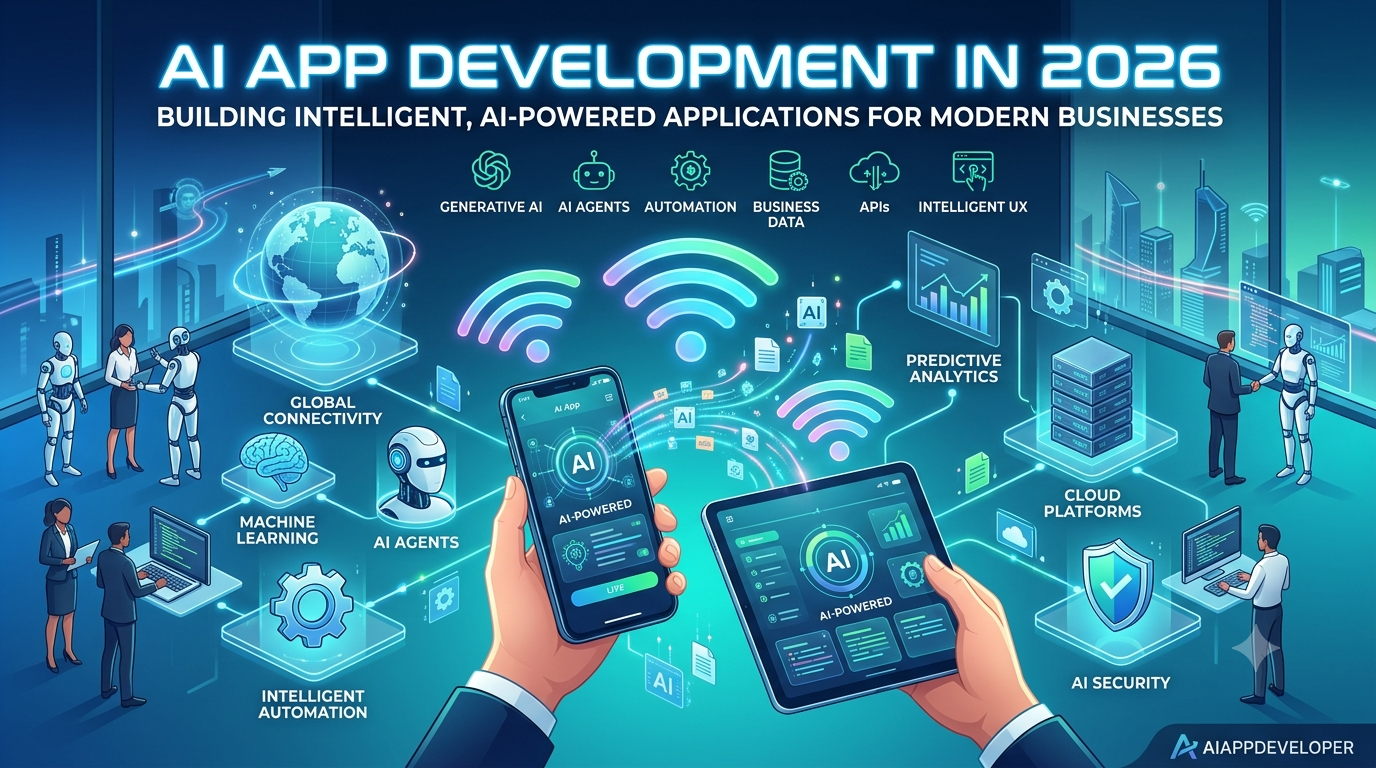
  • AI App Development in 2026: Building Intelligent, AI-Powered Applications for Modern Businesses

    AI App Development in 2026: Building Intelligent, AI-Powered Applications for Modern Businesses

    Artificial intelligence is changing the way businesses build and use software. Applications are moving beyond traditional interfaces and rule-based workflows toward systems that can understand natural language, analyze data, generate content, automate tasks, and support complex business processes.

    In 2026, AI app development is increasingly focused on building applications that combine generative AI, AI agents, automation, business data, APIs, and intelligent user experiences.

    For businesses, the goal is no longer simply to add a chatbot to an existing application. Modern AI applications can be designed to solve specific business problems, automate workflows, provide personalized experiences, and help users make data-driven decisions.

    What Is AI App Development?

    AI app development is the process of creating software applications that use artificial intelligence technologies to perform tasks that traditionally require human interaction or decision-making.

    Depending on the use case, an AI application can include:

    • Generative AI
    • Machine learning
    • Natural language processing
    • Computer vision
    • Speech recognition
    • AI agents
    • Recommendation systems
    • Predictive analytics
    • Intelligent automation
    • Large language models
    • Retrieval-augmented generation (RAG)

    These technologies can be integrated into mobile applications, web platforms, enterprise software, SaaS products, and IoT systems.

    Why AI App Development Matters in 2026

    AI is increasingly becoming part of mainstream enterprise software rather than remaining limited to experimental projects. Industry research in 2026 points toward greater adoption of AI agents, AI-native architectures, and AI-powered workflows.

    Businesses are exploring AI applications for:

    • Automating repetitive tasks
    • Improving customer support
    • Analyzing large datasets
    • Generating content
    • Personalizing user experiences
    • Supporting employees
    • Detecting anomalies
    • Improving decision-making
    • Automating business workflows

    The most useful AI applications typically start with a clearly defined business problem rather than simply adding AI because it is available.

    Popular Types of AI Applications

    1. Generative AI Applications

    Generative AI applications can create new content based on user input and available context.

    Examples include:

    • AI writing assistants
    • Image generation platforms
    • AI coding applications
    • Document analysis tools
    • Marketing assistants
    • Business intelligence assistants

    Generative AI can be integrated into existing software or used as the foundation of an entirely new product.

    2. AI Chatbot Applications

    AI-powered chatbots can provide conversational interfaces for customers and employees.

    Modern chatbots can potentially:

    • Answer questions
    • Search company knowledge
    • Summarize documents
    • Support customers
    • Generate responses
    • Assist employees
    • Connect with business systems

    A production chatbot should be designed around reliable data, appropriate access controls, monitoring, and human escalation where needed.

    3. AI Agent Applications

    One of the major developments in 2026 is the movement toward AI agents.

    Unlike a traditional chatbot that primarily responds to questions, an AI agent can be designed to understand a goal, plan a sequence of actions, use tools, retrieve information, and complete defined tasks under appropriate controls.

    Google Cloud describes 2026 as a period in which agentic workflows are increasingly being used for multi-step business processes.

    Possible applications include:

    • Customer-service agents
    • Sales assistants
    • Research agents
    • IT support agents
    • Data-analysis agents
    • Scheduling agents
    • Workflow automation agents

    AI agents should still operate within clearly defined permissions and business rules.

    AI-Powered Mobile App Development

    AI can transform conventional mobile applications into more intelligent products.

    An AI-powered mobile application might provide:

    • Voice interaction
    • Personalized recommendations
    • Intelligent search
    • Image recognition
    • Predictive notifications
    • AI assistants
    • Automated content generation
    • Personalized user experiences

    For example, a fitness application could analyze user activity and generate personalized recommendations, while an e-commerce application could provide conversational product discovery.

    AI + IoT App Development

    AI becomes particularly powerful when combined with connected-device data.

    A typical architecture can look like:

    IoT Device → Mobile App → API → Cloud → AI Model → Analytics / Automation

    AI can analyze data from connected devices to identify patterns, detect anomalies, or trigger automated actions.

    Potential applications include:

    • Smart homes
    • Industrial IoT
    • Predictive maintenance
    • Wearables
    • Healthcare monitoring
    • Smart buildings
    • Connected vehicles

    This creates opportunities for businesses developing integrated AI, IoT, and mobile applications.

    AI-Powered Business Automation

    AI applications can automate workflows that traditionally require multiple manual steps.

    For example:

    Customer Request → AI Classification → Data Retrieval → Decision Support → Workflow Action → Human Approval

    Depending on the application, AI can interact with APIs and enterprise systems to perform specific actions.

    This approach can help organizations move from simple AI assistants toward more integrated intelligent workflows.

    Retrieval-Augmented Generation for AI Apps

    AI applications often need access to company-specific information.

    A general-purpose language model may not automatically know an organization’s latest internal information.

    Retrieval-Augmented Generation (RAG) can address this by allowing an AI application to retrieve relevant information from approved knowledge sources before generating a response.

    A RAG architecture may include:

    • Documents
    • Databases
    • APIs
    • Vector databases
    • Embedding models
    • Retrieval systems
    • AI models
    • Application interfaces

    This can be useful for:

    • Enterprise knowledge assistants
    • Customer support
    • Document search
    • Internal research
    • Product information
    • Technical documentation

    Multimodal AI Applications

    AI applications are increasingly capable of working with multiple forms of information.

    A multimodal application can potentially process:

    • Text
    • Images
    • Audio
    • Video
    • Documents
    • Structured data

    For example, a healthcare-related application might combine text and image inputs, while a manufacturing application could combine sensor data, images, and maintenance records.

    The exact capabilities depend on the selected AI models and application architecture.

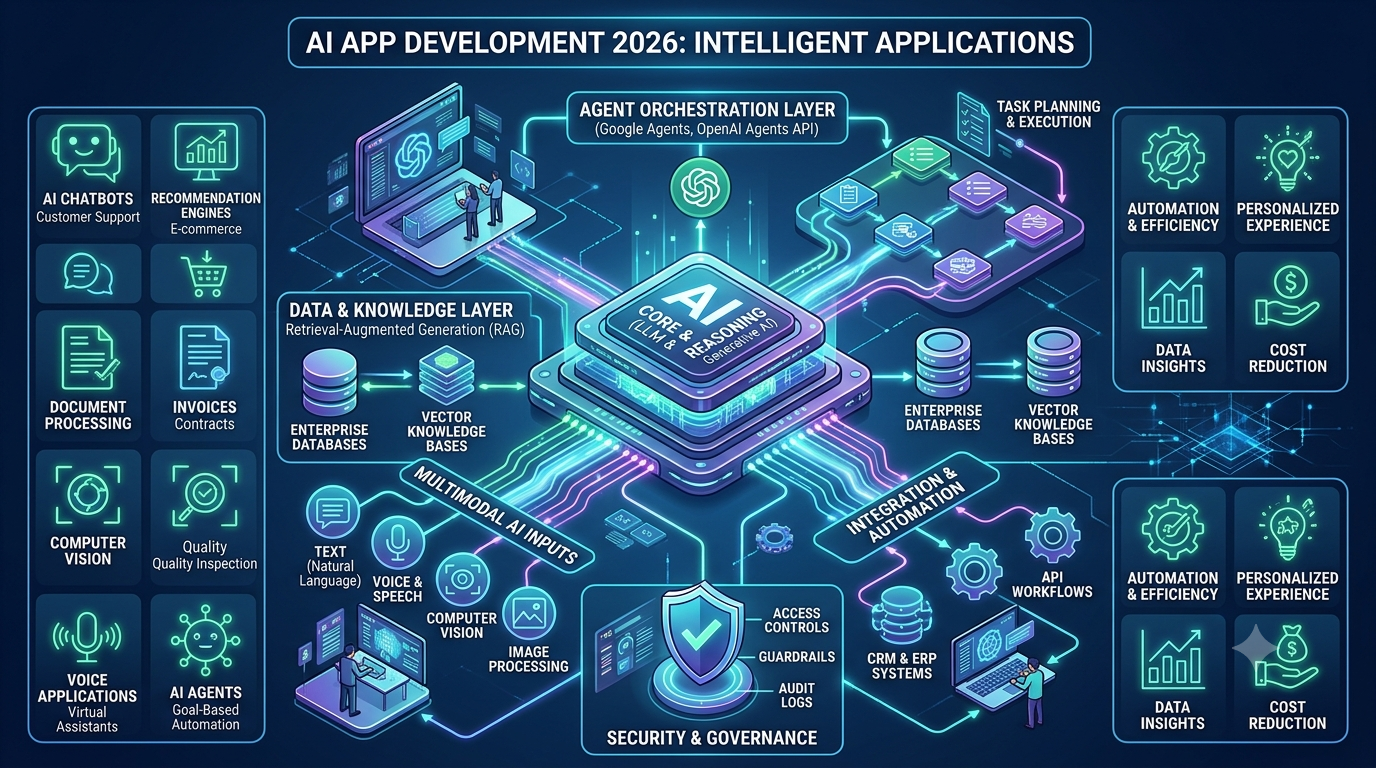
    AI App Development Architecture

    A modern AI application can contain several layers.

    User Interface

    The frontend can be a:

    • Mobile application
    • Web application
    • Enterprise dashboard
    • Voice interface
    • Conversational interface

    Application Layer

    This layer manages:

    • Authentication
    • Business logic
    • User requests
    • AI orchestration
    • Workflow management
    • API integrations

    AI Layer

    The AI layer can include:

    • Foundation models
    • Machine-learning models
    • AI agents
    • Embedding models
    • Classification models
    • Computer-vision models

    Data Layer

    The application may connect to:

    • SQL databases
    • NoSQL databases
    • Vector databases
    • Data warehouses
    • Enterprise knowledge bases

    Integration Layer

    APIs and connectors allow AI applications to communicate with external systems.

    This architecture enables AI to become part of the complete business workflow rather than functioning as an isolated feature.

    AI App Security and Privacy

    Security needs to be considered from the beginning of AI application development.

    Important areas include:

    • User authentication
    • Authorization
    • Data encryption
    • API security
    • Access control
    • Secure prompt handling
    • Sensitive-data protection
    • Model access controls
    • Audit logging
    • Monitoring

    AI agents introduce additional considerations because they may have permission to access systems or perform actions.

    Deloitte’s 2026 enterprise AI research highlights that AI-agent adoption is advancing while governance maturity is not keeping pace in many organizations.

    For this reason, AI applications should use appropriate guardrails, permission boundaries, testing, monitoring, and human oversight.

    AI App Development Process

    A structured development process can help businesses move from an AI idea to a production application.

    Step 1: Identify the Business Problem

    Start by defining the problem the AI application needs to solve.

    Ask:

    • What task should AI improve?
    • Who will use the application?
    • What data is required?
    • What outcome should the system produce?

    Step 2: Select the AI Approach

    Determine whether the application needs:

    • Generative AI
    • Machine learning
    • RAG
    • Computer vision
    • Speech AI
    • AI agents
    • Predictive analytics

    Not every application needs the same AI technology.

    Step 3: Design the Architecture

    Define the relationship between:

    Frontend + Backend + AI Model + Data + APIs + Security

    Step 4: Develop the MVP

    Build a focused version of the application that validates the core use case.

    Step 5: Integrate Business Data

    Connect the AI system with approved databases, documents, APIs, or other information sources.

    Step 6: Test the AI Application

    Testing should cover both traditional software quality and AI-specific behavior.

    Areas can include:

    • Accuracy
    • Reliability
    • Security
    • Response quality
    • Hallucination risks
    • API failures
    • Performance
    • Access controls
    • Cost

    Step 7: Deploy and Monitor

    After deployment, AI applications require ongoing monitoring.

    Models, data, user behavior, costs, and application requirements can change over time.

    How Much Does AI App Development Cost?

    There is no single price for AI application development.

    Development costs depend on factors such as:

    • Application complexity
    • AI model requirements
    • Number of platforms
    • Custom AI model development
    • API integrations
    • Data requirements
    • RAG implementation
    • AI agent functionality
    • Security requirements
    • Cloud infrastructure
    • User volume
    • Ongoing AI inference costs

    A simple AI assistant can have a very different development scope from a multi-agent enterprise platform.

    Businesses should therefore define the required functionality and technical architecture before creating a detailed budget.

    Choosing an AI App Development Company

    When selecting an AI app development company, businesses should evaluate experience across both traditional software development and AI engineering.

    Important capabilities can include:

    • AI application development
    • Generative AI integration
    • AI agent development
    • Machine learning
    • Mobile app development
    • Web application development
    • RAG implementation
    • API integration
    • Cloud architecture
    • Data engineering
    • AI security
    • Application maintenance

    The development team should also understand that successful AI projects require more than model selection. Data quality, workflow design, application architecture, security, and monitoring all affect the final product.

    The Future of AI App Development

    AI applications are moving toward more intelligent and action-oriented experiences.

    Industry research in 2026 highlights several important directions, including agentic AI, domain-specific models, multimodal AI, AI-native architecture, and intelligent workflow automation.

    The future of AI application development is likely to include:

    • AI-native applications
    • Autonomous task execution
    • Multi-agent workflows
    • Voice-first interfaces
    • Multimodal applications
    • Personalized AI assistants
    • AI-powered enterprise software
    • AI + IoT applications
    • Intelligent automation
    • Human-AI collaboration

    However, successful adoption will depend on more than technological capability. Businesses will also need reliable data, appropriate governance, security controls, and clear business objectives.

    Conclusion

    AI app development in 2026 is moving beyond simple chatbots and isolated AI features. Businesses are building applications that combine generative AI, AI agents, machine learning, RAG, multimodal capabilities, automation, APIs, and enterprise data.

    For companies planning an AI-powered product, the most important starting point is a clearly defined business problem and a practical technical strategy.

    Whether you are building an AI mobile app, AI chatbot, enterprise AI platform, AI agent, recommendation engine, or AI-powered SaaS product, the right architecture can help transform an idea into a scalable application.

    AIAppDeveloper can help businesses explore AI application concepts, intelligent automation, AI agent development, and custom AI-powered software solutions designed around specific business requirements.

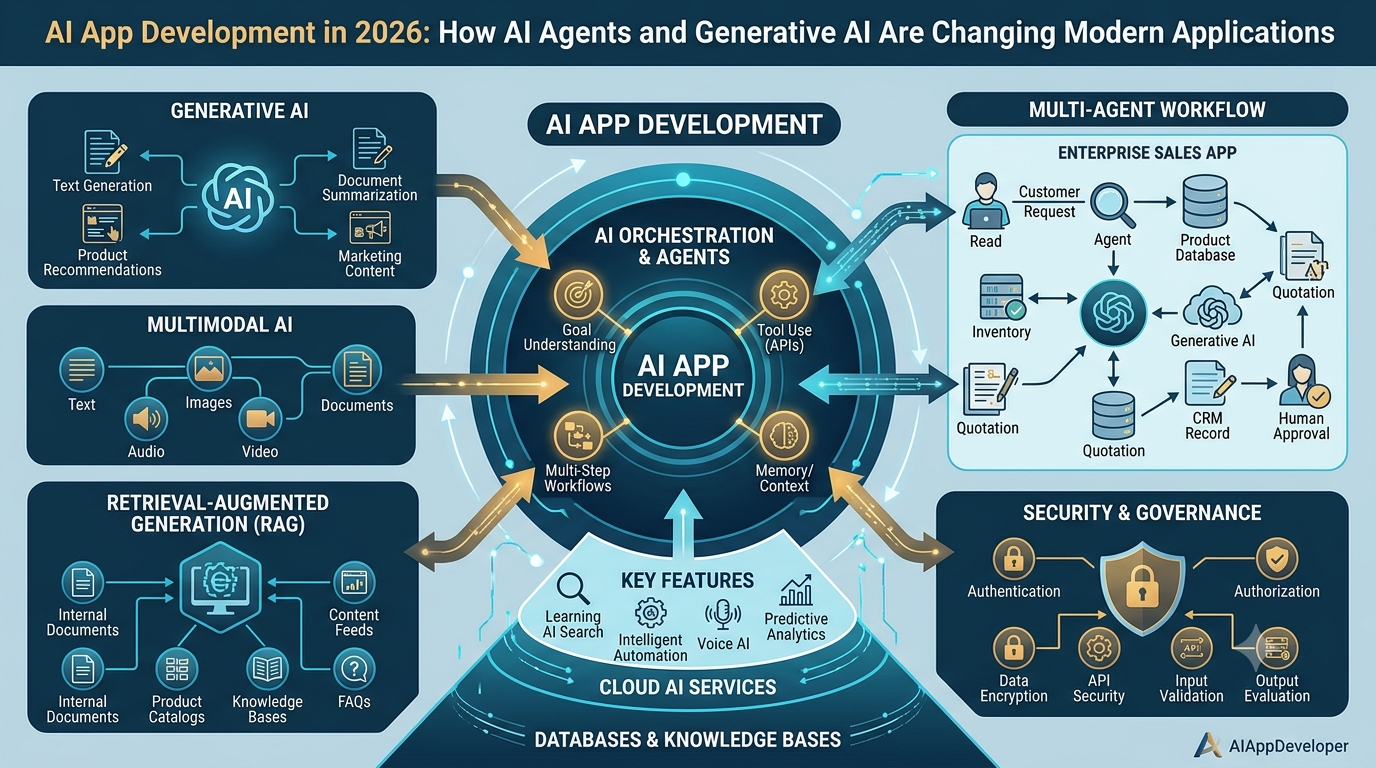
  • AI App Development in 2026: How AI Agents and Generative AI Are Changing Modern Applications

    AI App Development in 2026: How AI Agents and Generative AI Are Changing Modern Applications

    Artificial intelligence is changing the way modern software is designed, developed, and used. In 2026, businesses are moving beyond basic chatbots and experimenting with applications that can understand context, generate content, analyze data, automate workflows, and take actions on behalf of users.

    This shift is creating demand for AI app development that combines large language models, machine learning, generative AI, AI agents, APIs, cloud platforms, and traditional application architecture.

    For startups and enterprises, the opportunity is no longer simply to “add AI” to an existing application. The bigger opportunity is to build software around intelligent workflows from the beginning.

    What Is AI App Development?

    AI app development is the process of creating mobile, web, or enterprise applications that use artificial intelligence to perform tasks such as prediction, personalization, automation, natural-language interaction, recommendation, content generation, and decision support.

    An AI-powered application can combine:

    • Generative AI
    • Large language models
    • Machine learning
    • Natural language processing
    • Computer vision
    • Speech recognition
    • AI agents
    • Retrieval-augmented generation (RAG)
    • Cloud AI services
    • Business APIs
    • Databases and knowledge bases

    A modern architecture can connect the user interface with AI models, business data, APIs, and automation systems to produce either an intelligent response or an actual business action.

    Why AI App Development Is Growing in 2026

    AI is increasingly becoming part of mainstream application development. Salesforce’s 2026 IT research reports that nearly 40% of new applications already include AI features, while AI agents are increasingly being incorporated into business and IT workflows.

    At the same time, Gartner projects worldwide spending on AI models and platforms to reach approximately $64 billion in 2026, with particularly strong growth in specialized generative AI models and AI application development platforms.

    This growth is encouraging businesses to explore AI applications for:

    • Customer service
    • Healthcare
    • Finance
    • Retail
    • E-commerce
    • Education
    • Marketing
    • Logistics
    • Manufacturing
    • Enterprise operations
    • Productivity

    AI Agents Are Becoming a Major Part of AI Applications

    One of the biggest changes in AI application development is the transition from conversational systems to AI agents.

    A traditional chatbot may answer a customer’s question.

    An AI agent can potentially understand a goal, retrieve information, use connected tools, perform multiple steps, and complete an approved task.

    For example, an enterprise sales application could allow an AI agent to:

    1. Read a customer request.
    2. Search the company’s product database.
    3. Check inventory.
    4. Generate a quotation.
    5. Update a CRM record.
    6. Send the quotation for human approval.

    Google Cloud identifies agentic workflows and multi-agent collaboration as important areas of AI development in 2026.

    This makes AI agent development an important consideration for companies building next-generation applications.

    Generative AI Is Moving Beyond Chatbots

    Generative AI has become one of the most visible components of modern AI software.

    Businesses can integrate generative AI into applications for:

    • Text generation
    • Document summarization
    • Product recommendations
    • Marketing content
    • Code assistance
    • Knowledge search
    • Customer support
    • Data analysis
    • Report generation
    • Personalized experiences

    However, successful generative AI applications require more than connecting an app to an AI model.

    The application also needs reliable data, appropriate prompts, access controls, monitoring, evaluation, and integration with business systems.

    Multimodal AI Applications

    Another important development is multimodal AI.

    Instead of working only with text, multimodal applications can process combinations of:

    • Text
    • Images
    • Audio
    • Video
    • Documents
    • Structured business data

    For example, an insurance application could allow a user to upload an image of vehicle damage and provide additional information through voice or text.

    A healthcare application could combine documents, images, and structured patient information to assist authorized professionals.

    This opens new opportunities for AI application development across industries.

    Retrieval-Augmented Generation for Business Applications

    For enterprise applications, AI responses often need to be based on company-specific information.

    This is where Retrieval-Augmented Generation (RAG) can become useful.

    A RAG-based application can retrieve relevant information from approved business sources before generating a response.

    Possible sources include:

    • Internal documents
    • Product catalogs
    • Knowledge bases
    • FAQs
    • Databases
    • Policies
    • Technical documentation
    • Customer records

    This approach can help businesses build AI applications that are more closely connected to their own information rather than relying solely on a general-purpose model.

    AI-Powered Personalization

    Modern applications can use AI to create more personalized experiences.

    For example, an e-commerce application can analyze user interactions and recommend products based on browsing behavior, purchase history, preferences, and other permitted signals.

    Similarly, an education application can personalize learning content according to a student’s progress.

    AI personalization can be applied to:

    • Product recommendations
    • Search results
    • Content feeds
    • Learning paths
    • Marketing campaigns
    • Customer support
    • User interfaces

    AI-Native Application Architecture

    AI is also influencing application architecture itself.

    Instead of treating AI as a small feature inside an otherwise traditional application, businesses can design applications around AI-driven workflows.

    A modern AI application may include:

    User Interface → Application Backend → AI Orchestration → Model/API Layer → Business Data → External Tools

    This architecture can support AI agents, RAG pipelines, multiple models, business APIs, analytics, and automation.

    SAP’s 2026 analysis describes this broader movement toward AI-native architecture, where applications increasingly combine AI capabilities with business data, reasoning, and workflows.

    Key Features of Modern AI Applications

    Businesses considering custom AI app development can explore features such as:

    1. AI Chat Interfaces

    Natural-language interfaces allow users to interact with applications using conversational commands.

    2. AI Search

    Users can search business information using natural-language questions instead of traditional keywords.

    3. AI Recommendations

    Machine learning can analyze permitted user and business data to generate personalized recommendations.

    4. Intelligent Automation

    AI can automate repetitive workflows and route tasks between systems.

    5. AI Agents

    Agents can coordinate multiple steps and interact with approved APIs and tools.

    6. Voice AI

    Voice interfaces can enable hands-free interaction with mobile and web applications.

    7. Computer Vision

    Image and video analysis can support applications in retail, manufacturing, healthcare, security, and logistics.

    8. Predictive Analytics

    Machine learning models can identify patterns and generate forecasts from historical data.

    Security Should Be Built Into AI App Development

    AI applications often interact with sensitive business and customer information. Security therefore needs to be considered during architecture and development rather than added at the end.

    Important areas include:

    • Authentication
    • Authorization
    • Data encryption
    • API security
    • Access controls
    • Prompt and input validation
    • Model monitoring
    • Data privacy
    • Audit logging
    • Human approval for high-impact actions
    • AI output evaluation

    AI adoption is also increasing the importance of governance and security because organizations need visibility into how AI systems access data and perform actions.

    How to Build an AI Application in 2026

    A practical AI app development process can include the following stages.

    Step 1: Define the Business Problem

    Start with the problem rather than the AI model.

    Determine what the application needs to improve, automate, predict, or simplify.

    Step 2: Identify the AI Use Case

    Decide whether the application requires:

    • Generative AI
    • Machine learning
    • Computer vision
    • Voice AI
    • AI agents
    • RAG
    • Predictive analytics
    • A combination of technologies

    Step 3: Prepare the Data

    Data quality has a major impact on AI application performance.

    Businesses should identify the required data sources, remove unnecessary duplication, establish access controls, and create appropriate data pipelines.

    Step 4: Select the AI Architecture

    Choose the appropriate combination of models, APIs, databases, cloud infrastructure, orchestration, and application components.

    Step 5: Build the MVP

    Develop a focused version of the application around the most important use case.

    This makes it easier to test usability, AI performance, security, and business value.

    Step 6: Integrate Business Systems

    AI applications often become more useful when they connect with existing:

    • CRM systems
    • ERP platforms
    • Payment systems
    • Databases
    • E-commerce platforms
    • Communication tools
    • Enterprise APIs

    Step 7: Test and Evaluate

    AI applications require testing beyond traditional software testing.

    Teams should evaluate:

    • Accuracy
    • Reliability
    • Response quality
    • Latency
    • Security
    • Cost
    • Hallucination risk
    • User experience

    Step 8: Deploy and Monitor

    After deployment, continuously monitor application performance, model behavior, infrastructure costs, security events, and user feedback.

    AI App Development for Startups and Enterprises

    The requirements of an AI startup can differ significantly from those of a large enterprise.

    A startup may prioritize:

    • Faster MVP development
    • Product-market validation
    • Scalable architecture
    • Lower initial infrastructure costs
    • Rapid experimentation

    An enterprise may require:

    • Existing system integration
    • Advanced security
    • Data governance
    • Role-based access
    • Compliance requirements
    • Monitoring
    • Multi-model architecture
    • Enterprise scalability

    A capable AI app development company should therefore design the technology stack around the application’s actual requirements rather than forcing every project into the same architecture.

    How Much Does AI App Development Cost?

    The cost of AI app development depends on several factors, including:

    • Application complexity
    • Number of platforms
    • AI model requirements
    • Custom machine learning
    • AI agent functionality
    • RAG implementation
    • Third-party API integrations
    • Cloud infrastructure
    • Security requirements
    • Data engineering
    • UI/UX complexity
    • Testing and maintenance

    A simple AI-enabled application and a large enterprise AI platform can have completely different development requirements.

    For this reason, businesses should first define the product scope and technical architecture before estimating the development budget.

    The Future of AI App Development

    The next phase of AI application development is likely to focus increasingly on intelligent agents, specialized models, multimodal systems, AI-native architecture, and applications capable of completing multi-step workflows.

    Gartner highlights agentic AI, multimodal capabilities, domain-specific models, and smaller reasoning models as important emerging directions for generative AI.

    For businesses, the key question is becoming less about whether AI should be used and more about where AI can create measurable value inside the product or workflow.

    Build Your AI Application With AIAppDeveloper

    Developing a successful AI application requires more than connecting an API to a chatbot interface.

    The right solution combines AI app development, software engineering, data architecture, AI model integration, user experience, security, and scalable infrastructure.

    AIAppDeveloper can help businesses explore and build intelligent applications around their specific requirements, from AI-powered features and generative AI applications to intelligent automation and AI agent solutions.

    If you are planning an AI product in 2026, start with the business problem, define the AI use case, and build an architecture that can scale with your product.

    SEO Keywords

    Primary Keyword: AI app development

    Secondary Keywords:
    AI app development company, AI application development, AI app developers, custom AI app development, AI software development, AI agent development, generative AI app development, AI-powered applications, machine learning app development, AI mobile app development, AI web application development, multimodal AI development, RAG application development, enterprise AI development, AI chatbot development, AI automation solutions, AI development services.

    Suggested SEO Title

    AI App Development in 2026: AI Agents, Generative AI & More

    Meta Description

    Explore AI app development in 2026, including AI agents, generative AI, RAG, multimodal applications, personalization, automation, security, and enterprise AI solutions.

    Suggested URL

    /blogs/ai-app-development-2026-ai-agents-generative-ai/

    Suggested Internal Backlinks

    • AI app development → AIAppDeveloper.ai
    • AI app development company → AIAppDevelopers.ai
    • AI agent development → relevant AI service page
    • custom AI app development → relevant development/service page
    • AI software development → Quartus Technology
    • IoT AI solutions → BLEIoT / IoTBLE
    • custom POS software development → CustomPOS Developers
  • 10 Things Every AI App Developer Hears That Sound Funny in 2026

    10 Things Every AI App Developer Hears That Sound Funny in 2026

    AI is everywhere.

    AI writes code.

    AI creates images.

    AI answers questions.

    AI summarizes meetings.

    AI analyzes data.

    AI can even write an email explaining why you didn’t finish the meeting notes.

    And yet, when you tell someone you’re an AI app developer, the first question is often:

    “So… can you build me an AI that does everything?”

    Well, technically…

    Let’s talk about it.

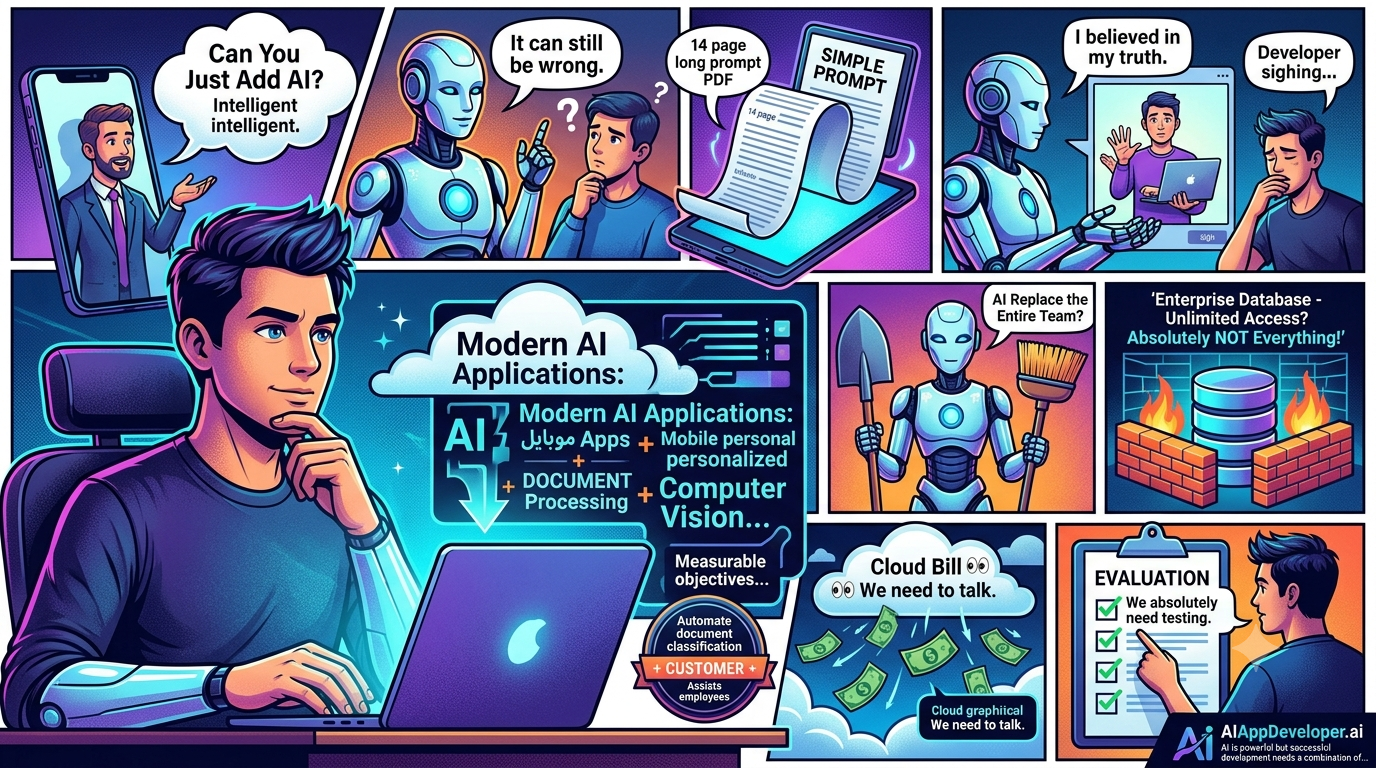
    1. “Can You Just Add AI?”

    Client:

    “The app is almost finished. Can we just add AI?”

    Developer:

    “Sure. What should the AI do?”

    Client:

    “Make it intelligent.”

    Developer:

    “Intelligent how?”

    Client:

    “You know… AI intelligent.”

    And that’s when the requirements meeting begins.

    AI isn’t a magic button.

    An effective AI application needs a clear use case, appropriate models, quality data, integrations, security, testing, monitoring, and a good user experience.

    2. The AI Knows Everything

    User:

    “Does AI know everything?”

    Developer:

    “No.”

    User:

    “But it’s AI.”

    Developer:

    “It can still be wrong.”

    User:

    “Really?”

    Developer:

    “Yes.”

    User:

    “Then why did it answer so confidently?”

    Developer:

    “That’s a very good question.”

    Modern AI applications can be powerful, but AI-generated answers still need appropriate validation, especially in business-critical applications.

    3. “Make the Chatbot Sound Human”

    Client:

    “We need a chatbot that sounds exactly like a human.”

    Developer:

    “Okay.”

    Client:

    “And it should understand everything.”

    Developer:

    “Okay.”

    Client:

    “And never make mistakes.”

    Developer:

    “Okay.”

    Client:

    “And it should answer instantly.”

    Developer:

    “Would you like it to make coffee too?”

    A good AI chatbot requires more than connecting a language model to a chat window.

    It may involve:

    • Natural language processing
    • Retrieval-augmented generation
    • Knowledge bases
    • API integrations
    • Conversation memory
    • Authentication
    • Security
    • Monitoring
    • Human escalation

    4. The Prompt Is 14 Pages Long

    Developer:

    “What prompt are you using?”

    AI enthusiast:

    “It’s simple.”

    Developer:

    “Okay.”

    They open the prompt.

    Page 1…

    Page 2…

    Page 7…

    Page 14…

    Developer:

    “That’s not a prompt. That’s a novel.”

    Prompt engineering can be useful, but building reliable AI applications often requires architecture beyond increasingly complicated instructions.

    5. “AI Will Replace the Entire Team”

    Someone says:

    “AI will replace all developers.”

    Developers:

    “Interesting.”

    Then AI generates code.

    Developer reviews it.

    Fixes three bugs.

    Changes the architecture.

    Updates the security logic.

    Adds error handling.

    Tests the integration.

    Reviews the output again.

    Developer:

    “So who’s reviewing the AI?”

    AI:

    “Apparently you.”

    AI-assisted development can improve productivity, but human oversight remains important for architecture, security, testing, business logic, and quality.

    6. The AI Image Problem

    User:

    “Generate a picture of a person holding a laptop.”

    AI:

    Done.

    User:

    “Great! Now make the laptop look realistic.”

    AI:

    Done.

    User:

    “Why does the person have six fingers?”

    Developer:

    “Let’s not focus on that.”

    AI image generation has improved dramatically, but generated content can still contain unexpected details.

    7. “Can AI Read Our Entire Database?”

    Client:

    “Can we connect the AI to our database?”

    Developer:

    “Yes, depending on the architecture and data.”

    Client:

    “Excellent.”

    Developer:

    “Which data?”

    Client:

    “Everything.”

    Developer:

    “Absolutely not everything.”

    Enterprise AI applications need careful consideration of permissions, privacy, security, data access, retrieval architecture, and governance.

    Giving an AI application access to business data should never mean giving it unlimited access to everything.

    8. The AI API Bill

    Developer:

    “The prototype works!”

    Team:

    “Excellent!”

    Developer:

    “Let’s test it with more users.”

    A few days later:

    Cloud bill:

    👀

    Developer:

    “We need to talk.”

    AI applications need cost management just like any other software system.

    Model selection, token usage, caching, request optimization, architecture, and workload design can all affect operating costs.

    9. “Make It Smarter”

    Client:

    “The AI works well, but can you make it smarter?”

    Developer:

    “How?”

    Client:

    “Smarter.”

    Developer:

    “What exactly should it improve?”

    Client:

    “Everything.”

    Developer:

    “Excellent. I’ll just add the ‘Everything’ module.”

    The best AI development projects start with measurable objectives.

    For example:

    • Improve customer support response time
    • Automate document classification
    • Generate product recommendations
    • Analyze business data
    • Summarize internal documents
    • Automate repetitive workflows
    • Assist employees with knowledge retrieval

    Specific goals make AI systems easier to design, test, and improve.

    10. The Most Dangerous AI Sentence

    Everything is working.

    The model responds.

    The application is fast.

    The dashboard looks great.

    The client is happy.

    Then someone says:

    “We don’t need testing. It’s AI.”

    Every AI developer in the room:

    “We absolutely need testing.”

    AI applications require evaluation just like traditional software.

    Accuracy, hallucinations, latency, security, reliability, edge cases, data quality, and user experience all need to be considered.

    What Does an AI App Developer Actually Build?

    Modern AI app development can involve much more than chatbots.

    AI applications can include:

    • AI-powered mobile apps
    • AI chatbots
    • Generative AI applications
    • AI customer-support systems
    • Recommendation engines
    • AI document processing
    • Voice-enabled applications
    • Computer vision applications
    • Predictive analytics
    • AI automation platforms
    • Intelligent search
    • AI assistants
    • Enterprise knowledge systems

    The technology stack can include AI models, APIs, databases, cloud platforms, mobile applications, web applications, automation systems, and custom backend services.

    The Future of AI App Development

    AI applications are becoming increasingly integrated into everyday software.

    Instead of treating AI as a separate feature, businesses are increasingly using it as part of broader workflows.

    A customer-support platform might use AI to summarize conversations.

    A retail application might use AI for recommendations.

    An enterprise application might use AI to search internal knowledge.

    A mobile application might use AI to personalize the user experience.

    The important question isn’t simply:

    “Where can we add AI?”

    It’s:

    “Where can AI solve a real problem?”

    Final Thoughts

    AI is powerful.

    AI is exciting.

    AI is changing software development.

    But AI is also occasionally wrong, occasionally expensive, and occasionally capable of confidently explaining something that isn’t true.

    That’s why successful AI application development needs a combination of:

    AI + software engineering + good data + security + testing + human oversight.

    At AIAppDeveloper.ai, the focus is on building practical AI applications that connect intelligent technology with real business requirements.

    Because adding AI to an application is easy to say.

    Building AI that actually helps users?

    That’s the interesting part.

  • AI App Development in 2026: How Businesses Are Building Intelligent Applications

    AI App Development in 2026: How Businesses Are Building Intelligent Applications

    Artificial intelligence is changing the way businesses build and use software.

    Traditional applications depend largely on predefined rules and workflows. Modern AI applications can understand natural language, analyze information, generate content, make recommendations, automate tasks, and interact with users in more intelligent ways.

    In 2026, AI app development is moving beyond basic chatbots. Businesses are increasingly exploring AI-powered applications, intelligent assistants, recommendation engines, document-processing systems, predictive analytics, and AI agents capable of completing multi-step tasks.

    Google’s 2026 developer announcements highlight the growing focus on agent-based application development, including managed agents, AI development tools, and integrations for building production applications.

    At the same time, OpenAI introduced its Agents API in September 2026, providing developers with infrastructure for building and running agents that can use tools, work with files, coordinate subagents, and operate across longer-running tasks.

    What Is AI App Development?

    AI app development is the process of designing and developing applications that use artificial intelligence to perform tasks that traditionally require manual input or predefined programming logic.

    An AI application may use:

    • Machine learning
    • Generative AI
    • Large language models
    • Computer vision
    • Natural language processing
    • Speech recognition
    • Predictive analytics
    • Recommendation systems
    • AI agents
    • Automation
    • Data analytics

    For example, an AI customer-support application can understand a user’s question, retrieve relevant information from a company knowledge base, generate an answer, and escalate complex requests to a human employee.

    Why Businesses Are Investing in AI Applications

    AI is increasingly being incorporated into business applications rather than treated as a separate technology layer.

    A 2026 Salesforce report based on more than 4,000 IT leaders describes AI as becoming a foundational part of applications and workflows, while reporting strong developer expectations around AI agents in application development.

    Businesses are exploring AI applications to:

    • Automate repetitive processes
    • Improve customer experiences
    • Analyze large datasets
    • Personalize services
    • Reduce manual work
    • Support employees
    • Generate business insights
    • Improve operational efficiency
    • Create new digital products

    The objective should not simply be to add AI to an application. The AI functionality should solve a specific business problem.

    Types of AI Applications

    AI can be incorporated into applications in many different ways.

    1. AI Chatbot Applications

    AI chatbots can communicate with customers and employees using natural language.

    Applications include:

    • Customer support
    • Internal employee assistance
    • Sales support
    • Product information
    • Technical support
    • Frequently asked questions

    Modern AI chatbots can be connected to business data and APIs rather than relying only on generic responses.

    2. AI Recommendation Applications

    Recommendation engines analyze user behavior and other relevant information to provide personalized suggestions.

    Examples include:

    • E-commerce recommendations
    • Content recommendations
    • Product suggestions
    • Financial insights
    • Personalized learning
    • Entertainment applications

    3. AI Document Processing Applications

    Businesses deal with large volumes of documents every day.

    AI applications can help extract information from:

    • Invoices
    • Contracts
    • Forms
    • Reports
    • Receipts
    • Insurance documents
    • Legal documents

    An AI-powered document-processing application can extract relevant information and send it to another business system.

    4. AI Computer Vision Applications

    Computer vision enables applications to analyze images and video.

    Potential use cases include:

    • Quality inspection
    • Object detection
    • Security monitoring
    • Medical image analysis
    • Retail analytics
    • Manufacturing inspection
    • Product recognition

    5. AI Voice Applications

    Voice-enabled applications can combine speech recognition, AI models, and text-to-speech technology.

    Businesses can develop AI voice applications for:

    • Customer service
    • Appointment scheduling
    • Virtual assistants
    • Sales qualification
    • Information systems
    • Accessibility

    6. AI Agent Applications

    AI agents represent an important development in modern application architecture.

    Instead of simply answering a question, an AI agent can potentially:

    1. Understand a goal
    2. Break the goal into tasks
    3. Access approved tools
    4. Retrieve information
    5. Execute actions
    6. Evaluate results
    7. Continue working until the task is completed

    Google describes this shift as moving from simple prompts toward AI systems that can orchestrate complex workflows.

    OpenAI’s Agents API similarly provides infrastructure for agents that can use tools, maintain context, and coordinate subagents for longer-running tasks.

    AI App Architecture

    A modern AI application can contain multiple technical layers.

    User Interface

    The frontend may be a:

    • Mobile application
    • Web application
    • Enterprise dashboard
    • Voice interface
    • Customer portal

    Application Backend

    The backend manages:

    • Authentication
    • Business logic
    • APIs
    • User permissions
    • Data processing
    • AI orchestration

    AI Model Layer

    The application can connect to appropriate AI models for tasks such as:

    • Text generation
    • Classification
    • Summarization
    • Image analysis
    • Speech processing
    • Reasoning
    • Data extraction

    Knowledge and Data Layer

    AI applications often need access to business information.

    This can include:

    • Databases
    • Documents
    • Product catalogs
    • CRM data
    • Knowledge bases
    • APIs
    • Enterprise systems

    Integration Layer

    AI applications may connect with:

    • CRM platforms
    • ERP systems
    • Payment systems
    • Communication tools
    • Cloud services
    • Internal APIs
    • Third-party applications

    Retrieval-Augmented Generation

    Retrieval-Augmented Generation (RAG) is commonly used when an AI application needs to answer questions using a company’s own information.

    A simplified architecture looks like:

    User → AI Application → Retrieval System → Business Data → AI Model → Response

    Instead of relying exclusively on information learned during model training, the application can retrieve relevant information from an approved knowledge source and use it to generate a response.

    RAG can be useful for:

    • Enterprise knowledge assistants
    • Customer support
    • Technical documentation
    • Internal search
    • Product information
    • Document analysis

    AI Agents vs Traditional Chatbots

    A traditional chatbot may primarily respond to user questions.

    An AI agent can be designed to perform a sequence of actions.

    For example:

    Customer: “Find my latest order and tell me when it will arrive.”

    A traditional system may provide information after predefined inputs.

    An agent-based system could potentially:

    1. Identify the customer
    2. Access the order-management API
    3. Retrieve the latest order
    4. Check shipping information
    5. Interpret the delivery status
    6. Generate a response

    The exact capabilities depend on the tools, permissions, model, and architecture provided to the agent.

    AI App Development Process

    Building a reliable AI application requires more than selecting an AI model.

    Step 1: Define the Business Problem

    Start by identifying the specific problem the application needs to solve.

    Questions to consider include:

    • Who will use the application?
    • What task should AI perform?
    • What data is required?
    • What systems need to be connected?
    • What business outcome is expected?

    Step 2: Select the AI Approach

    Depending on the problem, developers may choose:

    • Generative AI
    • Machine learning
    • RAG
    • Computer vision
    • Speech AI
    • Predictive analytics
    • AI agents
    • A combination of technologies

    Step 3: Design the Data Architecture

    Data quality is critical for AI applications.

    Developers need to determine:

    • Where data is stored
    • How data is accessed
    • What data can be used
    • How information is secured
    • How frequently information changes

    Step 4: Design the Application Architecture

    The architecture should define how the frontend, backend, AI model, database, APIs, and external systems interact.

    Step 5: Develop the AI Features

    Developers can implement capabilities such as:

    • AI chat
    • Search
    • Summarization
    • Classification
    • Recommendations
    • Document processing
    • Agents
    • Automated workflows

    Step 6: Integrate Business Systems

    AI becomes more useful when it can securely interact with existing business systems.

    Examples include:

    • CRM
    • ERP
    • Inventory
    • Payment
    • HR
    • Customer-support platforms

    Step 7: Test the Application

    Testing should evaluate both software functionality and AI behavior.

    Testing can include:

    • Accuracy
    • Response quality
    • Security
    • Latency
    • API reliability
    • Permission controls
    • Failure handling
    • Prompt injection resistance
    • Data privacy

    Step 8: Deploy and Monitor

    After deployment, developers should monitor:

    • Usage
    • Cost
    • Response quality
    • Latency
    • Errors
    • User feedback
    • Security events

    AI applications may require continuous improvement after launch.

    Security in AI App Development

    Security should be considered during architecture and development rather than added at the end.

    Important areas include:

    • User authentication
    • Authorization
    • Data encryption
    • API security
    • Access controls
    • Secure data storage
    • Audit logs
    • Model access controls
    • Prompt injection protection
    • Sensitive-data handling

    Agentic applications introduce additional security considerations because an AI system may have access to tools and external systems.

    Google has emphasized that agentic software changes security requirements because systems can interpret intent, use tools, and take actions.

    For enterprise applications, developers should carefully define what an AI system is allowed to access and which actions require human approval.

    AI App Development for Different Industries

    AI applications can be developed for almost every major industry.

    Healthcare

    Potential applications include:

    • Patient-support tools
    • Medical documentation
    • Appointment systems
    • Healthcare analytics
    • Administrative automation

    Healthcare applications require particularly careful handling of privacy, security, and regulatory requirements.

    Finance

    AI can support:

    • Financial analysis
    • Customer service
    • Document processing
    • Fraud detection
    • Risk analysis
    • Internal automation

    Retail

    Retail businesses can use AI for:

    • Product recommendations
    • Customer support
    • Inventory insights
    • Personalized experiences
    • Sales analysis

    Manufacturing

    Manufacturers can explore AI applications for:

    • Predictive maintenance
    • Quality inspection
    • Production analytics
    • Supply-chain optimization
    • Industrial monitoring

    Education

    AI applications can support:

    • Personalized learning
    • Educational assistants
    • Automated content generation
    • Student support
    • Learning analytics

    AI App Development Trends in 2026

    Several developments are shaping AI application development in 2026.

    Agentic Applications

    AI applications are increasingly being designed to complete multi-step tasks rather than only generate responses. Google and OpenAI are both providing developer infrastructure aimed at agent-based applications.

    Multimodal AI

    Applications can increasingly combine text, images, audio, and other forms of information.

    This enables more natural user experiences and broader business use cases.

    AI + Automation

    Businesses are combining AI reasoning with traditional software automation.

    For example:

    AI → Understand Request → Call API → Process Data → Update System → Notify User

    Enterprise AI

    Businesses are increasingly connecting AI applications with internal data and existing enterprise systems.

    This makes data governance, permissions, security, and integration architecture increasingly important.

    AI-Powered Software Development

    AI-assisted development is also becoming a major part of the software-development ecosystem. Recent investment in AI coding-agent companies reflects growing enterprise interest in AI-assisted engineering workflows.

    How Much Does AI App Development Cost?

    The cost of developing an AI application depends on its functionality and technical architecture.

    Factors that influence cost include:

    • Application complexity
    • Number of platforms
    • AI model requirements
    • API usage
    • Data volume
    • RAG implementation
    • AI agent functionality
    • Third-party integrations
    • Security requirements
    • Cloud infrastructure
    • Development team
    • Testing requirements
    • Ongoing maintenance

    A simple AI-enabled application can require significantly less development work than an enterprise AI platform with multiple integrations, custom workflows, and agent capabilities.

    Therefore, businesses should define the required functionality before estimating development costs.

    Why Choose Custom AI App Development?

    Off-the-shelf AI tools can be useful for common tasks, but custom development provides greater control over the application.

    A custom AI application can be designed around:

    • Specific business workflows
    • Proprietary data
    • Existing software
    • Custom user experiences
    • Security requirements
    • Industry requirements
    • Internal APIs
    • Enterprise processes

    This can make custom development particularly relevant for companies building AI-powered products as part of their core business.

    Conclusion

    AI app development is moving from simple chatbot experiences toward intelligent applications capable of understanding information, using business data, interacting with software systems, and completing multi-step workflows.

    In 2026, AI agents, generative AI, RAG, multimodal models, automation, and enterprise integrations are becoming important parts of modern AI application architecture.

    For businesses planning an AI-powered product, the key is not simply choosing the latest AI model. The application needs a well-designed combination of AI models, data, software architecture, APIs, security, user experience, and business workflows.

    A carefully planned AI application can provide a foundation for automation, intelligent decision support, personalized experiences, and new digital products.

    Frequently Asked Questions

    What is AI app development?

    AI app development is the process of building applications that use artificial intelligence technologies such as generative AI, machine learning, computer vision, NLP, or AI agents.

    What is an AI agent?

    An AI agent is a software system designed to understand a goal, reason through tasks, use available tools, and perform actions according to its instructions and permissions.

    Can AI be added to an existing application?

    Yes. AI functionality can often be integrated into existing web, mobile, and enterprise applications through APIs, AI models, RAG systems, or custom machine-learning components.

    What is RAG in AI applications?

    RAG, or Retrieval-Augmented Generation, allows an AI application to retrieve relevant information from an external knowledge source and use that information when generating a response.

    How long does it take to develop an AI application?

    The timeline depends on the application’s functionality, integrations, AI architecture, data requirements, security needs, and testing requirements.

    Is custom AI app development suitable for businesses?

    Custom AI development can be useful when a business needs AI functionality tailored to specific workflows, proprietary data, integrations, or industry requirements.


    Primary Keyword: AI App Development

    Secondary Keywords:
    AI App Development Company, AI Application Development, AI App Developers, Custom AI App Development, AI Software Development, AI Agent Development, Generative AI App Development, Enterprise AI Development, AI Application Development Services, AI Development Company

    SEO Title:
    AI App Development in 2026: Build Intelligent AI-Powered Applications

    Meta Description:
    Explore AI app development in 2026, including AI agents, generative AI, RAG, application architecture, use cases, development process, security, and costs.

    Suggested URL Slug:
    /ai-app-development/

  • AI App Development in 2026: How to Build Intelligent AI-Powered Applications

    AI App Development in 2026: How to Build Intelligent AI-Powered Applications

    Artificial intelligence has moved beyond simple chatbots and text-generation tools. In 2026, businesses are using AI applications to automate workflows, analyze information, personalize customer experiences, generate content, process documents, and support complex business decisions.

    Modern AI app development combines machine learning, generative AI, natural language processing, computer vision, automation, APIs, cloud infrastructure, and increasingly AI agents that can plan and execute multi-step tasks.

    For startups and enterprises, building a custom AI application can provide a way to integrate intelligent capabilities directly into existing products, websites, mobile apps, and business workflows.

    What Is AI App Development?

    AI app development is the process of designing and developing software applications that use artificial intelligence to perform tasks that traditionally require human intelligence.

    An AI application may be designed to:

    • Understand natural language
    • Generate text, images, audio, or code
    • Analyze documents and images
    • Answer customer questions
    • Predict business outcomes
    • Recommend products or services
    • Automate repetitive workflows
    • Search and summarize large datasets
    • Recognize objects, speech, or patterns
    • Execute multi-step tasks through AI agents

    Unlike conventional applications that follow fixed rules, AI-powered applications can process data and respond dynamically based on context.

    Why AI App Development Is Growing in 2026

    Businesses are increasingly moving from experimenting with AI to integrating AI into real operational workflows.

    Modern AI development platforms now support applications that can combine models with tools, external systems, files, APIs, and business data. OpenAI, for example, now provides developer capabilities for building agents that can use tools and perform actions, while Google’s 2026 developer platform includes managed agents capable of reasoning, executing code, managing files, and interacting with external information.

    This creates opportunities for businesses to develop AI applications that do more than simply respond to prompts.

    Types of AI Applications Businesses Can Build

    1. AI Chatbot Applications

    AI chatbots can provide automated assistance through websites, mobile applications, and customer portals.

    Common use cases include:

    • Customer support
    • Sales assistance
    • Lead qualification
    • Product recommendations
    • Internal employee support
    • FAQ automation

    AI chatbots can also connect with company databases and knowledge bases to provide more context-aware responses.

    2. Generative AI Applications

    Generative AI applications create new content based on user instructions and available data.

    Businesses can build applications for:

    • AI content generation
    • Marketing copy
    • Product descriptions
    • Document generation
    • Code assistance
    • Image generation
    • Audio generation
    • Video workflows
    • Report generation

    3. AI Agent Applications

    AI agents are becoming an important area of AI application development.

    Unlike a basic chatbot, an AI agent can be designed to:

    1. Understand a user’s objective
    2. Plan a sequence of actions
    3. Use available tools
    4. Access business data
    5. Perform tasks
    6. Evaluate results
    7. Continue until the requested workflow is completed

    Modern agent platforms increasingly support tool calling, code execution, persistent context, and multi-agent workflows.

    For example, an enterprise could build an AI sales agent that can research a prospect, update a CRM, prepare an email draft, and create a follow-up task.

    AI App Development Architecture

    A modern AI application usually contains several interconnected layers.

    User Interface

    The application can provide a web, mobile, desktop, or voice-based interface.

    Application Backend

    The backend manages:

    • Authentication
    • Business logic
    • APIs
    • User requests
    • Database operations
    • AI model communication

    AI Model Layer

    Depending on the application, developers may integrate:

    • Large language models
    • Multimodal AI models
    • Computer vision models
    • Speech recognition models
    • Text-to-speech models
    • Machine learning models
    • Embedding models

    Knowledge and Data Layer

    AI applications may connect to:

    • SQL databases
    • Cloud storage
    • Business documents
    • CRM systems
    • Product databases
    • Knowledge bases
    • Vector databases

    AI Agent and Tool Layer

    For advanced applications, agents can interact with APIs, databases, external tools, and business systems.

    This allows an AI application to move from simply generating an answer to actually completing a workflow.

    Retrieval-Augmented Generation for AI Apps

    Retrieval-Augmented Generation (RAG) is commonly used when an AI application needs to answer questions using private or company-specific information.

    Instead of relying only on a model’s training data, the application can:

    1. Receive a user question
    2. Search relevant information
    3. Retrieve matching documents or data
    4. Provide that context to the AI model
    5. Generate a response based on the retrieved information

    RAG can be useful for:

    • Enterprise knowledge assistants
    • Customer support
    • Legal document search
    • Healthcare information systems
    • Technical documentation
    • Internal company portals
    • Product knowledge systems

    AI App Development for Mobile Applications

    AI capabilities can be integrated into both Android and iOS applications.

    Examples include:

    • AI personal assistants
    • Voice-enabled apps
    • AI fitness applications
    • AI education applications
    • AI shopping assistants
    • Image recognition apps
    • AI productivity tools
    • Personalized recommendation apps

    Developers can combine native mobile technologies with cloud-based AI APIs to create responsive and scalable AI experiences.

    AI-Powered Computer Vision Applications

    Computer vision enables applications to understand images and video.

    Businesses can develop AI applications for:

    • Object detection
    • Image classification
    • Facial recognition
    • Document scanning
    • OCR
    • Quality inspection
    • Medical image analysis
    • Retail monitoring
    • Manufacturing inspection

    Computer vision can be combined with other AI technologies to create multimodal applications capable of processing text, images, audio, and video.

    Voice AI Application Development

    Voice interfaces are becoming increasingly useful for customer service, productivity, accessibility, and hands-free applications.

    A voice AI application may include:

    Speech → AI processing → Decision → Response → Text-to-Speech

    Use cases include:

    • AI voice assistants
    • Customer service agents
    • Appointment systems
    • Voice search
    • Sales assistants
    • Automotive applications
    • Healthcare assistants
    • Smart devices

    AI App Development for Different Industries

    Healthcare

    AI applications can assist with:

    • Patient communication
    • Medical documentation
    • Appointment management
    • Healthcare information search
    • Image analysis
    • Administrative automation

    Retail and E-commerce

    AI can power:

    • Product recommendations
    • AI shopping assistants
    • Customer support
    • Personalized offers
    • Demand forecasting
    • Product search

    Finance

    AI applications can support:

    • Document analysis
    • Fraud detection
    • Customer service
    • Financial data analysis
    • Risk analysis
    • Automated reporting

    Education

    AI applications can provide:

    • Personalized learning
    • AI tutors
    • Automated assessments
    • Study assistants
    • Content generation
    • Language learning

    Manufacturing

    AI can help with:

    • Predictive maintenance
    • Quality inspection
    • Production analytics
    • Computer vision
    • Supply chain optimization

    Key Technologies Used in AI App Development

    A modern AI application can combine several technologies.

    Programming Languages

    Common choices include:

    • Python
    • JavaScript
    • TypeScript
    • Java
    • Swift
    • Kotlin

    AI and Machine Learning

    Depending on requirements, developers may use:

    • Large language models
    • Generative AI
    • Machine learning
    • Deep learning
    • NLP
    • Computer vision
    • Speech AI
    • Recommendation systems

    Cloud Infrastructure

    AI applications can be deployed using cloud infrastructure for scalability, storage, APIs, monitoring, and model integration.

    Databases

    Depending on the application, developers may use:

    • PostgreSQL
    • MySQL
    • MongoDB
    • Redis
    • Vector databases

    How to Build an AI Application

    A structured development process can reduce technical risks and improve the application’s reliability.

    Step 1: Define the Business Problem

    Start by identifying the specific problem the AI application needs to solve.

    Instead of starting with a particular AI model, define the desired business outcome.

    Step 2: Select the AI Approach

    Determine whether the application requires:

    • Generative AI
    • RAG
    • Machine learning
    • Computer vision
    • Voice AI
    • AI agents
    • Predictive analytics
    • A combination of technologies

    Step 3: Design the Architecture

    Create the application’s architecture covering:

    • Frontend
    • Backend
    • AI models
    • APIs
    • Database
    • Security
    • Cloud infrastructure

    Step 4: Develop an MVP

    Build a minimum viable product to test the core AI workflow.

    An MVP allows businesses to evaluate usability, model performance, cost, and user feedback before expanding the application.

    Step 5: Integrate Business Data

    Connect the application with relevant databases, documents, APIs, CRM platforms, or other business systems.

    Step 6: Test the AI Application

    Testing should evaluate both conventional software behavior and AI-specific performance.

    Important areas include:

    • Accuracy
    • Response quality
    • Latency
    • Security
    • Reliability
    • Hallucination risk
    • Data privacy
    • API failures
    • Cost per interaction

    Step 7: Deploy and Monitor

    After deployment, continuously monitor:

    • AI response quality
    • Application performance
    • Infrastructure usage
    • Model costs
    • Security events
    • User feedback

    AI applications should be continuously evaluated because model behavior, data, prompts, and integrations can change over time.

    AI App Security and Data Privacy

    Security should be considered from the beginning of AI application development.

    Important practices include:

    • Secure API authentication
    • Encryption
    • Role-based access control
    • Input validation
    • Secure data storage
    • Secrets management
    • Logging and monitoring
    • Data minimization
    • Prompt injection protection
    • Access control for AI tools

    Agentic applications require additional controls because an AI system may have permission to access data or perform actions in external systems.

    For sensitive workflows, developers should implement permission boundaries and human approval for high-impact actions.

    How Much Does AI App Development Cost?

    The cost of AI app development depends on the application’s complexity.

    Typical cost factors include:

    • UI/UX design
    • Mobile or web development
    • AI model integration
    • Custom machine learning
    • RAG implementation
    • Vector database
    • AI agent development
    • API integrations
    • Cloud infrastructure
    • Security
    • Testing
    • Maintenance

    A basic AI chatbot may require significantly less development effort than an enterprise AI platform with multiple agents, private data, complex integrations, and high security requirements.

    The best way to estimate cost is to define the application’s features, users, integrations, AI requirements, and expected usage before development begins.

    Challenges in AI App Development

    AI applications can provide significant capabilities, but development teams need to address several challenges.

    AI Hallucinations

    AI models can sometimes generate inaccurate information. Applications should use validation, grounding, retrieval, structured outputs, or human review where appropriate.

    AI Infrastructure Costs

    Model usage can become expensive at scale. Developers should monitor token usage, caching, model selection, and workload efficiency.

    Data Privacy

    Applications processing customer or business data need appropriate access controls and data-handling practices.

    Model Selection

    Different models have different capabilities, latency, context limits, and costs. Model selection should be based on the application’s actual requirements.

    AI Agent Reliability

    Agentic systems introduce additional complexity because multiple model calls and tool interactions can create unexpected outcomes. Testing, monitoring, permissions, and human oversight become especially important.

    Why Businesses Need an AI App Development Company

    Developing an AI application requires more than connecting an API to a chatbot interface.

    An experienced AI app development company can help with:

    • AI strategy
    • Product architecture
    • AI model selection
    • RAG implementation
    • AI agent development
    • Mobile and web application development
    • API integration
    • Cloud deployment
    • Security
    • Testing
    • AI performance optimization
    • Long-term maintenance

    A development partner can also help determine which parts of a business workflow should use AI and which should remain conventional software logic.

    The Future of AI App Development

    AI application development is moving toward systems that can understand context, use tools, work with business data, and complete multi-step tasks.

    In 2026, both OpenAI and Google are expanding developer platforms around AI agents and tool-based workflows. Google’s developer ecosystem, for example, supports managed agents with capabilities including tool use, code execution, file management, and background execution.

    This means the next generation of AI applications will increasingly combine:

    AI models + business data + software tools + automation + human oversight

    The result can be software that is not only intelligent but also capable of participating directly in business workflows.

    Build Your AI Application With AIAppDeveloper.ai

    Whether you need an AI chatbot, generative AI platform, AI mobile application, computer vision solution, RAG application, or autonomous AI agent, the development process should begin with a clear business objective.

    AIAppDeveloper.ai can help businesses transform AI ideas into production-ready applications with the right combination of AI models, application development, APIs, data, security, and scalable infrastructure.

    If your business is planning an AI-powered product in 2026, now is the time to define the use case, validate the technology, build an MVP, and prepare the application for scale.

    Frequently Asked Questions

    What is AI app development?

    AI app development is the process of building applications that use artificial intelligence technologies such as generative AI, machine learning, NLP, computer vision, voice AI, and AI agents.

    How much does it cost to build an AI application?

    AI app development costs vary based on features, AI model requirements, integrations, application platforms, security, and expected usage. A simple AI application costs less to develop than an enterprise AI platform with custom AI workflows and multiple integrations.

    Can AI be integrated into an existing mobile app?

    Yes. AI capabilities can be integrated into existing Android and iOS applications through APIs, cloud services, SDKs, and custom backend infrastructure.

    What is an AI agent?

    An AI agent is a software system designed to understand objectives, reason about tasks, use tools, and perform multiple actions to accomplish a goal.

    Can AI applications use private company data?

    Yes. AI applications can be connected to private databases, documents, APIs, and knowledge bases. RAG is one common architecture for allowing AI systems to retrieve relevant private information before generating responses.

    How long does it take to develop an AI application?

    Development time depends on the application’s complexity. An MVP can be developed faster than a large enterprise application requiring custom AI models, multiple integrations, security controls, and extensive testing.

    Why should businesses build custom AI applications?

    Custom AI applications can be designed around a company’s specific workflows, data, customers, and business requirements rather than relying only on generic AI tools.


    SEO Information

    Primary Keyword: AI app development

    Secondary Keywords:

    • AI app development company
    • AI application development
    • AI app developers
    • custom AI app development
    • AI development services
    • generative AI app development
    • AI agent development
    • AI mobile app development
    • enterprise AI development
    • AI software development
    • AI chatbot development
    • AI-powered applications

    SEO Title:
    AI App Development in 2026: Build Intelligent AI-Powered Applications

    Meta Description:
    Learn how AI app development works in 2026, including AI agents, generative AI, RAG, mobile AI apps, computer vision, security, development costs, and business use cases.

    Suggested URL Slug:
    /ai-app-development-2026/

  • AI App Development in 2026: How Businesses Can Build Intelligent AI Applications

    AI App Development in 2026: How Businesses Can Build Intelligent AI Applications

    Artificial intelligence is becoming an important part of modern software development.

    Businesses are using AI applications to automate repetitive work, analyze large amounts of information, improve customer experiences, generate content, assist employees, and create new digital products.

    In 2026, AI application development is moving beyond basic chatbots. Modern AI applications can combine large language models (LLMs), machine learning, computer vision, speech recognition, AI agents, business APIs, databases, automation, and cloud infrastructure to perform increasingly sophisticated tasks.

    However, building a useful AI application requires more than connecting an application to an AI API.

    Businesses need to consider the AI model, application architecture, data, security, user experience, integrations, performance, cost, and ongoing model management.

    What Is AI App Development?

    AI app development is the process of designing and building software applications that use artificial intelligence to perform tasks that traditionally require human decision-making or analysis.

    AI applications can be developed for:

    • Mobile devices
    • Web applications
    • Enterprise software
    • SaaS platforms
    • Customer-support systems
    • Healthcare platforms
    • Financial applications
    • E-commerce
    • Education
    • Manufacturing
    • Marketing
    • Business automation

    An AI application may use one or multiple AI technologies depending on the business requirements.

    For example:

    User → AI Application → AI Model → Business Data/API → Response

    A more advanced architecture could be:

    User → AI Agent → LLM → Business APIs → Database → AI Processing → Action

    The appropriate architecture depends on what the application needs to accomplish.

    Why Are Businesses Investing in AI Applications?

    AI can help businesses automate tasks and make software more intelligent.

    Common business objectives include:

    • Automating repetitive processes
    • Improving customer support
    • Analyzing business data
    • Personalizing user experiences
    • Generating content
    • Extracting information from documents
    • Supporting employees
    • Detecting patterns
    • Making predictions
    • Connecting different business systems

    The value of an AI application ultimately depends on whether it solves a meaningful business problem rather than simply adding an AI feature.

    Types of AI Applications

    AI applications can take many different forms.

    AI Chatbot Applications

    AI chatbots can understand natural-language questions and generate responses.

    They can be used for:

    • Customer support
    • Internal knowledge bases
    • Product assistance
    • Sales support
    • Employee help desks
    • FAQ automation

    Modern chatbot applications can also connect to business databases and APIs.

    Generative AI Applications

    Generative AI applications can create new content based on user instructions.

    Examples include:

    • Text generation
    • Image generation
    • Code generation
    • Document generation
    • Marketing content
    • Product descriptions
    • Business reports

    Generative AI applications can be customized for specific business workflows.

    AI Agent Applications

    AI agents are designed to perform multi-step tasks rather than simply returning a response.

    For example:

    User Request → AI Agent → Search Data → Analyze Information → Call API → Complete Task → Return Result

    An AI agent may interact with business systems such as:

    • CRM platforms
    • Databases
    • Payment systems
    • Inventory software
    • Scheduling platforms
    • Communication tools
    • Internal APIs

    The exact capabilities depend on how the agent is designed and what permissions it receives.

    Large Language Models in AI App Development

    Large language models are an important component of many modern AI applications.

    An application can use an LLM to understand and generate natural language.

    Common use cases include:

    • Question answering
    • Summarization
    • Content generation
    • Document analysis
    • Classification
    • Information extraction
    • Conversational interfaces
    • Coding assistance

    However, the LLM is only one part of the overall application.

    A production AI application may also require:

    • Prompt management
    • Retrieval systems
    • Databases
    • APIs
    • Authentication
    • Monitoring
    • Guardrails
    • Application logic
    • User interfaces

    Retrieval-Augmented Generation

    Businesses often need AI applications to work with their own information.

    Retrieval-Augmented Generation (RAG) can help connect an AI model with an external knowledge source.

    A simplified RAG architecture is:

    User Question → Retrieval System → Relevant Documents → AI Model → Answer

    Instead of relying only on the model’s general knowledge, the application can retrieve relevant information from a controlled data source.

    Potential sources include:

    • Company documents
    • Product catalogs
    • Knowledge bases
    • Manuals
    • Internal policies
    • Technical documentation
    • Databases

    This can be useful for enterprise AI applications where responses need to reference organization-specific information.

    AI and APIs

    AI applications frequently need to interact with existing software.

    For example, an AI assistant could connect to:

    AI Application → CRM API → Customer Data

    or:

    AI Agent → Inventory API → Product Availability

    or:

    AI Application → Payment API → Transaction Information

    API integration allows AI functionality to become part of an existing business workflow rather than operating as an isolated chatbot.

    AI Mobile App Development

    AI functionality can be integrated into iOS and Android applications.

    AI mobile applications can provide:

    • Conversational assistants
    • Voice interfaces
    • Image analysis
    • Personalized recommendations
    • Document scanning
    • AI search
    • Smart notifications
    • Predictive features

    A mobile AI application can connect to cloud-based AI services while using native device capabilities such as cameras, microphones, location services, and notifications.

    AI Web Application Development

    Web applications provide another platform for AI-powered software.

    An AI web application may include:

    • AI chat interfaces
    • Document analysis
    • Business intelligence
    • Automated workflows
    • AI search
    • Content generation
    • Customer-support tools
    • Enterprise assistants

    Modern web applications can combine AI models with traditional backend systems to create intelligent business workflows.

    AI Computer Vision Applications

    AI is not limited to text.

    Computer vision can allow software to analyze images and video.

    Potential applications include:

    • Object detection
    • Image classification
    • Quality inspection
    • Document processing
    • Facial recognition where legally and appropriately used
    • Medical image analysis
    • Retail analytics
    • Industrial monitoring

    For example, a manufacturing application could analyze product images to identify potential defects.

    AI Speech and Voice Applications

    Speech technologies can add voice interfaces to applications.

    A voice-enabled AI application may combine:

    Speech → Speech Recognition → AI Processing → Response Generation → Text-to-Speech

    Potential use cases include:

    • Voice assistants
    • Customer-service applications
    • Transcription
    • Meeting analysis
    • Voice search
    • Accessibility features
    • Hands-free business applications

    AI-Powered Business Automation

    One of the most practical applications of AI is workflow automation.

    For example:

    Incoming Email → AI Classifies Request → Extracts Information → Updates CRM → Creates Task → Notifies Employee

    This type of workflow combines AI with traditional software automation.

    The AI handles tasks such as understanding language or extracting information, while deterministic software handles business rules and system operations.

    AI Application Architecture

    A scalable AI application may contain several layers.

    User Interface

    The frontend allows users to interact with the application.

    It may be:

    • Mobile
    • Web
    • Desktop
    • Voice-based

    Application Backend

    The backend manages:

    • Authentication
    • Business logic
    • User permissions
    • API requests
    • AI orchestration

    AI Layer

    The AI layer may contain:

    • LLMs
    • Machine learning models
    • Computer vision
    • Speech models
    • Embedding models
    • AI agents

    Data Layer

    The application may use:

    • SQL databases
    • NoSQL databases
    • Vector databases
    • Object storage
    • Enterprise data sources

    Integration Layer

    APIs connect the AI application with external business systems.

    This architecture can be expanded as the application grows.

    AI Security

    Security should be considered from the beginning of AI application development.

    AI applications may process sensitive business information, customer data, documents, or proprietary information.

    Security measures may include:

    • Authentication
    • Authorization
    • Encryption
    • Secure APIs
    • Access controls
    • Data isolation
    • Secret management
    • Audit logging
    • Monitoring

    AI-specific risks should also be considered.

    These can include:

    • Prompt injection
    • Unauthorized data access
    • Insecure tool usage
    • Sensitive information exposure
    • Improper permissions
    • Model-output manipulation

    AI agents require particular attention because they may be given access to external tools or business systems.

    AI Hallucinations and Accuracy

    AI models can sometimes generate information that appears plausible but is incorrect.

    Businesses should therefore design applications around the level of accuracy required by the use case.

    Possible approaches include:

    • Retrieval systems
    • Structured data sources
    • Output validation
    • Human review
    • Rule-based verification
    • Confidence thresholds
    • Source references
    • Restricted tool access

    For high-impact applications, AI output should not automatically be treated as authoritative without appropriate validation.

    AI Application Development Process

    A structured development process can help businesses reduce risk.

    Step 1: Define the Business Problem

    Start with the business outcome.

    Ask:

    • What task should AI perform?
    • Who will use it?
    • What data does it need?
    • What systems must it connect to?
    • How will success be measured?

    Step 2: Select the AI Approach

    Determine whether the application needs:

    • An LLM
    • RAG
    • Machine learning
    • Computer vision
    • Speech AI
    • An AI agent
    • Traditional automation
    • A combination of technologies

    Step 3: Build a Proof of Concept

    A proof of concept can validate whether the proposed AI approach works before significant development investment.

    Step 4: Design the Architecture

    Plan:

    • Frontend
    • Backend
    • AI model
    • Data sources
    • APIs
    • Authentication
    • Infrastructure
    • Monitoring

    Step 5: Develop the MVP

    The MVP should focus on the most important user workflow.

    Avoid building unnecessary AI features before validating the core product.

    Step 6: Test the AI System

    Testing should evaluate both software behavior and AI output.

    Test areas can include:

    • Accuracy
    • Reliability
    • Security
    • Response time
    • API failures
    • Unexpected inputs
    • Prompt injection
    • Data access
    • Cost

    Step 7: Deploy and Monitor

    After deployment, teams should monitor:

    • Usage
    • Performance
    • AI output quality
    • Errors
    • Costs
    • Security events
    • User feedback

    AI applications often require ongoing optimization.

    AI App Development Costs

    The cost of developing an AI application depends on its complexity.

    Important factors include:

    • Application type
    • Number of platforms
    • AI model requirements
    • Custom model development
    • Data requirements
    • API integrations
    • RAG implementation
    • AI agent functionality
    • Security requirements
    • User authentication
    • Cloud infrastructure
    • Testing
    • Ongoing AI usage

    A basic AI-enabled application can be significantly different in scope from an enterprise AI platform with multiple agents, databases, APIs, and security controls.

    Therefore, businesses should define the required functionality before estimating development costs.

    How to Choose an AI App Development Company

    Choosing an AI development partner requires evaluating both software engineering and AI capabilities.

    AI Development Experience

    Look for experience building real AI applications rather than only experimenting with AI APIs.

    LLM Integration

    The development team should understand how to integrate and manage large language models within production applications.

    Backend Development

    AI applications often require reliable backend systems, APIs, databases, and authentication.

    Data Engineering

    If the application uses proprietary business data, the team should understand data processing, retrieval, storage, and access controls.

    AI Security

    Ask how the development team approaches AI-specific security risks and traditional application security.

    Cloud Infrastructure

    Production AI applications may require scalable cloud infrastructure and monitoring.

    Post-Launch Support

    AI models, APIs, infrastructure, and application requirements can change over time. Ongoing maintenance is therefore important.

    AI Agents and the Next Generation of Applications

    AI agents are changing how users interact with software.

    Traditional applications often require users to navigate multiple screens and manually perform individual steps.

    An AI agent can potentially coordinate several operations.

    For example:

    User: “Find customers who haven’t renewed their subscription and prepare follow-up tasks.”

    The application could potentially:

    1. Query the customer database.
    2. Identify relevant accounts.
    3. Analyze subscription status.
    4. Create follow-up tasks.
    5. Prepare messages.
    6. Present the results to the user.

    The exact level of automation should depend on business requirements and the permissions granted to the agent.

    AI and IoT

    AI becomes particularly interesting when combined with connected devices.

    A connected system can follow this architecture:

    IoT Device → Sensor Data → Cloud → AI Model → Decision → Automated Action

    For example, an industrial system could collect machine data and use AI to identify unusual patterns.

    This combination of AI + IoT can support:

    • Predictive maintenance
    • Anomaly detection
    • Equipment monitoring
    • Smart automation
    • Energy optimization
    • Intelligent asset management

    The Future of AI App Development

    AI applications are moving toward more integrated and context-aware systems.

    Businesses are increasingly exploring:

    • AI agents
    • Multimodal AI
    • Generative AI
    • AI-powered search
    • RAG systems
    • Voice AI
    • Computer vision
    • AI automation
    • Edge AI
    • AI-powered analytics
    • Intelligent enterprise applications

    The most useful AI applications are likely to be those that connect intelligence with real business workflows.

    Instead of simply answering questions, an AI application can potentially understand information, interact with business systems, perform tasks, and support decisions.

    Conclusion

    AI app development in 2026 involves much more than adding a chatbot to an existing application.

    Successful AI applications can combine LLMs, RAG, AI agents, machine learning, APIs, databases, cloud infrastructure, automation, security, and intuitive user interfaces.

    Businesses should begin with a clear problem, select the appropriate AI technology, build a focused MVP, validate the results, and then scale the architecture as the product gains users.

    Whether you are developing an AI chatbot, enterprise assistant, AI SaaS platform, computer vision application, voice assistant, AI agent, or intelligent business automation system, a carefully designed architecture can turn AI capabilities into a practical software product.

    Build Your AI Application With AIAppDevelopers.ai

    AIAppDevelopers.ai helps businesses explore and develop AI-powered applications, generative AI solutions, AI agents, LLM integrations, AI automation, machine learning applications, and intelligent software platforms.

    If you have an AI product idea or want to add artificial intelligence to an existing application, the right combination of AI technology, software architecture, data, integrations, and security can help turn the concept into a scalable application.

    Primary SEO keywords: AI app development, AI application development, AI app development company, AI developers, generative AI app development, AI agent development, LLM application development, AI software development

    Suggested URL slug: /ai-app-development/

    Suggested Meta Title: AI App Development Company | Build AI Applications in 2026

    Suggested Meta Description: Build intelligent AI applications with LLMs, generative AI, AI agents, RAG, machine learning, automation, APIs, and secure cloud architecture.

    Suggested internal links: AI agent development, generative AI development, LLM app development, machine learning development, AI automation, AI chatbot development, AI IoT solutions

  • AI App Development in 2026: How Businesses Can Build Smarter AI-Powered Mobile Apps

    AI App Development in 2026: How Businesses Can Build Smarter AI-Powered Mobile Apps

    Artificial intelligence is rapidly changing how businesses build and use mobile applications.

    Modern apps are no longer limited to displaying information, processing transactions, or connecting users with basic services. With technologies such as large language models (LLMs), generative AI, computer vision, speech recognition, recommendation engines, and AI agents, businesses can create applications that understand users, automate tasks, personalize experiences, and make intelligent decisions.

    This is driving strong demand for AI app development across industries including healthcare, finance, retail, education, logistics, real estate, hospitality, fitness, and enterprise software.

    Businesses looking to build an AI-powered application in 2026 need more than an AI API. They need the right combination of mobile development, AI models, backend infrastructure, data security, cloud services, and user experience.

    This guide explains how AI app development works in 2026, the most important features, technologies, development steps, costs, and how businesses can approach building a scalable AI-powered mobile application.

    What Is AI App Development?

    AI app development is the process of creating mobile or web applications that use artificial intelligence to perform tasks that traditionally require human intelligence.

    An AI-powered application can:

    • Understand natural language
    • Generate text and content
    • Analyze images and documents
    • Recognize speech
    • Make recommendations
    • Predict user behavior
    • Automate repetitive workflows
    • Answer customer questions
    • Analyze business data
    • Detect patterns and anomalies
    • Execute multi-step tasks using AI agents

    AI can be integrated into an existing mobile application or used as the foundation for an entirely new product.

    For example, a traditional customer-support application may provide a list of FAQs. An AI-powered application can understand a customer’s question, retrieve relevant information, generate an answer, and escalate complex issues to a human employee.

    Why Businesses Are Investing in AI Apps in 2026

    AI applications are becoming a strategic technology investment rather than simply an experimental feature.

    Businesses are using AI to improve customer experiences, automate operations, analyze data, and create new digital products.

    1. Personalized User Experiences

    AI can analyze user behavior and preferences to deliver more relevant experiences.

    Examples include:

    • Personalized product recommendations
    • Customized learning content
    • Personalized fitness plans
    • AI-powered travel recommendations
    • Individualized financial insights
    • Smart content feeds

    Instead of giving every customer the same experience, an AI app can dynamically adapt to individual users.

    2. Intelligent Automation

    AI can automate repetitive business processes that previously required manual intervention.

    For example, an enterprise application could use AI to:

    • Classify incoming documents
    • Extract information from invoices
    • Summarize reports
    • Categorize customer requests
    • Generate responses
    • Analyze support tickets
    • Create business reports

    This can reduce manual work while allowing employees to focus on higher-value activities.

    3. AI-Powered Customer Support

    AI chatbots and virtual assistants are becoming important components of modern applications.

    An AI assistant can provide 24/7 support and answer questions using company-approved information.

    Advanced implementations can combine:

    LLM + company knowledge base + retrieval + business APIs + secure authentication

    This allows the assistant to provide more useful responses while interacting with real business systems.

    4. Faster Decision-Making

    AI applications can process large amounts of information much faster than traditional manual workflows.

    For example, an AI analytics application can identify trends in:

    • Sales
    • Customer behavior
    • Inventory
    • Marketing performance
    • Financial transactions
    • Operational data

    The application can then present the results through dashboards or natural-language insights.

    Key Features of AI-Powered Mobile Apps

    A successful AI application should combine intelligent capabilities with a simple user experience.

    AI Chatbot

    AI chat functionality is one of the most common AI application features.

    Users can interact with the application using natural language instead of navigating through multiple menus.

    AI Search

    AI-powered search allows users to search using natural language.

    For example, instead of searching:

    “black running shoes size 10”

    a user could ask:

    “Show me comfortable black running shoes for long-distance running.”

    The application can understand the intent and return relevant results.

    Voice AI

    Voice-enabled applications allow users to interact with AI using spoken commands.

    Common applications include:

    • Voice assistants
    • Healthcare applications
    • Automotive apps
    • Productivity applications
    • Smart-home applications
    • Customer service

    AI Image Recognition

    Computer vision can allow applications to understand images and visual information.

    Potential applications include:

    • Product recognition
    • Document scanning
    • Medical image analysis
    • Defect detection
    • Identity verification
    • Inventory management
    • Visual search

    AI Recommendations

    Recommendation engines can analyze user behavior and recommend relevant products, services, content, or actions.

    Examples include:

    • E-commerce recommendations
    • Streaming content
    • Restaurant recommendations
    • Financial products
    • Educational content
    • Fitness programs

    AI Document Processing

    AI can extract structured information from unstructured documents.

    An AI document-processing application can analyze:

    • PDFs
    • Invoices
    • Contracts
    • Receipts
    • Forms
    • Reports
    • Identification documents

    This is particularly useful for enterprise applications.

    AI Agents in Mobile Applications

    One of the major developments in AI application development is the rise of AI agents.

    A traditional chatbot generally responds to user questions.

    An AI agent can go further.

    Depending on its permissions and system design, an agent can:

    1. Understand the user’s objective
    2. Break the objective into tasks
    3. Access approved tools
    4. Retrieve information
    5. Perform actions
    6. Check results
    7. Respond to the user

    For example, a business travel application could allow a user to say:

    “Plan my business trip to New York next week.”

    An AI agent could potentially coordinate approved services for flights, hotels, calendar scheduling, and travel information.

    The important consideration is that agentic applications require strong security, permissions, monitoring, and human oversight.

    Generative AI App Development

    Generative AI enables applications to create new content based on user prompts or application data.

    AI applications can generate:

    • Text
    • Images
    • Summaries
    • Product descriptions
    • Marketing content
    • Reports
    • Code
    • Recommendations
    • Conversational responses

    Businesses can integrate generative AI into existing products or create completely new AI-first applications.

    LLM Integration for Mobile Apps

    Large language models are an important component of modern AI applications.

    An AI app can connect to an LLM through an API or use a self-hosted/open model depending on the project’s requirements.

    A typical architecture may include:

    Mobile App → Backend API → AI Orchestration Layer → LLM → Business Data / Tools

    The backend should generally act as a controlled layer between the mobile application and AI services.

    This allows developers to implement:

    • Authentication
    • Authorization
    • Rate limiting
    • Prompt management
    • Data validation
    • Logging
    • Security controls
    • Usage monitoring

    Retrieval-Augmented Generation (RAG)

    For business applications, simply connecting an LLM to an application may not be enough.

    A business may want its AI assistant to answer questions using internal documents and approved company information.

    This is where Retrieval-Augmented Generation (RAG) can be useful.

    A simplified RAG workflow is:

    User Question → Search Relevant Data → Retrieve Context → Send Context to Model → Generate Response

    Businesses can use RAG for:

    • Internal knowledge assistants
    • Customer support
    • Product documentation
    • Employee portals
    • Legal document search
    • Technical support
    • Enterprise knowledge management

    RAG can help an application ground responses in a controlled knowledge source, although developers still need evaluation and safeguards against incorrect outputs.

    AI App Architecture

    A scalable AI application typically includes several layers.

    Mobile Application

    The frontend can be developed for:

    • iOS
    • Android
    • Cross-platform mobile
    • Tablets

    Popular development approaches include native development and cross-platform frameworks.

    Backend

    The backend manages:

    • Users
    • Authentication
    • APIs
    • Business logic
    • Data
    • AI requests
    • Application permissions

    AI Layer

    The AI layer may include:

    • LLMs
    • Machine learning models
    • Recommendation systems
    • Computer vision
    • Speech recognition
    • AI agents
    • Embedding models

    Data Layer

    Depending on the application, the data architecture may include:

    • Relational databases
    • NoSQL databases
    • Object storage
    • Vector databases
    • Analytics systems

    Cloud Infrastructure

    Cloud infrastructure can provide scalable resources for:

    • AI processing
    • APIs
    • Databases
    • Storage
    • Monitoring
    • Authentication

    AI App Development Process

    Building an AI application requires a structured development process.

    Step 1: Define the Business Problem

    The first step is identifying the problem AI is expected to solve.

    Instead of starting with:

    “We need an AI app.”

    define the actual objective.

    For example:

    “We want to reduce customer-support response time.”

    This makes it easier to determine where AI provides measurable value.

    Step 2: Select AI Use Cases

    Not every application needs multiple AI features.

    Businesses should prioritize