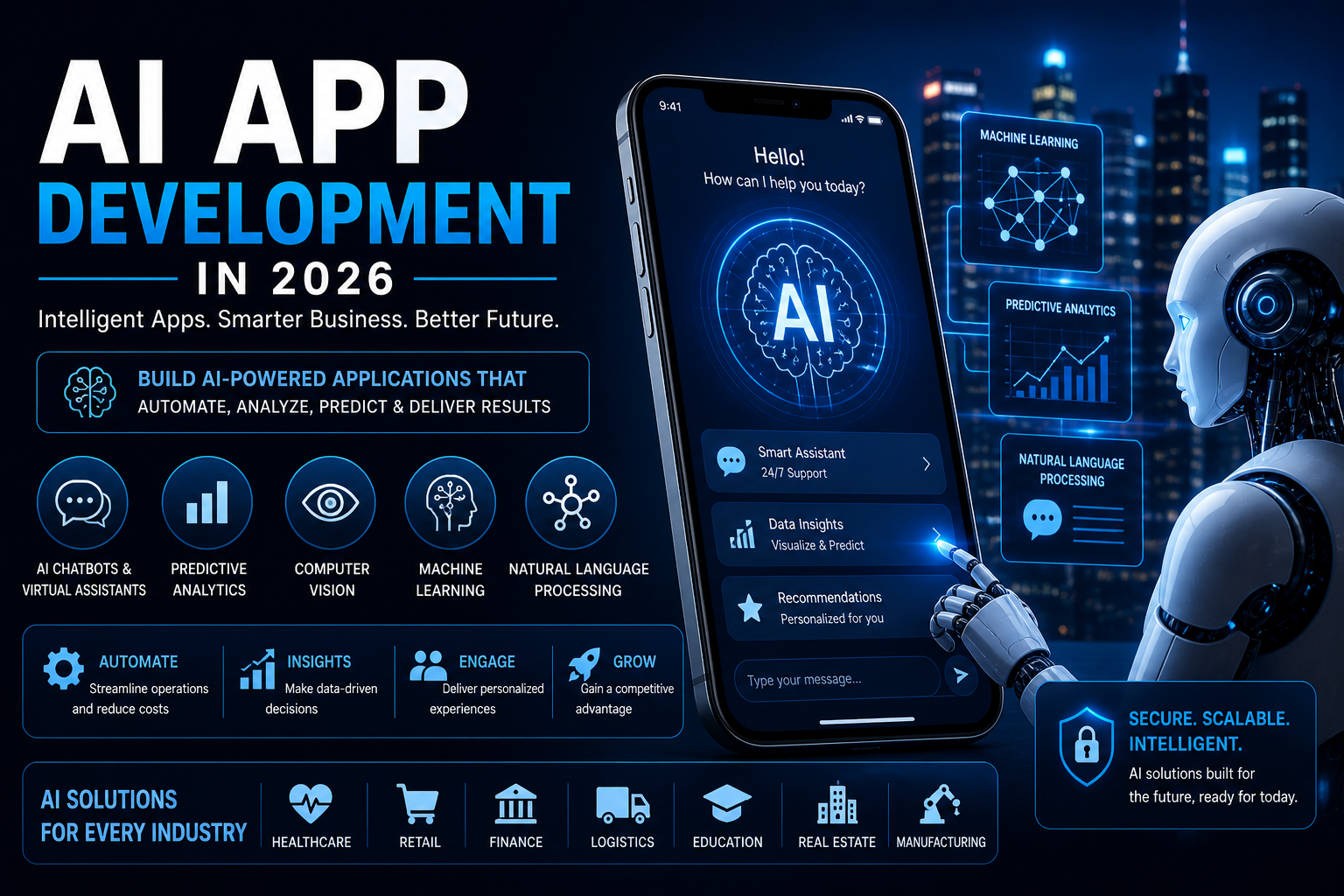
AI App Developers

Author: Joseph

  • Engineering AI-First Mobile Applications: From Model Inference to Enterprise Architecture

    Engineering AI-First Mobile Applications: From Model Inference to Enterprise Architecture

    Integrating AI into mobile applications has shifted from simple API calls to building resilient, context-aware, AI-first software systems.

    Building production-ready AI mobile applications requires navigating complex architectural choices across on-device edge processing, cloud orchestration, vector retrieval, and user experience design.

    At AI App Developer, we help organizations transition from experimental AI prototypes to scalable, high-performance mobile ecosystems. Here is an architectural blueprint for developing modern AI-driven mobile apps.

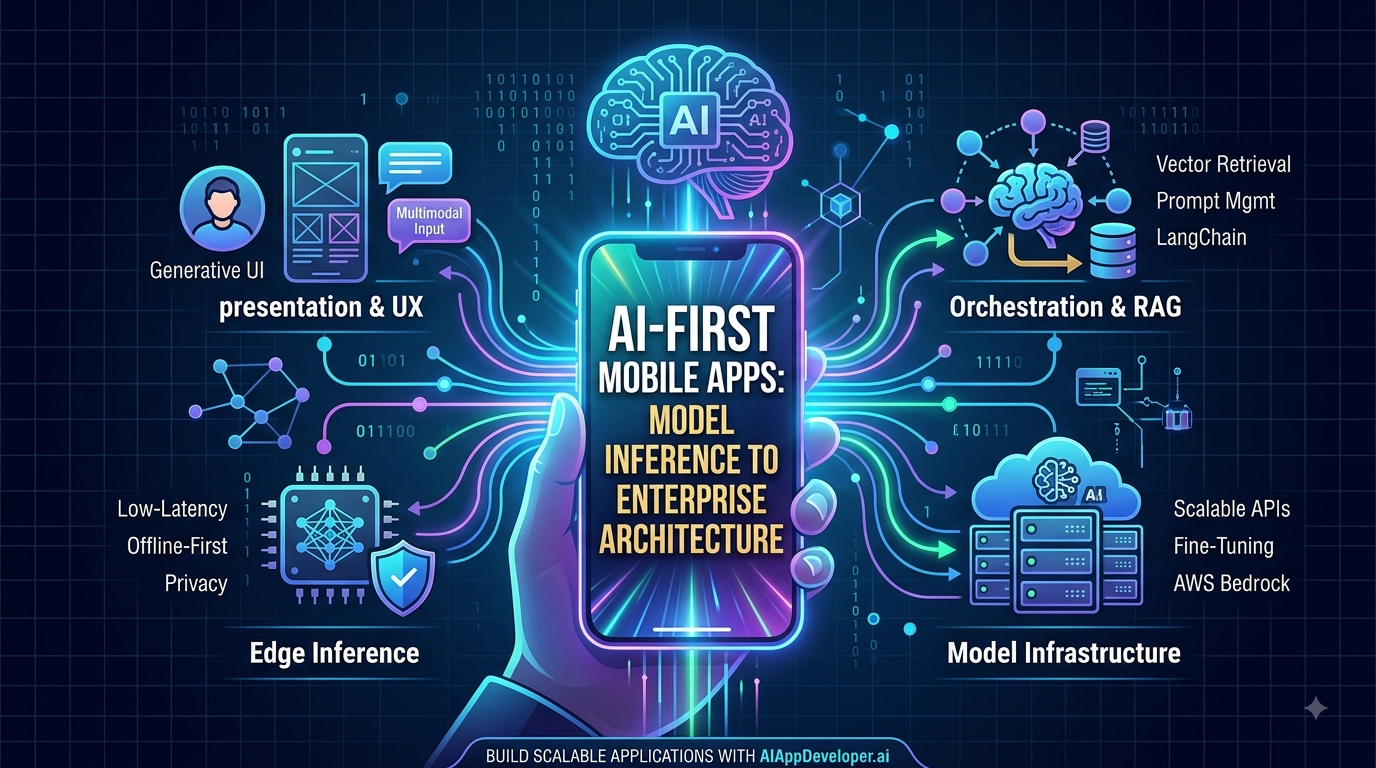
    The AI Mobile App Stack Architecture

    Unlike traditional client-server apps governed by fixed business rules, an AI mobile application processes non-deterministic inputs, real-time context, and continuously evolving models.

    A production AI app ecosystem spans four core layers:

    Mobile UX Engine 📱⟷Edge Logic / On-Device ML ⚡⟷RAG & Orchestration 🧠⟷Enterprise Data Infrastructure ☁R◯

    Component Breakdown

    LayerFunctionalityPrimary Tech / Infrastructure
    Presentation & UXGenerative UI, streaming text responses, multimodal inputs (voice/vision), agent feedback loops.Swift/SwiftUI, Kotlin/Jetpack Compose, React Native, Flutter
    Edge InferenceLow-latency, offline-first predictions; local sensor processing; data privacy filtering.CoreML, TensorFlow Lite, ONNX Runtime, Executors / On-Device LLMs
    Orchestration & RAGDynamic prompt management, vector retrieval (RAG), agentic workflows, function calling.LangChain, LlamaIndex, Vector DBs (Pinecone, Qdrant), Custom Middleware
    Model InfrastructureScalable inference APIs, model fine-tuning, latency optimizations, fallback routing.OpenAI, AWS Bedrock, Google Vertex AI, vLLM / Hosted Open-Source Models

    Critical Engineering Decisions in AI App Development

    1. Hybrid Inference: Edge vs. Cloud

    Determining where machine learning execution occurs impacts latency, operational costs, user privacy, and battery efficiency:

    • On-Device (Edge ML): Ideal for real-time task processing (e.g., audio/vision processing, text autocompletion). Edge execution eliminates network latency, supports offline use, and keeps sensitive user data localized on the smartphone.
    • Cloud-Based ML: Required for complex reasoning tasks, heavy Generative AI models, or massive Retrieval-Augmented Generation (RAG) datasets.

    Best practice: Architect a hybrid execution fallback path. Run low-latency classification or preprocessing on-device, then offload heavy reasoning tasks to cloud endpoints.

    2. Context Management & Vector Search (RAG)

    To make AI applications contextual without incurring massive prompt costs, mobile apps rely on Retrieval-Augmented Generation (RAG).

    • Local Caching: Store conversation histories and user state vector embeddings locally (e.g., via SQLite / Local Vector DBs).
    • Remote Retrieval: Query cloud vector databases for domain-specific context before sending final prompts to the inference endpoint.

    3. Graceful Failure & Non-Deterministic Handling

    Generative models can hallucinate or exceed rate limits. Resilient mobile architectures must implement:

    • Streaming Responses: Use WebSockets or Server-Sent Events (SSE) to stream output tokens instantly, reducing perceived latency.
    • Fallback Mechanisms: Route traffic to lighter models or deterministic rules if primary endpoints experience downtime or latency spikes.
    • Confidence Thresholds: Include human-in-the-loop validation steps whenever output confidence drops below acceptable risk levels.

    Key Business Capabilities Driven by Mobile AI

    Integrating machine learning enables applications to go beyond static software utilities:

    1. Predictive Workflows: Anticipating user actions, auto-filling operational data, and reducing user drop-off.
    2. Conversational Interfaces: Replacing rigid navigation hierarchies with dynamic, natural language interfaces.
    3. Multimodal Intelligence: Combining camera, voice, and location telemetry to solve complex real-world tasks instantly.
    4. Adaptive Personalization: Continuously tuning content recommendation engines and interface layouts based on user interaction patterns.

    Build Scalable AI Mobile Apps with AI App Developer

    Developing enterprise-ready AI mobile applications requires deep knowledge across mobile operating system internals, scalable model orchestration, vector retrieval, and UX design.

    At AI App Developer, we bring together specialized mobile engineering and modern AI development practices to deliver robust, high-performance applications tailored to your business needs.

    👉 Ready to transform your software strategy with custom AI mobile development? Schedule a technical consultation with our engineering team at aiappdeveloper.ai today.

  • AI App Development Trends in 2026: What Businesses Need to Know

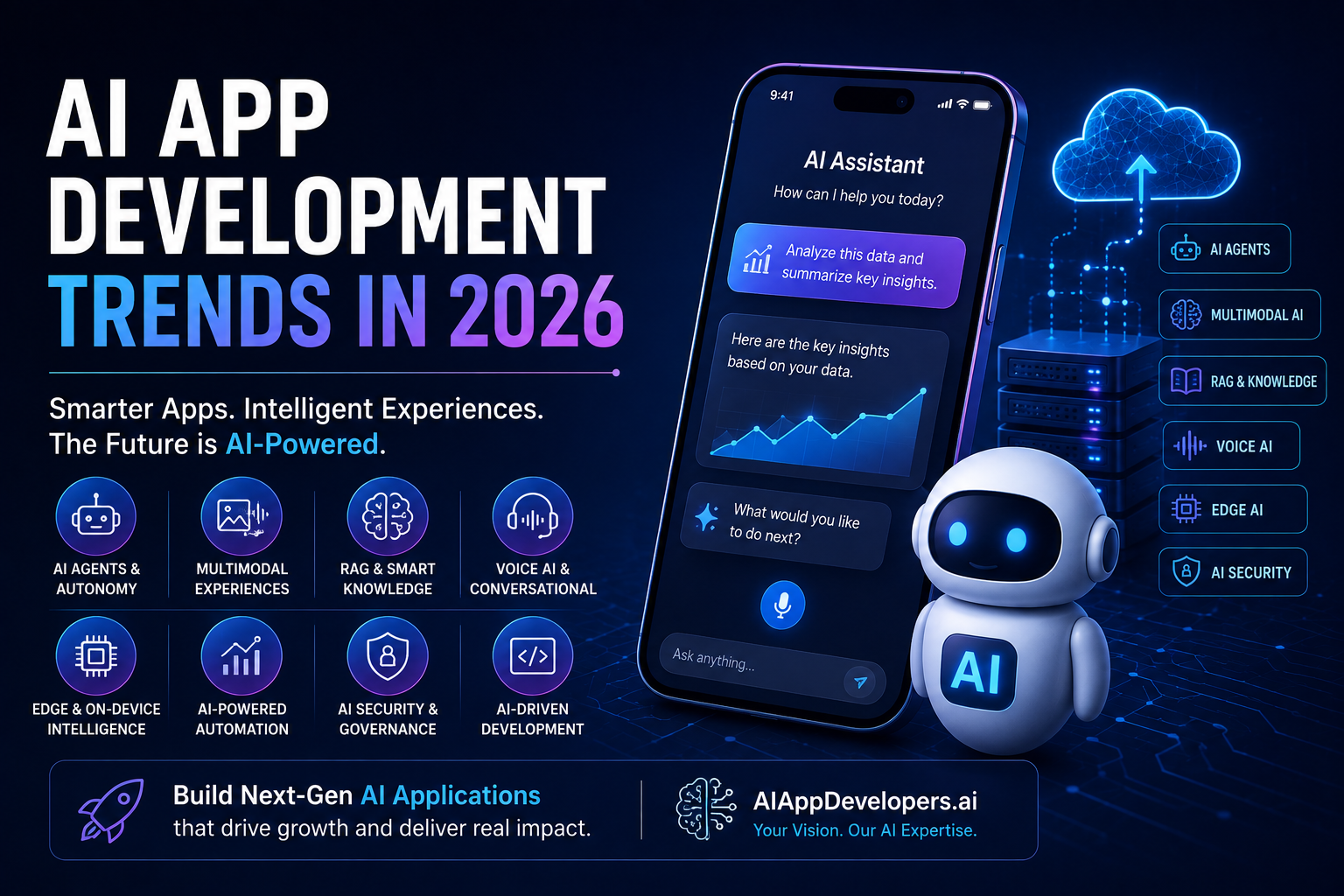
    AI App Development Trends in 2026: What Businesses Need to Know

    AI is no longer just a feature that businesses experiment with.

    In 2026, artificial intelligence is becoming part of the core architecture of modern applications—from customer support and healthcare platforms to fintech, eCommerce, logistics, education, and enterprise software.

    The biggest shift is simple:

    AI apps are moving from “answering questions” to understanding context, making decisions, using tools, and completing tasks.

    That change is creating a new generation of intelligent applications.

    According to Gartner, worldwide AI spending is forecast to reach $2.59 trillion in 2026, representing a 47% year-over-year increase. Gartner also expects enterprises to expand their use of AI agents across workflows.

    So, what does this mean for businesses planning an AI application?

    Let’s explore the biggest AI app development trends in 2026.

    1. AI Agents Are Becoming the New Application Layer

    One of the biggest trends in AI application development is the rise of agentic AI.

    Traditional AI applications generally work like this:

    User → Prompt → AI → Response

    AI agents can work more like:

    Goal → Planning → Tools → Actions → Results → Feedback

    Instead of simply telling a customer how to complete a task, an AI agent could potentially perform multiple steps on the user’s behalf.

    For example, an AI travel application could:

    1. Understand the user’s travel requirements.
    2. Search available options.
    3. Compare prices.
    4. Create an itinerary.
    5. Ask for approval.
    6. Complete an authorized booking workflow.

    This is why businesses are increasingly exploring AI agent development instead of building simple chatbot experiences.

    Gartner’s 2026 research highlights orchestrators, autonomous workflows, and real-time reasoning as important areas for organizations exploring agentic AI.

    What this means for businesses

    If you’re planning an AI application in 2026, don’t ask only:

    “Where can we add a chatbot?”

    Ask:

    “Which business workflow could AI understand, automate, and improve?”

    That question can lead to significantly more valuable AI products.

    2. Multimodal AI Is Changing User Experiences

    AI applications are no longer limited to text.

    Modern AI systems can increasingly work with multiple types of information, including:

    • Text
    • Images
    • Audio
    • Video
    • Documents
    • Structured business data

    This is known as multimodal AI.

    Imagine a healthcare application where a user can upload a medical document, ask a voice question, and receive an explanation.

    Or consider an eCommerce application where customers can upload a product image and ask:

    “Find something similar in my budget.”

    These experiences are difficult to create with traditional text-only AI.

    Multimodal capabilities are therefore becoming an important consideration for businesses building next-generation AI applications.

    Gartner’s 2026 research on AI application development platforms specifically identifies multimodal applications alongside AI assistants, agents, orchestration, observability, security, and model management as important capabilities.

    3. AI Copilots Are Moving Into Business Software

    Not every business needs a fully autonomous AI agent.

    For many organizations, the better solution is an AI copilot.

    An AI copilot works alongside employees and customers rather than completely replacing their workflows.

    Examples include:

    Sales Copilot

    Helps sales teams summarize customer conversations, identify opportunities, and prepare follow-ups.

    Customer Support Copilot

    Summarizes conversations and suggests responses to support representatives.

    Developer Copilot

    Helps developers understand code, generate solutions, write tests, and troubleshoot problems.

    Finance Copilot

    Helps analyze reports, transactions, and financial information.

    HR Copilot

    Can help employees find company policies, summarize documents, and answer internal questions.

    This makes AI copilots particularly attractive for enterprise AI app development.

    4. AI Is Becoming Part of the Core Application Architecture

    Earlier AI implementations often looked like:

    Existing App + AI Feature

    In 2026, businesses are increasingly considering:

    AI-Native Application Architecture

    The difference is significant.

    Instead of adding AI at the end, developers can design the application around AI from the beginning.

    That can influence:

    • Data architecture
    • APIs
    • User experience
    • Authentication
    • Model selection
    • Retrieval systems
    • Agent orchestration
    • Monitoring
    • Security
    • Cost management

    This approach can make AI a fundamental part of the product rather than a decorative feature.

    5. RAG Is Becoming More Sophisticated

    Retrieval-Augmented Generation (RAG) remains an important technique for enterprise AI applications.

    A basic RAG system works by retrieving relevant information from a knowledge base and providing that information to an AI model before generating a response.

    For example:

    Company Documents → Search/Retrieval → Relevant Information → AI Model → Answer

    This is particularly useful for:

    • Internal knowledge assistants
    • Customer support
    • Legal document search
    • Healthcare information systems
    • Enterprise documentation
    • Product support
    • Financial research

    But RAG in 2026 is increasingly about more than simply searching documents.

    Businesses need to think about:

    • Data quality
    • Retrieval accuracy
    • Access permissions
    • Context management
    • Evaluation
    • Observability
    • Security
    • Freshness of information

    Gartner’s guidance on building agentic AI specifically highlights data readiness and retrieval foundations as important factors for reliable production systems.

    6. AI Apps Are Becoming More Personalized

    People don’t want generic AI experiences.

    They want applications that understand their:

    • Preferences
    • History
    • Goals
    • Behavior
    • Context

    For example, an AI fitness application could use previous activity to personalize recommendations.

    An education application could adapt lessons according to a student’s progress.

    An eCommerce application could personalize product discovery based on previous purchases.

    Personalization can make an AI application significantly more useful—but it also creates important requirements around data privacy, consent, security, and access control.

    7. Voice AI Is Becoming a Major Interface

    Typing isn’t always the most convenient way to interact with software.

    Voice-enabled AI applications can make interactions more natural.

    Potential use cases include:

    • Voice customer support
    • AI receptionists
    • Healthcare assistants
    • Sales assistants
    • Automotive applications
    • Field-service applications
    • Voice-controlled productivity tools
    • Personal assistants

    A modern voice AI application may combine:

    Speech Recognition + AI Reasoning + Business APIs + Text-to-Speech

    The result can feel less like using traditional software and more like having a conversation with an intelligent digital assistant.

    8. On-Device and Edge AI Are Growing

    Not every AI task needs to happen in the cloud.

    Some applications benefit from running AI directly on devices.

    This can provide advantages such as:

    • Lower latency
    • Better privacy
    • Reduced network dependency
    • Faster responses
    • Offline functionality
    • Lower cloud processing requirements

    This is particularly relevant for:

    • Smartphones
    • Wearables
    • IoT devices
    • Automotive systems
    • Industrial equipment
    • Smart cameras
    • Healthcare devices

    The future is therefore likely to involve a combination of:

    Cloud AI + Edge AI + On-Device AI

    Developers need to decide where each AI task should run based on performance, privacy, cost, and hardware capabilities.

    9. Small and Specialized AI Models Are Becoming More Important

    Bigger models aren’t automatically better for every application.

    A business may not need the largest available model for a simple classification, extraction, recommendation, or automation task.

    Smaller specialized models can potentially provide:

    • Lower latency
    • Lower inference costs
    • Easier deployment
    • Better privacy options
    • More predictable performance

    This creates an important architecture decision:

    Which model is appropriate for each task?

    A sophisticated AI application may use multiple models instead of relying on one model for everything.

    10. AI Model Orchestration Is Becoming Essential

    Imagine an application that receives a customer request.

    One model might classify the request.

    Another might retrieve company information.

    Another system might perform calculations.

    An AI agent might then decide which business API to call.

    The final response could be generated by another model.

    This creates an orchestration layer.

    A simplified architecture could look like:

    User → AI Router → Model/RAG/Tool → Business API → AI Response

    As AI applications become more sophisticated, orchestration becomes increasingly important.

    11. AI + APIs Will Create More Action-Oriented Applications

    An AI application becomes significantly more useful when it can interact with existing business systems.

    For example:

    AI + CRM

    The AI can access authorized customer information.

    AI + ERP

    The AI can help analyze inventory and operations.

    AI + POS

    The AI can analyze sales and provide business insights.

    AI + Calendar

    The AI can help manage schedules.

    AI + Payment Systems

    The AI can assist with authorized payment workflows.

    This means AI app development is increasingly about integrating intelligence with existing software infrastructure.

    The AI model itself is only one component.

    12. AI-Powered Automation Is Moving Beyond Chatbots

    Businesses have spent years deploying chatbots.

    The next stage is workflow automation.

    Consider customer support.

    A traditional chatbot may answer:

    “Where is my order?”

    An AI-powered workflow could potentially:

    1. Identify the customer.
    2. Find the order.
    3. Check shipping status.
    4. Identify a delay.
    5. Create a support ticket if required.
    6. Notify the customer.
    7. Escalate the case when necessary.

    The important difference is action.

    AI applications are increasingly being designed to connect intelligence with business processes.

    13. AI Security and Governance Are Becoming Critical

    More AI capability also means more responsibility.

    Businesses need to consider:

    • Data privacy
    • Access control
    • Prompt injection
    • Model misuse
    • Data leakage
    • Authentication
    • Audit trails
    • AI hallucinations
    • Model monitoring
    • Human oversight

    An AI agent with access to business systems needs stronger controls than a simple public chatbot.

    AI security should therefore be included during architecture and development rather than added after deployment.

    14. AI Observability Is Becoming a Must-Have

    Traditional applications can be monitored through logs, metrics, and traces.

    AI applications introduce additional questions:

    • Why did the model produce this answer?
    • Which data was retrieved?
    • Which tool did the agent call?
    • How much did the request cost?
    • How long did inference take?
    • Was the response accurate?
    • Did the agent complete the task correctly?

    AI observability helps development teams monitor these issues.

    For production AI applications, teams should consider:

    Performance + Accuracy + Cost + Security + Reliability

    rather than monitoring server uptime alone.

    15. AI Application Development Platforms Are Maturing

    Developers now have access to an increasingly broad ecosystem for building AI applications.

    Modern AI development platforms can provide capabilities for:

    • AI assistants
    • AI agents
    • Multimodal applications
    • Model management
    • RAG
    • Orchestration
    • Evaluation
    • Observability
    • Security
    • Deployment

    This is making AI development more accessible, but it also creates another challenge:

    Choosing the right architecture and technology stack.

    The fastest development platform isn’t always the best platform for a production application.

    16. AI Coding Agents Are Changing Software Development

    AI isn’t only changing the applications developers build.

    It is changing how developers build them.

    AI coding agents can assist with:

    • Code generation
    • Debugging
    • Testing
    • Documentation
    • Refactoring
    • Code analysis
    • Pull requests
    • Development workflows

    Research published in 2026 examining AI-authored pull requests in Android and iOS open-source projects found meaningful adoption of AI coding agents, with differences across platforms and task types.

    However, AI-generated code still requires human review.

    Businesses should treat AI coding tools as development accelerators—not replacements for engineering practices.

    17. AI + IoT Will Create Smarter Applications

    The combination of AI and connected devices opens another major opportunity.

    Imagine:

    IoT Sensors → Real-Time Data → AI Analysis → Automated Action

    Potential applications include:

    • Smart buildings
    • Predictive maintenance
    • Healthcare monitoring
    • Industrial automation
    • Smart retail
    • Fleet management
    • Energy optimization
    • Agriculture

    AI can turn raw sensor data into predictions, recommendations, and automated decisions.

    For companies already investing in IoT, adding AI can create a much more intelligent technology ecosystem.

    18. AI Applications Will Become More Industry-Specific

    Generic AI is useful.

    But specialized AI can be much more valuable.

    In 2026, we’re seeing increasing opportunities for vertical AI applications in areas such as:

    Healthcare AI

    Patient support, documentation, scheduling, medical information workflows, and operational automation.

    Fintech AI

    Fraud detection, financial analysis, customer support, risk workflows, and automation.

    Retail AI

    Personalization, demand forecasting, inventory intelligence, and customer engagement.

    Real Estate AI

    Property search, lead qualification, document analysis, and customer communication.

    Education AI

    Personalized learning, tutoring, assessment, and educational content.

    Logistics AI

    Route optimization, forecasting, fleet intelligence, and automated operations.

    The winning AI application may not be the one with the most features.

    It may be the one that solves a specific industry problem exceptionally well.

    How Businesses Should Approach AI App Development in 2026

    With so many AI technologies available, businesses can easily fall into the “AI for everything” trap.

    A better approach is to start with the business problem.

    Step 1: Identify the Problem

    What process is expensive, slow, repetitive, or difficult?

    Step 2: Identify the AI Opportunity

    Ask whether AI can realistically improve the process.

    Step 3: Define the User

    Who will use the AI application?

    Customers?

    Employees?

    Managers?

    Partners?

    Step 4: Choose the Right AI Architecture

    Decide whether you need:

    • AI chatbot
    • AI copilot
    • RAG application
    • AI agent
    • Multimodal AI
    • Voice AI
    • Predictive AI
    • AI + IoT
    • A combination of these

    Step 5: Build an MVP

    Don’t try to build the entire AI ecosystem at once.

    Start with the highest-value workflow.

    Step 6: Evaluate

    Measure:

    • Accuracy
    • User satisfaction
    • Response time
    • Cost
    • Task completion
    • Business ROI

    Step 7: Scale

    Once the AI application proves its value, expand the workflows and integrations.

    How Much Does AI App Development Cost in 2026?

    There is no universal price for AI application development.

    The cost depends on:

    • Application complexity
    • AI model selection
    • Number of AI features
    • RAG requirements
    • Agent architecture
    • Mobile/web platforms
    • Backend complexity
    • API integrations
    • Data requirements
    • Security
    • Cloud infrastructure
    • AI training or fine-tuning
    • Testing
    • Ongoing maintenance

    A basic AI-powered application can be significantly less complex than an enterprise AI platform with multiple agents, databases, APIs, and real-time data.

    The smartest approach is to define the MVP and technical architecture before estimating the complete project.

    Should You Build an AI App or Add AI to an Existing App?

    This depends on your business.

    If you already have a successful application, adding AI may be the fastest route.

    For example:

    Existing CRM + AI Copilot

    Existing eCommerce + AI Recommendation Engine

    Existing POS + AI Analytics

    Existing Healthcare App + AI Assistant

    But if AI is central to the product itself, building an AI-native application may make more sense.

    AI App Development Trends: What Matters Most?

    There are dozens of AI trends in 2026.

    But businesses don’t need to adopt all of them.

    The most important trends to watch are:

    1. Agentic AI
    2. Multimodal AI
    3. AI copilots
    4. RAG and enterprise knowledge systems
    5. AI-powered automation
    6. Voice AI
    7. On-device AI
    8. Smaller specialized models
    9. AI + APIs
    10. AI security and governance
    11. AI observability
    12. AI + IoT
    13. Industry-specific AI
    14. AI-assisted software development

    The bigger trend connecting all of these is the move from AI that generates information to AI that helps complete real-world work.

    Why Work With an AI App Development Company?

    Building an AI application isn’t simply about connecting an API to an attractive user interface.

    A production-ready AI application requires decisions around:

    • User experience
    • AI architecture
    • Model selection
    • Data pipelines
    • RAG
    • Agent orchestration
    • APIs
    • Cloud infrastructure
    • Security
    • Evaluation
    • Monitoring
    • Scalability

    An experienced AI app development team can help turn an idea into a practical product architecture.

    Build Your AI Application With AIAppDevelopers.ai

    At AIAppDevelopers.ai, businesses can work with an experienced AI application development team to turn AI ideas into production-ready applications.

    AI development services can include:

    • Custom AI app development
    • Generative AI development
    • AI chatbot development
    • AI agent development
    • AI copilot development
    • RAG application development
    • Machine learning solutions
    • Computer vision applications
    • Voice AI development
    • Multimodal AI applications
    • AI API integration
    • AI-powered mobile apps
    • AI-powered web applications
    • AI + IoT solutions
    • AI consulting and strategy

    Whether you want to add AI to an existing product or build a completely new AI-native application, the right architecture can make the difference between an impressive demo and a reliable business product.

    Frequently Asked Questions

    What are the biggest AI app development trends in 2026?

    The biggest trends include agentic AI, multimodal applications, AI copilots, RAG, AI automation, voice AI, on-device AI, specialized models, AI security, AI observability, and industry-specific AI applications.

    Is AI app development worth investing in 2026?

    For businesses with a clear use case, AI can improve automation, customer experience, personalization, decision-making, and operational efficiency. The strongest investments typically start with a measurable business problem rather than AI technology alone.

    What is an AI agent?

    An AI agent is a system designed to pursue a goal by reasoning through tasks, using tools or external systems, and taking actions with varying levels of human oversight.

    What is the difference between an AI chatbot and an AI agent?

    A chatbot primarily responds to user inputs. An AI agent can potentially plan and execute multi-step tasks using tools, APIs, and business systems.

    How much does it cost to develop an AI app?

    AI app development costs vary significantly depending on features, architecture, integrations, AI models, data requirements, security, and scalability. A discovery and architecture phase is the best way to create a realistic estimate.

    Can AI be added to an existing mobile application?

    Yes. AI can be integrated into existing Android, iOS, Flutter, React Native, and web applications through APIs, SDKs, backend services, or on-device models.

    Can AI applications work with company data?

    Yes. Techniques such as RAG can allow AI applications to retrieve relevant information from authorized business data sources. Security, permissions, data quality, and governance should be designed into the system.

    Final Thoughts

    The biggest AI app development trend in 2026 isn’t a particular model or framework.

    It’s a change in what people expect software to do.

    Applications are becoming more intelligent, more conversational, more personalized, and more capable of completing tasks.

    The next generation of successful applications won’t simply say:

    “Here is the information you requested.”

    They will increasingly say:

    “I understand what you’re trying to accomplish. Here’s what I can do to help.”

    For businesses, that creates enormous opportunities—but also makes architecture, security, data, and user experience more important than ever.

    If you have an AI application idea, the best time to validate it is before investing heavily in development.

    Have an AI app idea? Let’s turn it into a real product.

    Talk to the AI application development team at AIAppDevelopers.ai and start planning your AI solution for 2026.
  • AI App Development in 2026: From Chatbots to AI Agents and Multimodal Apps

    AI App Development in 2026: From Chatbots to AI Agents and Multimodal Apps

    Artificial intelligence is changing how modern applications are designed, developed, and used.

    A few years ago, adding AI to an application often meant integrating a chatbot, recommendation engine, or basic machine-learning model. In 2026, AI application development is moving toward something much more powerful: applications that can understand context, work with multiple types of data, use external tools, and complete tasks on behalf of users.

    AI agents, multimodal AI, voice interfaces, retrieval-augmented generation, personalized experiences, and AI-powered automation are becoming important components of modern software architecture.

    For businesses planning a new AI product, the question is no longer simply:

    “Can we add AI to our app?”

    The more important question is:

    “What should AI actually do inside our application?”

    What Is AI App Development?

    AI app development is the process of building applications that use artificial intelligence to understand information, generate content, make predictions, automate tasks, interact with users, or support decision-making.

    An AI application can combine:

    • Artificial intelligence models
    • Machine learning
    • Large language models
    • Natural language processing
    • Computer vision
    • Speech recognition
    • Generative AI
    • AI agents
    • APIs
    • Databases
    • Cloud infrastructure
    • Mobile and web interfaces

    A typical architecture might look like:

    User → Application → AI Model → Business Data → Tools/APIs → Response or Action

    The architecture becomes more sophisticated when the AI can actually perform tasks instead of simply generating text.

    Why AI App Development Is Growing in 2026

    AI is moving from experimental projects into production software.

    Businesses are using AI to improve:

    • Customer support
    • Sales
    • Marketing
    • Healthcare workflows
    • Finance
    • Education
    • Retail
    • Logistics
    • Human resources
    • Software development
    • Business operations

    The major shift is from AI as a feature to AI as part of the application architecture.

    Current developer platforms are increasingly focused on agents that can use tools, access business context, and perform actions across systems. OpenAI, for example, describes its current platform around agent workflows, tool use, file search, web search, remote MCP servers, and realtime voice experiences.

    AI Chatbots Are Evolving Into AI Agents

    Chatbots primarily respond to user messages.

    AI agents are designed to go further.

    An AI agent can potentially:

    1. Understand a user’s objective
    2. Break the objective into tasks
    3. Retrieve relevant information
    4. Use external tools
    5. Make decisions within defined boundaries
    6. Complete actions
    7. Report the result

    For example, a traditional customer-support chatbot might answer:

    “What is the status of my order?”

    An AI agent could potentially:

    Identify the customer → Find the order → Check shipping information → Contact an internal system → Explain the status → Create an escalation if necessary.

    This is one of the biggest opportunities in modern AI application development.

    Google’s developer ecosystem similarly describes agents as systems that can perceive their environment, make decisions, and take actions toward goals.

    Top AI App Development Trends in 2026

    1. Agentic AI Applications

    Agentic AI is becoming one of the most important areas of AI software development.

    Instead of waiting for a user to provide instructions at every step, an AI agent can execute a defined workflow using tools and business information.

    Potential applications include:

    • AI sales agents
    • Customer-support agents
    • Research agents
    • Personal assistants
    • Recruiting agents
    • Finance assistants
    • Healthcare workflow assistants
    • IT support agents
    • Marketing agents

    The key difference is that the AI can move from answering to acting.

    2. Multimodal AI Applications

    Modern AI applications are no longer limited to text.

    AI systems can increasingly work with:

    • Text
    • Images
    • Audio
    • Video
    • Documents
    • Structured data

    Google’s Gemini Embedding 2, for example, is designed to map text, images, video, audio, and documents into a shared embedding space, enabling applications such as multimodal retrieval and agentic RAG.

    This creates opportunities for applications that can understand information from multiple sources simultaneously.

    Example

    A construction application could allow a worker to:

    Take a photo → Ask a voice question → AI analyzes the image → Retrieves relevant project documentation → Provides an answer.

    That’s considerably more powerful than a traditional text chatbot.

    3. Voice AI Applications

    Voice is becoming an important interface for AI applications.

    Businesses can develop:

    • AI voice assistants
    • Customer-service agents
    • Voice-enabled mobile apps
    • Healthcare assistants
    • Sales assistants
    • Appointment-booking systems
    • Voice-based learning applications

    Real-time AI APIs are making it increasingly practical to build applications where users can communicate naturally through speech.

    Voice can be particularly useful when users are driving, working, exercising, or operating in environments where typing is inconvenient.

    4. Retrieval-Augmented Generation

    Large language models are powerful, but businesses often need AI systems to work with their own information.

    This is where Retrieval-Augmented Generation (RAG) becomes useful.

    A simplified RAG architecture is:

    User Question → Search Knowledge Base → Retrieve Relevant Data → AI Model → Answer

    A company can connect an AI application to:

    • PDFs
    • Product catalogs
    • Internal documents
    • Knowledge bases
    • Websites
    • Databases
    • Support documentation

    The AI can then use relevant information as context when generating responses.

    Multimodal retrieval is also expanding beyond text. Google’s Gemini Embedding 2 is designed to support text, image, video, audio, and document embeddings, opening additional possibilities for multimodal RAG applications.

    5. Personalized AI Applications

    Personalization is another major opportunity.

    Instead of giving every user the same experience, an AI application can potentially adapt based on:

    • User preferences
    • Previous interactions
    • Purchase history
    • Location
    • Behavior
    • Account information
    • Business context

    For example, an AI fitness application could provide recommendations based on a user’s previous activity.

    A shopping application could personalize product discovery.

    A learning platform could adjust explanations according to a student’s progress.

    Personalization should still be designed with appropriate privacy, consent, and data-governance controls.

    6. AI-Powered Mobile Applications

    Mobile applications are becoming important delivery platforms for AI experiences.

    Businesses can integrate AI into:

    • iOS applications
    • Android applications
    • Cross-platform applications
    • Tablet applications
    • Wearable applications

    AI can power:

    • Smart search
    • Voice interaction
    • Image analysis
    • Personalized recommendations
    • Automated content generation
    • Customer support
    • Predictive features
    • Intelligent notifications

    Modern mobile applications can also combine cloud AI with on-device processing when latency, privacy, or offline functionality makes that architecture appropriate.

    Google’s 2026 release of Gemma 4 12B is one example of the continued push toward capable multimodal models that can run locally on suitable hardware.

    7. AI-Powered Business Automation

    AI applications can automate repetitive business workflows.

    Consider a sales workflow:

    Lead Arrives → AI Qualifies Lead → AI Enriches Information → CRM Updated → Salesperson Notified

    Or a support workflow:

    Customer Request → AI Understands Issue → Retrieves Knowledge → Generates Response → Creates Ticket When Necessary

    The value comes from connecting AI to the systems where business work actually happens.

    8. Generative UI and AI-First Interfaces

    Traditional applications provide fixed interfaces.

    AI-first applications can increasingly create interfaces around what the user is trying to accomplish.

    For example, instead of navigating through multiple screens, a user could say:

    “Show me this month’s sales and identify the products that are underperforming.”

    The application could respond with relevant charts, filters, summaries, and recommended actions.

    Google has been exploring standards for portable, framework-agnostic generative interfaces that allow AI agents to produce UI experiences across platforms.

    This points toward applications where user intent becomes an important part of the interface.

    AI App Development Use Cases

    Healthcare

    AI applications can assist with:

    • Patient information workflows
    • Medical documentation
    • Appointment systems
    • Healthcare chat assistants
    • Image analysis
    • Patient communication
    • Administrative automation

    Healthcare applications require especially careful attention to privacy, security, safety, and applicable regulations.

    FinTech

    AI can support:

    • Fraud detection
    • Financial assistants
    • Document analysis
    • Customer support
    • Risk analysis
    • Personalized financial insights
    • Transaction monitoring

    Financial applications also require strong security and compliance controls.

    Retail and E-Commerce

    AI can improve:

    • Product recommendations
    • Visual search
    • Customer support
    • Personalized shopping
    • Inventory forecasting
    • Product discovery
    • Automated content

    Education

    AI-powered education applications can provide:

    • Personalized tutoring
    • Homework assistance
    • Language learning
    • Automated feedback
    • Learning recommendations
    • Educational content generation

    Real Estate

    AI applications can help with:

    • Property search
    • Lead qualification
    • Property descriptions
    • Document analysis
    • Customer communication
    • Market insights

    Logistics

    AI can support:

    • Route optimization
    • Demand forecasting
    • Delivery tracking
    • Customer communication
    • Warehouse automation
    • Document processing

    Hospitality

    AI applications can assist with:

    • Reservations
    • Guest communication
    • Personalized recommendations
    • Concierge services
    • Restaurant ordering
    • Customer support

    AI App Architecture

    A modern AI application usually contains several layers.

    Frontend

    The user interface can be built for:

    • Web
    • iOS
    • Android
    • Cross-platform mobile
    • Desktop

    Application Backend

    The backend manages:

    • Authentication
    • Business logic
    • APIs
    • User data
    • Permissions
    • AI orchestration

    AI Layer

    This layer can contain:

    • LLMs
    • Vision models
    • Speech models
    • Embedding models
    • Classification models
    • AI agents

    Knowledge Layer

    The AI may access:

    • Databases
    • Vector databases
    • Documents
    • APIs
    • Business systems
    • Knowledge bases

    Integration Layer

    AI applications can connect with:

    • CRM
    • ERP
    • Payment systems
    • Communication platforms
    • Search services
    • Internal APIs

    Monitoring Layer

    Production AI applications need monitoring for:

    • Accuracy
    • Latency
    • Cost
    • Errors
    • Security
    • Model performance
    • User feedback

    AI App Development Challenges

    AI application development creates enormous opportunities, but it also introduces new engineering challenges.

    Hallucinations

    AI models can sometimes produce incorrect information.

    Applications should therefore use techniques such as retrieval, validation, structured outputs, tool constraints, and human review where appropriate.

    Data Privacy

    Businesses must carefully determine what information is sent to AI models and where that information is stored.

    Sensitive information requires appropriate security controls.

    Cost

    AI inference can create significant operating costs.

    Developers should consider:

    • Model selection
    • Token usage
    • Caching
    • Request routing
    • Batch processing
    • Smaller models where appropriate

    Latency

    Users expect applications to respond quickly.

    Developers may need to combine:

    • Streaming
    • Caching
    • Edge processing
    • Smaller models
    • Parallel tool calls
    • Efficient retrieval

    Reliability

    An AI application should not fail unpredictably.

    Production systems need:

    • Error handling
    • Fallbacks
    • Monitoring
    • Evaluation
    • Guardrails
    • Human escalation

    AI App Security

    Security becomes even more important when AI applications can access tools and business systems.

    Developers should consider:

    • Authentication
    • Authorization
    • Prompt injection
    • Data leakage
    • API security
    • Tool permissions
    • Secrets management
    • Audit logging
    • Model access controls
    • Human approval for sensitive actions

    An AI agent should not automatically receive unrestricted access to a company’s systems.

    A better architecture is:

    AI Agent → Permission Layer → Approved Tool → Business System

    This allows organizations to control what the agent can and cannot do.

    How to Build an AI Application

    A successful AI application should begin with a business problem rather than a model.

    Step 1: Define the Problem

    Identify the specific workflow that AI should improve.

    Step 2: Identify the Users

    Understand who will interact with the application.

    Step 3: Determine the AI Capability

    Decide whether the application needs:

    • Generative AI
    • RAG
    • Computer vision
    • Speech AI
    • Predictive analytics
    • AI agents
    • Multimodal AI

    Step 4: Design the Architecture

    Choose the appropriate:

    • Models
    • APIs
    • Database
    • Cloud infrastructure
    • Frontend
    • Backend
    • Integrations

    Step 5: Build an MVP

    Start with the smallest version capable of demonstrating real business value.

    Step 6: Test the AI

    Evaluate:

    • Accuracy
    • Reliability
    • Latency
    • Cost
    • Security
    • User experience

    Step 7: Deploy and Monitor

    Production AI requires continuous monitoring and improvement.

    Step 8: Scale

    Once the application demonstrates value, expand features, integrations, and user capacity.

    How Much Does AI App Development Cost?

    There is no single price for developing an AI application.

    The cost depends on factors such as:

    • Application complexity
    • Number of platforms
    • AI model requirements
    • Custom model development
    • API usage
    • Data requirements
    • Integrations
    • Security requirements
    • User volume
    • Development team
    • Maintenance requirements

    A simple AI assistant and an enterprise AI agent platform are completely different projects.

    Instead of asking only “How much does an AI app cost?”, businesses should first determine:

    What problem will the application solve, how many users will it serve, and what systems must it connect to?

    Why Businesses Need Experienced AI App Developers

    AI development requires more than connecting an API to a chatbot interface.

    A production-ready AI application may require expertise in:

    • AI architecture
    • LLM integration
    • Agent development
    • RAG
    • Vector databases
    • Mobile development
    • Web development
    • Cloud infrastructure
    • API development
    • Security
    • Data engineering
    • AI evaluation
    • DevOps

    The strongest AI applications combine software engineering and AI engineering rather than treating AI as an isolated feature.

    The Future of AI Application Development

    The direction of AI app development is increasingly clear.

    Applications are becoming:

    More intelligent

    More conversational

    More multimodal

    More personalized

    More autonomous

    More connected to business systems

    The biggest change may be the transition from applications that simply respond to users toward applications that can understand intent and complete workflows.

    AI agents are already being developed to work across files, tools, code, and longer-running tasks, while multimodal systems are expanding how applications understand text, images, audio, video, and documents.

    This creates a new model of application development:

    User Intent → AI Reasoning → Tools → Data → Action → Result

    Conclusion

    AI app development in 2026 is moving far beyond chatbots.

    Businesses can now build applications that combine generative AI, AI agents, multimodal models, RAG, voice interfaces, personalization, automation, and intelligent user experiences.

    But successful AI development isn’t about adding the most AI features.

    It’s about using AI where it creates measurable value.

    A well-designed AI application should solve a real problem, protect user data, integrate with existing systems, deliver reliable results, and continuously improve.

    For businesses planning their next digital product, the opportunity is significant:

    Don’t just build an app with AI. Build an application where AI makes the entire experience smarter.

    Final Takeaway

    The next generation of applications will increasingly be built around intent, intelligence, context, and automation.

    Companies that start designing AI into their products today can create experiences that are faster, more personalized, and more capable than traditional software.

    The future of app development is not simply about making applications smarter.

    It is about making software capable of doing more.

  • From AI Chatbots to AI Agents: How Intelligent Apps Are Transforming Businesses in 2026

    From AI Chatbots to AI Agents: How Intelligent Apps Are Transforming Businesses in 2026

    Artificial intelligence is no longer limited to answering customer questions or generating content. In 2026, businesses are moving beyond basic AI chatbots and exploring intelligent AI applications that can understand goals, analyze information, make recommendations, and complete multi-step tasks.

    This evolution is changing how companies approach customer service, sales, operations, healthcare, finance, education, and software development.

    The next generation of AI-powered applications is not designed only to respond. It is designed to assist, automate, adapt, and help businesses achieve measurable outcomes.

    What Is the Difference Between an AI Chatbot and an AI Agent?

    An AI chatbot is primarily designed to communicate with users. It receives a question, processes the request, and generates a response.

    An AI agent can go further.

    AI agents can be designed to:

    • Understand a business goal
    • Break a complex task into smaller steps
    • Access connected tools and business systems
    • Analyze data
    • Make context-aware recommendations
    • Perform approved actions
    • Report results to users or teams

    For example, a traditional customer support chatbot may answer:

    “What is the status of my order?”

    An AI-powered customer service agent could potentially:

    1. Identify the customer
    2. Check the order management system
    3. Review shipping information
    4. Detect a delivery issue
    5. Create a support ticket
    6. Send an updated delivery notification

    This creates a more useful and connected customer experience.

    Why Businesses Are Investing in AI-Powered Applications

    Businesses are adopting AI applications because customers and employees expect faster, more personalized, and more intelligent digital experiences.

    A well-developed AI application can help organizations:

    1. Automate Repetitive Work

    Many teams spend valuable time on repetitive activities such as:

    • Entering data
    • Sorting documents
    • Responding to common customer questions
    • Creating reports
    • Scheduling appointments
    • Reviewing large amounts of information

    AI automation can reduce manual effort and allow employees to focus on strategic and high-value work.

    2. Improve Customer Experiences

    AI applications can analyze customer behavior, preferences, previous interactions, and real-time activity.

    This can help businesses provide:

    • Personalized recommendations
    • Faster support
    • Relevant product suggestions
    • Smart onboarding experiences
    • More accurate responses

    Personalization is becoming an important part of modern mobile and web applications.

    3. Support Faster Decision-Making

    Businesses generate large amounts of information every day. AI can help transform raw data into useful insights.

    AI-powered dashboards can identify:

    • Sales trends
    • Customer behavior patterns
    • Operational risks
    • Unusual activity
    • Growth opportunities

    Instead of manually reviewing multiple reports, business leaders can receive relevant insights through a single intelligent platform.

    4. Create Scalable Digital Products

    AI applications can support growing businesses without requiring every process to be handled manually.

    For example, an AI-powered learning platform can provide personalized educational content to thousands of users. An intelligent customer support system can help manage a growing number of requests while maintaining consistent service.

    Scalability should be considered from the beginning of AI app development.

    Popular Types of AI Applications in 2026

    AI is being integrated into many types of mobile and web applications.

    AI Customer Support Applications

    These applications can help customers find information, troubleshoot problems, and receive support at any time.

    Common features include:

    • AI chat assistants
    • Automated ticket routing
    • Sentiment analysis
    • Multilingual support
    • Smart knowledge search

    AI Sales Applications

    AI can help sales teams identify opportunities and improve customer engagement.

    Features may include:

    • Lead scoring
    • Sales forecasting
    • Automated follow-ups
    • Personalized outreach
    • Customer behavior analysis

    AI Healthcare Applications

    AI-powered healthcare solutions can support medical professionals and patients through:

    • Appointment automation
    • Medical document analysis
    • Patient engagement
    • Health data monitoring
    • Intelligent healthcare workflows

    AI should support qualified professionals and be developed with strong privacy, security, and compliance practices.

    AI Education Applications

    AI can make learning more interactive and personalized.

    Examples include:

    • AI tutors
    • Adaptive learning platforms
    • Automated assessments
    • Personalized study plans
    • Intelligent learning recommendations

    AI Finance Applications

    Financial organizations can use AI for:

    • Fraud detection
    • Expense analysis
    • Financial forecasting
    • Customer support
    • Risk assessment

    Because financial applications process sensitive information, security and responsible AI practices are essential.

    Key Features of a Successful AI Application

    Adding an AI model to an app is not enough. A successful AI product requires useful features, reliable data, strong architecture, and a clear business purpose.

    Important elements include:

    Clear Business Objectives

    Every AI feature should solve a real problem.

    Before development begins, businesses should ask:

    • What problem will the AI application solve?
    • Who will use it?
    • What tasks should AI assist with?
    • How will success be measured?

    A clear strategy helps prevent unnecessary features and keeps development focused.

    High-Quality Data

    AI systems depend on the quality of the information they use.

    Poor, outdated, incomplete, or inconsistent data can reduce the reliability of AI-generated results.

    A strong AI development process should include:

    • Data validation
    • Data cleaning
    • Secure data management
    • Regular monitoring
    • Performance evaluation

    Human Oversight

    AI should not operate without appropriate controls in every situation.

    Human review is especially important when applications affect:

    • Financial decisions
    • Healthcare information
    • Legal processes
    • Security
    • Customer accounts

    Human-in-the-loop systems can help businesses maintain control while benefiting from AI automation.

    Security and Privacy

    AI applications may process customer information, business documents, financial data, or confidential records.

    Security should be included throughout the development process.

    Important practices may include:

    • Secure authentication
    • Data encryption
    • Role-based access
    • API security
    • Activity monitoring
    • Privacy-focused architecture

    Scalable Infrastructure

    An AI application should be prepared for future growth.

    A scalable architecture can help support:

    • More users
    • Larger datasets
    • New AI features
    • Additional integrations
    • Increased application traffic

    Cloud-based infrastructure and modular application architecture can make future expansion easier.

    The AI App Development Process

    Building an AI application requires more than writing code. It involves strategy, product design, data planning, AI integration, testing, and ongoing improvement.

    A typical development process includes:

    Step 1: AI Strategy and Discovery

    The development team identifies the business problem, target users, required features, technical requirements, and expected outcomes.

    Step 2: Product Planning

    The team creates the application roadmap and defines:

    • User journeys
    • AI capabilities
    • Integrations
    • Data requirements
    • Security needs
    • Development priorities

    Step 3: UI and UX Design

    AI applications should remain simple and easy to use.

    Users should understand:

    • What the AI can do
    • How AI-generated results are created
    • When human review is required
    • How to correct or provide feedback on results

    Step 4: AI Model and Technology Selection

    The right technology depends on the application.

    Possible technologies include:

    • Large language models
    • Machine learning models
    • Natural language processing
    • Computer vision
    • Speech recognition
    • Predictive analytics
    • AI agent frameworks

    The best solution is not always the largest or most complex model. It is the technology that meets the product’s requirements efficiently and reliably.

    Step 5: Application Development

    Developers build the mobile application, web platform, backend systems, APIs, databases, and AI integrations.

    Step 6: Testing and Validation

    AI applications should be tested for:

    • Accuracy
    • Performance
    • Security
    • User experience
    • Reliability
    • Edge cases
    • Responsible AI behavior

    Step 7: Deployment and Continuous Improvement

    After launch, the application should be monitored and improved using user feedback and performance data.

    AI products are not always “build once and forget.” They may require ongoing evaluation, optimization, and updates.

    How to Choose an AI App Development Company

    Choosing the right development partner can affect the success of an AI project.

    Consider these factors:

    Technical Experience

    Look for experience with:

    • AI application development
    • Machine learning
    • Generative AI
    • AI agents
    • Mobile and web development
    • Cloud infrastructure
    • API integrations

    Business Understanding

    A development company should understand the business problem before recommending technology.

    The goal should be to create a useful product—not to add AI simply because it is trending.

    Custom Development Capabilities

    Every business has different requirements.

    Custom AI application development can provide greater flexibility for:

    • Unique workflows
    • Industry-specific features
    • Business integrations
    • Custom user experiences
    • Long-term scalability

    Security Practices

    Ask how the company handles:

    • Data privacy
    • Application security
    • User access
    • AI model integrations
    • Sensitive business information

    Post-Launch Support

    AI applications may require ongoing improvements.

    A reliable development partner should be able to support:

    • Performance monitoring
    • Feature updates
    • Security improvements
    • AI optimization
    • Application maintenance

    The Future of AI Applications

    The future of AI app development is moving toward intelligent systems that can understand context, work across connected platforms, and support complete business workflows.

    Businesses are increasingly exploring AI agents that can coordinate multi-step processes rather than only generating answers. This shift is expected to influence productivity, customer service, software development, security, and business operations.

    However, successful AI adoption will depend on more than powerful models.

    Businesses will need:

    • Reliable data
    • Clear use cases
    • Secure infrastructure
    • Responsible AI practices
    • Human oversight
    • Skilled development teams

    The companies that focus on practical value instead of AI hype will be better positioned to build useful and sustainable AI products.

    Build Your Custom AI Application with AIAppDevelopers.ai

    At AIAppDevelopers.ai, we help startups, entrepreneurs, and businesses transform ideas into intelligent digital products.

    Our AI application development services can support:

    • Custom AI applications
    • AI-powered mobile apps
    • AI web applications
    • Generative AI solutions
    • AI chatbot development
    • AI agent development
    • Machine learning solutions
    • AI automation platforms
    • AI integration and consulting

    Whether you are developing a new AI startup, modernizing an existing application, or automating a business workflow, the right strategy and technology can help turn your idea into a scalable solution.

    Conclusion

    AI applications are evolving from simple digital tools into intelligent business systems.

    The biggest opportunity is not simply adding a chatbot to an application. It is creating AI-powered experiences that solve real problems, improve efficiency, support better decisions, and deliver value to users.

    With the right AI strategy, secure architecture, reliable data, and experienced development team, businesses can build intelligent applications designed for long-term growth.

    Ready to turn your AI idea into a powerful digital product?

    Connect with AIAppDevelopers.ai to discuss your custom AI application development project.

  • AI App Development in 2026: Building the Next Generation of Intelligent Digital Products

    AI App Development in 2026: Building the Next Generation of Intelligent Digital Products

    AI App Development in 2026: Building the Next Generation of Intelligent Digital Products

    Artificial Intelligence is no longer a futuristic concept—it is the foundation of modern digital innovation. From intelligent assistants and predictive analytics to autonomous workflows and hyper-personalized experiences, AI-powered applications are reshaping industries across the globe.

    In 2026, businesses are no longer asking whether they should integrate AI into their products. The real question is: How fast can they leverage AI to gain a competitive advantage?

    As customer expectations evolve, organizations are investing heavily in AI app development to create smarter, faster, and more engaging digital experiences. AI-native applications, autonomous agents, multimodal interfaces, and real-time personalization are becoming industry standards rather than optional features. (brineweb)

    What is AI App Development?

    AI App Development is the process of creating software applications that use Artificial Intelligence technologies such as:

    • Machine Learning (ML)
    • Natural Language Processing (NLP)
    • Computer Vision
    • Generative AI
    • Predictive Analytics
    • Voice Recognition
    • AI Agents

    Unlike traditional applications that follow predefined rules, AI-powered applications can learn from data, adapt to user behavior, automate decision-making, and continuously improve performance.


    Why Businesses Are Investing in AI Applications

    Modern businesses face increasing demands for efficiency, automation, and customer engagement. AI applications help organizations:

    Automate Repetitive Tasks

    Reduce manual workloads and increase operational efficiency.

    Deliver Personalized Experiences

    Provide tailored recommendations, content, and interactions based on user behavior.

    Improve Decision Making

    Analyze vast amounts of data to generate actionable insights.

    Increase Customer Satisfaction

    Offer intelligent support through AI chatbots and virtual assistants.

    Reduce Operational Costs

    Automate workflows while improving productivity and scalability. AI adoption is increasingly tied to productivity gains and faster software delivery. (Reuters)


    Key AI App Development Trends in 2026

    1. AI-Native Applications

    Businesses are moving beyond simply adding AI features. Modern applications are being designed with AI at their core architecture.

    Examples include:

    • Intelligent productivity platforms
    • AI-powered CRMs
    • Smart healthcare systems
    • Automated business workflows

    AI is rapidly becoming the central layer of modern application design. (Redmind)

    2. Autonomous AI Agents

    AI agents can now perform complex multi-step tasks independently, including:

    • Scheduling meetings
    • Managing customer interactions
    • Processing business data
    • Executing workflows

    This shift is transforming AI from an assistant into an active digital workforce. (brineweb)

    3. Multimodal AI Experiences

    Users increasingly expect applications to understand:

    • Text
    • Voice
    • Images
    • Video

    Multimodal AI enables more natural and context-aware interactions. (Aitude)

    4. Hyper-Personalization

    AI can analyze user behavior in real time and deliver:

    • Personalized interfaces
    • Customized recommendations
    • Dynamic content experiences
    • Predictive suggestions

    Personalization is becoming a major competitive differentiator. (Redmind)

    5. On-Device AI

    Running AI models directly on smartphones and edge devices offers:

    • Faster response times
    • Better privacy
    • Reduced cloud costs
    • Offline functionality

    This trend is especially important for mobile applications. (YouWare)


    Industries Being Transformed by AI Apps

    Healthcare

    • Remote patient monitoring
    • AI diagnostics
    • Medical image analysis
    • Virtual health assistants

    Retail & E-Commerce

    • Personalized shopping experiences
    • Demand forecasting
    • Product recommendations
    • Customer service automation

    Finance

    • Fraud detection
    • Risk assessment
    • AI-driven investment insights
    • Automated customer support

    Education

    • Intelligent tutoring systems
    • Adaptive learning platforms
    • AI-powered assessments

    Logistics

    • Route optimization
    • Predictive maintenance
    • Supply chain automation

    Essential Features of a Modern AI Application

    Successful AI applications typically include:

    Intelligent Chat Interfaces

    Natural conversations powered by advanced language models.

    Predictive Analytics

    Data-driven forecasting and recommendations.

    Real-Time Learning

    Continuous improvement based on user interactions.

    Voice & Speech Processing

    Hands-free interactions and accessibility.

    Advanced Security

    AI-powered threat detection and fraud prevention.

    Cloud Scalability

    Support for growing user bases and increasing workloads.


    The AI App Development Process

    Step 1: Discovery & Strategy

    Identify business goals, target users, and AI opportunities.

    Step 2: Data Collection

    Gather and organize quality datasets for training and optimization.

    Step 3: AI Model Selection

    Choose the most suitable AI technologies and frameworks.

    Step 4: Design & Development

    Build intuitive user experiences integrated with AI capabilities.

    Step 5: Training & Testing

    Validate accuracy, performance, and reliability.

    Step 6: Deployment

    Launch the application across web, mobile, or enterprise environments.

    Step 7: Continuous Improvement

    Monitor usage patterns and retrain models as needed.


    Challenges in AI App Development

    While AI offers enormous potential, businesses must address:

    • Data privacy concerns
    • Model accuracy and bias
    • Regulatory compliance
    • Infrastructure requirements
    • Ongoing model maintenance

    Organizations increasingly prioritize responsible AI, governance, monitoring, and lifecycle management to ensure reliable deployment. (Aitude)


    Why Partner with an AI App Development Company?

    Building successful AI applications requires expertise in:

    • Artificial Intelligence
    • Machine Learning
    • Mobile Development
    • Cloud Infrastructure
    • Data Engineering
    • Security & Compliance

    An experienced AI development team can accelerate delivery, reduce risk, and help transform innovative ideas into scalable digital products.


    Final Thoughts

    The future belongs to intelligent applications. In 2026, AI is no longer just a feature—it is the driving force behind next-generation digital experiences. Businesses that invest in AI-powered solutions today will be better positioned to automate operations, enhance customer engagement, and unlock new growth opportunities.

    Whether you’re launching a startup, modernizing enterprise software, or creating the next breakthrough platform, AI app development is the key to building smarter, faster, and more impactful products for the future. (brineweb)

  • Why Hiring an AI App Developer Is the Smartest Business Move in 2026

    Why Hiring an AI App Developer Is the Smartest Business Move in 2026

    Artificial Intelligence is no longer a futuristic concept — it has become the foundation of modern digital transformation.

    From AI chatbots and recommendation engines to predictive analytics and automation systems, businesses across every industry are investing heavily in AI-powered applications.

    But building intelligent applications requires more than traditional app development skills.

    That’s why hiring an AI App Developer has become one of the most important decisions for businesses in 2026.


    🚀 What Is an AI App Developer?

    An AI App Developer specializes in building applications powered by Artificial Intelligence technologies such as:

    • Machine Learning (ML)
    • Natural Language Processing (NLP)
    • Computer Vision
    • Generative AI
    • Predictive Analytics
    • Automation Systems
    • Recommendation Engines

    These developers create intelligent apps capable of learning, analyzing data, automating tasks, and improving user experiences in real time.


    🌟 Why AI Apps Are Dominating the Market

    Businesses are rapidly adopting AI because it helps them:

    • Automate operations
    • Improve customer support
    • Increase productivity
    • Reduce manual work
    • Personalize customer experiences
    • Make smarter business decisions

    AI-powered applications are now used in:

    • Healthcare
    • Finance
    • Retail
    • Education
    • Logistics
    • Real Estate
    • eCommerce
    • Restaurants
    • Fitness
    • Enterprise Automation

    In 2026, companies without AI integration risk falling behind competitors.


    📱 What Does an AI App Developer Do?

    An AI App Developer combines software engineering with artificial intelligence expertise.

    Their responsibilities include:

    • Developing AI-powered mobile apps
    • Building smart automation systems
    • Integrating AI APIs
    • Creating chatbots & virtual assistants
    • Training machine learning models
    • Building recommendation systems
    • Implementing predictive analytics
    • Optimizing AI performance

    They ensure AI features work smoothly while delivering scalable and secure applications.


    🔥 Popular AI Applications in 2026

    AI is transforming almost every digital product category.

    🤖 AI Chatbots

    Businesses use AI chatbots for:

    • Customer support
    • Lead generation
    • Automated assistance
    • Sales automation

    🛒 AI in eCommerce

    AI apps help online stores with:

    • Product recommendations
    • Customer behavior analysis
    • Smart search
    • Inventory forecasting

    🏥 AI in Healthcare

    AI-powered healthcare apps support:

    • Patient monitoring
    • Medical diagnosis assistance
    • Health prediction systems
    • Smart wearable integration

    🚗 AI in Logistics

    AI improves:

    • Route optimization
    • Fleet tracking
    • Demand forecasting
    • Supply chain automation

    📊 AI Analytics Platforms

    Businesses use AI dashboards for:

    • Predictive reporting
    • Real-time insights
    • Customer analytics
    • Revenue forecasting

    ⚡ Key Skills Every AI App Developer Should Have

    A professional AI App Developer must understand both software development and AI architecture.

    Essential Skills Include:

    • Python
    • TensorFlow
    • OpenAI APIs
    • Machine Learning
    • Deep Learning
    • Flutter / React Native
    • Cloud Computing
    • Data Processing
    • NLP Integration
    • AI Model Deployment

    They also need expertise in:

    • UI/UX optimization
    • Scalability
    • Real-time processing
    • API integrations
    • Security implementation

    ☁️ AI + Cloud Computing = The Future

    Modern AI applications rely heavily on cloud infrastructure.

    AI developers use cloud platforms to:

    • Train AI models
    • Process large datasets
    • Enable real-time analytics
    • Scale applications globally

    Cloud-powered AI apps are faster, smarter, and more scalable than traditional software systems.


    🔐 Security in AI Applications

    As AI systems process sensitive business and customer data, security is critical.

    AI developers implement:

    • Secure APIs
    • Data encryption
    • Access control
    • AI model protection
    • Compliance standards

    This is especially important in industries like fintech, healthcare, and enterprise software.


    📊 Challenges in AI App Development

    AI app development is highly complex and requires deep technical expertise.

    Common challenges include:

    • Large data processing
    • AI model accuracy
    • Performance optimization
    • High infrastructure demands
    • Real-time AI responses
    • Integration complexity

    Experienced AI App Developers understand how to overcome these challenges while building efficient, scalable solutions.


    🌍 Why Businesses Need AI Developers in 2026

    The demand for AI-driven applications is growing faster than ever.

    Businesses hire AI developers to:

    • Automate repetitive tasks
    • Improve customer experiences
    • Increase operational efficiency
    • Gain competitive advantages
    • Build future-ready products

    AI is no longer optional — it has become a core business strategy.


    🔮 The Future of AI App Development

    AI technology is evolving rapidly with advancements in:

    • Generative AI
    • Autonomous systems
    • AI voice assistants
    • Smart automation
    • Human-AI collaboration
    • AI-powered IoT ecosystems

    Companies investing in AI today are preparing for the next generation of digital innovation.


    ✨ Final Thoughts

    Artificial Intelligence is transforming the way businesses operate, communicate, and grow.

    Whether it’s AI chatbots, automation platforms, predictive analytics, or intelligent mobile applications, AI-powered solutions are shaping the future of technology.

    A skilled AI App Developer helps businesses build scalable, intelligent, and future-ready applications that deliver real business value in 2026.

  • AI App Development in 2026: The Ultimate Guide for U.S. Businesses

    AI App Development in 2026: The Ultimate Guide for U.S. Businesses

    Artificial Intelligence is no longer the future—it’s the foundation of modern digital transformation. In 2026, U.S. businesses are rapidly investing in AI-powered applications to automate operations, enhance customer experiences, and gain a competitive edge.

    Whether you’re a startup or an enterprise, hiring an AI app developer is now essential to stay ahead in a data-driven world. At QuartusTech, we specialize in building intelligent, scalable, and high-performance AI applications tailored to business needs.


    🧠 What is AI App Development?

    AI app development involves creating software applications that use artificial intelligence technologies such as:

    • Machine Learning (ML)
    • Natural Language Processing (NLP)
    • Computer Vision
    • Predictive Analytics

    These applications can learn from data, make decisions, and improve performance over time.


    📊 Why U.S. Businesses Are Investing in AI Apps

    1. Automation at Scale

    AI reduces manual effort and increases operational efficiency.

    2. Personalized Customer Experience

    AI apps analyze user behavior to deliver tailored experiences.

    3. Data-Driven Decision Making

    AI helps businesses make smarter decisions using real-time insights.

    4. Competitive Advantage

    Companies using AI outperform competitors in innovation and growth.


    📱 Types of AI Applications

    Chatbots & Virtual Assistants

    Automate customer support with 24/7 availability.

    Recommendation Systems

    Used by eCommerce and streaming platforms to suggest products/content.

    AI-Powered Mobile Apps

    Smart apps with voice recognition, image processing, and automation.

    Predictive Analytics Tools

    Forecast trends, sales, and customer behavior.

    Computer Vision Apps

    Used in healthcare, security, and retail.


    ⚙️ Technologies Used in AI App Development

    • Python, TensorFlow, PyTorch
    • OpenAI APIs & LLMs
    • Cloud platforms (AWS, Azure, Google Cloud)
    • Data engineering tools
    • AI model deployment frameworks

    🏪 AI in Real-World Business Applications

    Retail

    • Smart POS systems
    • Customer behavior analysis
    • Inventory forecasting

    Healthcare

    • AI diagnostics
    • Remote monitoring
    • Medical imaging

    Finance

    • Fraud detection
    • Risk assessment
    • Automated trading

    Logistics

    • Route optimization
    • Demand forecasting

    🔐 Security & Ethics in AI Development

    AI applications must follow strict guidelines:

    • Data privacy compliance (GDPR, CCPA)
    • Secure data handling
    • Bias-free AI models
    • Transparent decision-making

    QuartusTech ensures ethical and secure AI development for U.S. businesses.


    💡 Benefits of Hiring an AI App Developer

    • Faster development cycles
    • Scalable solutions
    • Custom AI models
    • Integration with existing systems
    • Future-ready applications

    🏆 Why Choose QuartusTech for AI App Development?

    QuartusTech delivers end-to-end AI solutions:

    • Custom AI application development
    • AI-powered POS systems (MusePOS)
    • Mobile & web AI integration
    • Enterprise AI solutions
    • Ongoing optimization and support

    We focus on building intelligent systems that drive real business results.


    🔮 Future Trends in AI App Development (2026)

    • Generative AI applications
    • Autonomous AI agents
    • AI + IoT integration
    • Voice-first applications
    • AI-driven cybersecurity

    ❓ Frequently Asked Questions (FAQ)

    1. What does an AI app developer do?

    An AI app developer builds applications that use artificial intelligence to automate tasks, analyze data, and improve decision-making.


    2. How much does AI app development cost in the U.S.?

    Costs vary widely depending on complexity. Basic apps may start from $10,000+, while advanced enterprise solutions can go much higher.


    3. How long does it take to develop an AI app?

    It can take anywhere from a few weeks to several months depending on features and complexity.


    4. Which industries benefit most from AI apps?

    Retail, healthcare, finance, logistics, and SaaS industries benefit the most.


    5. Can QuartusTech build custom AI solutions?

    Yes, QuartusTech specializes in fully customized AI applications tailored to your business goals.


  • AI App Development in 2026: The Ultimate Guide for Businesses

    AI App Development in 2026: The Ultimate Guide for Businesses

    Artificial Intelligence is no longer a futuristic concept—it’s a business necessity. From automating operations to delivering personalized user experiences, AI-powered applications are transforming industries at scale.

    If you’re planning to build a future-ready product, AI app development is your competitive advantage in 2026.


    🔍 What is AI App Development?

    AI app development refers to building applications that use machine learning, natural language processing (NLP), computer vision, and predictive analytics to perform intelligent tasks.

    These apps can:

    • Learn from data 📊
    • Automate decisions ⚙️
    • Improve over time 🔁

    🚀 Why AI App Development is Growing Rapidly

    1. Data-Driven Decision Making

    Businesses are leveraging AI to analyze massive datasets and gain actionable insights.

    2. Automation at Scale

    AI reduces manual work and increases operational efficiency.

    3. Hyper-Personalization

    AI apps deliver tailored experiences based on user behavior.

    4. Competitive Advantage

    Companies using AI outperform competitors in speed, efficiency, and innovation.


    📱 Top Use Cases of AI App Development

    🛒 E-commerce

    • Product recommendations
    • Chatbots & virtual assistants
    • Demand forecasting

    🏥 Healthcare

    • AI diagnosis tools
    • Medical imaging analysis
    • Patient data management

    💳 FinTech

    • Fraud detection
    • Risk assessment
    • Automated trading

    🏭 Enterprise Solutions

    • Workflow automation
    • Predictive maintenance
    • Business intelligence dashboards

    🧠 Key Technologies Used in AI Apps

    • Machine Learning (ML)
    • Natural Language Processing (NLP)
    • Computer Vision
    • Deep Learning
    • Generative AI (like ChatGPT models)

    🛠️ AI App Development Process

    Step 1: Business Understanding

    Identify use cases and define AI goals.

    Step 2: Data Collection & Preparation

    Clean and structure data for training models.

    Step 3: Model Development

    Build and train AI models using ML algorithms.

    Step 4: App Development

    Integrate AI models into mobile/web applications.

    Step 5: Testing & Optimization

    Ensure accuracy, performance, and scalability.

    Step 6: Deployment & Monitoring

    Launch and continuously improve the AI system.


    💰 AI App Development Cost in 2026

    Project TypeEstimated Cost (USA Market)
    Basic AI App$10,000 – $25,000
    Mid-Level AI App$25,000 – $80,000
    Advanced AI Solution$80,000 – $250,000+

    💡 Cost depends on:

    • Complexity of AI models
    • Data availability
    • Integration requirements
    • Platform (web/mobile)

    🚧 Challenges in AI App Development

    • Data quality and availability
    • High development cost
    • Model accuracy issues
    • Integration complexity
    • Security & compliance

    👉 Partnering with experienced AI developers helps minimize these risks.


    🏆 Why Choose AIAppDevelopers?

    At AIAppDevelopers, we deliver cutting-edge AI solutions tailored for modern businesses.

    ✔️ Our Expertise:

    • Custom AI app development
    • Machine learning solutions
    • AI chatbot development
    • Computer vision apps
    • Generative AI integration

    ✔️ Industries We Serve:

    • Healthcare
    • Finance
    • Retail
    • Logistics
    • SaaS

    🔮 Future of AI App Development

    The AI landscape is evolving rapidly with:

    • Autonomous AI agents
    • AI-powered SaaS platforms
    • Voice & conversational AI
    • AI + IoT integration
    • Real-time predictive intelligence

    Businesses investing in AI today will dominate tomorrow’s digital economy.


    📢 Final Thoughts

    AI app development is not just about technology—it’s about transforming how businesses operate and deliver value.

    Whether you’re a startup or an enterprise, adopting AI can unlock new growth opportunities and efficiencies.


    ❓ FAQs (SEO Boost Section)

    Q1. What is AI app development?

    AI app development involves creating applications that use AI technologies to perform intelligent tasks.

    Q2. How long does it take to build an AI app?

    Typically 3–9 months depending on complexity.

    Q3. Is AI app development expensive?

    It can be, but ROI is high due to automation and efficiency gains.

    Q4. Which industries benefit most from AI?

    Healthcare, finance, retail, and logistics benefit significantly.

    Q5. Do AI apps require a lot of data?

    Yes, high-quality data is essential for accurate AI performance.

  • The Top AI App Development Trends Shaping the Future of Business

    The Top AI App Development Trends Shaping the Future of Business

    The landscape of artificial intelligence (AI) is evolving rapidly, and businesses across industries are racing to adopt cutting-edge AI-driven technologies to stay competitive. One area seeing remarkable growth is AI app development—an area poised to redefine how companies interact with customers, optimize operations, and drive revenue.

    In this blog, we’ll explore the top AI app development trends that businesses should keep an eye on in 2025 and beyond.

    1. AI-Powered Personalization

    In a world of information overload, consumers expect businesses to deliver tailored experiences. AI is taking personalization to the next level, enabling apps to understand user behavior, preferences, and needs more accurately.

    • Business Impact: Personalized marketing, product recommendations, and content delivery will become more precise and dynamic. AI will help companies enhance customer engagement and boost conversion rates.
    • Trend to Watch: Tools like predictive analytics and recommendation algorithms are evolving rapidly. Expect businesses to offer hyper-personalized experiences that feel less like mass marketing and more like one-on-one conversations.

    2. Voice and Chatbot Integration

    Voice assistants and chatbots are already integral to customer service, but their capabilities are expanding. AI-powered chatbots can now engage in natural conversations, understand context, and provide solutions in real-time.

    • Business Impact: Companies can improve customer support, reduce response times, and lower operational costs by automating routine inquiries and services.
    • Trend to Watch: We’re seeing a shift from basic FAQ bots to intelligent, conversational AI that understands and adapts to customer needs, offering a truly human-like experience.

    3. AI for Predictive Analytics

    Predictive analytics is becoming a game-changer for businesses looking to stay ahead of the curve. By using historical data and machine learning algorithms, businesses can forecast trends, predict customer behavior, and optimize decision-making.

    • Business Impact: Predictive analytics can be used to forecast sales trends, inventory needs, and even customer churn, allowing companies to allocate resources more effectively and reduce risk.
    • Trend to Watch: AI-powered tools are becoming more accurate at predicting outcomes and can suggest actions to optimize business strategies, helping companies make data-driven decisions in real time.

    4. AI-Driven Cybersecurity

    With the rise of digital transformation, security concerns are top of mind for businesses. AI is helping to proactively identify potential security threats before they become serious issues.

    • Business Impact: AI-powered apps can continuously monitor networks for suspicious activity, analyze patterns, and prevent security breaches, providing businesses with an extra layer of protection.
    • Trend to Watch: AI-enhanced encryption and real-time threat detection systems will be crucial for companies handling sensitive data, especially in sectors like finance, healthcare, and e-commerce.

    5. Automating Business Processes with AI

    AI is helping businesses streamline operations by automating routine tasks. From automating data entry and processing to optimizing supply chains, AI apps can significantly improve productivity.

    • Business Impact: Automation allows businesses to focus on higher-value tasks, reduce errors, and increase operational efficiency.
    • Trend to Watch: Robotic Process Automation (RPA) integrated with AI will continue to grow, allowing businesses to automate not just simple tasks but complex workflows as well.

    6. Augmented Reality (AR) and AI Integration

    AI and augmented reality (AR) are forming a powerful combination that businesses can leverage for immersive customer experiences. AR apps, powered by AI, can deliver highly interactive, real-time content, such as virtual try-ons or product demos.

    • Business Impact: Brands in retail, real estate, and entertainment sectors will leverage AI + AR to create engaging and memorable experiences for their customers.
    • Trend to Watch: As AI continues to improve image recognition and understanding of real-world environments, AR apps will become smarter and more context-aware, offering tailored experiences to users on the go.

    7. AI for Decision-Making Support

    Many businesses are turning to AI apps for strategic decision-making. By processing vast amounts of data and identifying patterns, AI can provide insights that human teams may miss.

    • Business Impact: AI can support businesses in making faster, more informed decisions, leading to better resource allocation, pricing strategies, and operational planning.
    • Trend to Watch: Expect a rise in AI-driven business intelligence tools that not only analyze data but also recommend actions based on insights.

    8. AI-Enhanced Customer Experience

    With the increasing reliance on digital interactions, customer experience (CX) is more important than ever. AI apps can improve CX by offering 24/7 customer service, anticipating needs, and proactively solving problems.

    • Business Impact: Businesses can improve customer loyalty by delivering consistent and personalized experiences across channels, ensuring customers feel heard and valued.
    • Trend to Watch: Look for businesses to invest heavily in AI-powered CX platforms that use machine learning to predict customer needs and emotions, delivering a more human-centric experience.

    9. Low-Code/No-Code AI Development

    One of the most exciting trends in AI app development is the rise of low-code/no-code platforms that empower non-technical business users to create AI-driven applications without writing complex code.

    • Business Impact: Businesses can innovate faster and reduce time-to-market by empowering employees from different departments to develop AI solutions tailored to their needs.
    • Trend to Watch: Low-code/no-code platforms will continue to make AI development more accessible, democratizing innovation across industries.